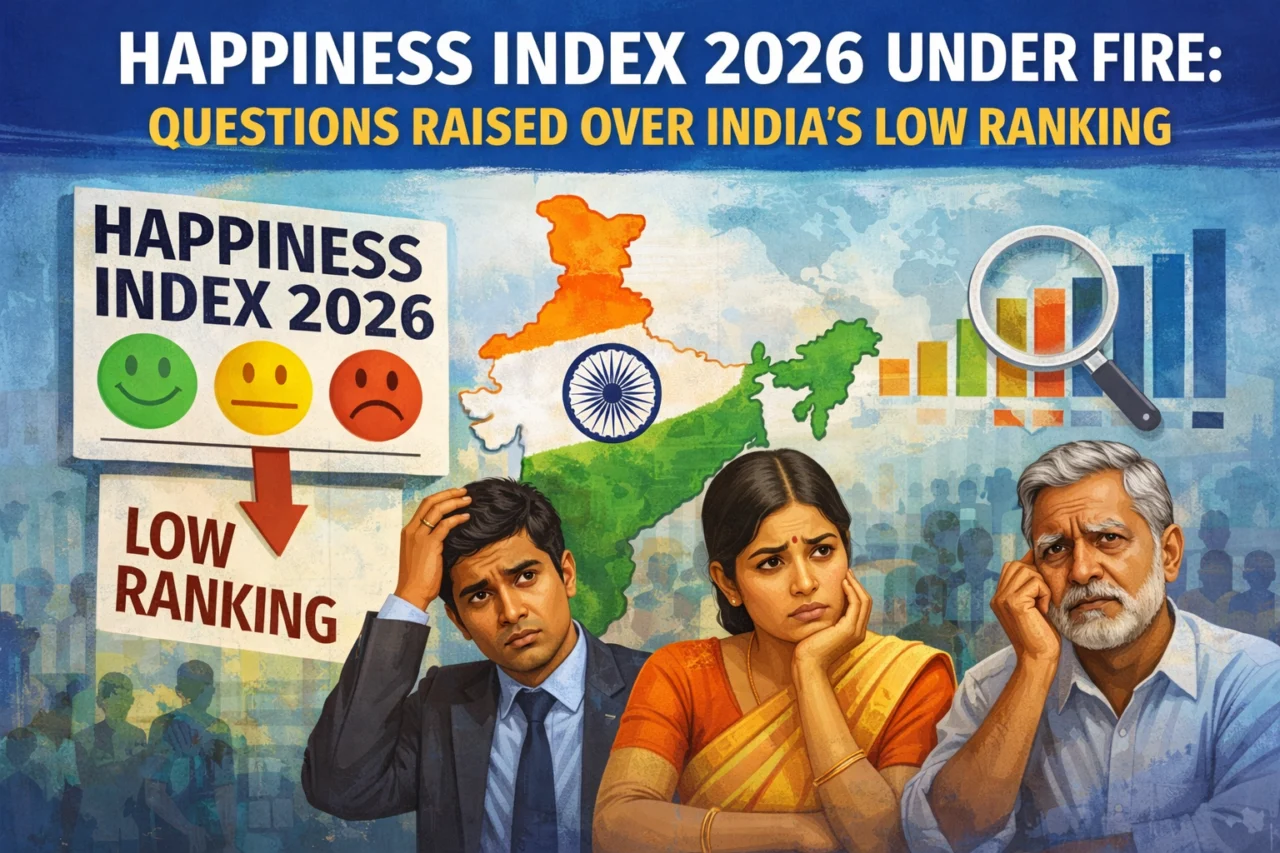
Globally, for a long time, a country’s progress has been measured primarily by its economic strength, specifically its Gross Domestic Product (GDP). However, evolving global perspectives, substantiated by facts and figures, have demonstrated that economic growth alone cannot serve as the sole yardstick for the quality and satisfaction of human life. It is from this perspective that the “World Happiness Report” was born, with the objective of measuring citizens’ life satisfaction. This year’s report has recently been published, and it clearly shows a clear instance of unfair treatment toward India. India has been assigned the 116th rank, even as it is currently undergoing rapid economic progress.
Here, we observe that the “World Happiness Report” indicates only limited improvement in India’s ranking over the past few years. For instance: 139th in 2021, 136th in 2022, 126th in both 2023 and 2024, and now the 116th position in 2026. Upon a deeper examination of these figures, this statistical improvement appears quite superficial in the context of India, as this rate of progress is extremely sluggish when weighed against the country’s actual economic and social achievements. This clearly reveals a deep chasm between the Happiness Index and actual developmental progress, a disparity that the “World Happiness Report” fails to acknowledge. It is precisely at this juncture that doubts regarding the credibility of this report arise, and the underlying bias held by its creators against India becomes apparent.
India’s Economic Progress
Today, even the global community can no longer overlook the statistics regarding India: an economy valued at $2.1 trillion in 2015 has expanded to $4.3 trillion by 2025, representing a growth of approximately 105 per cent. Driven by this rapid expansion, India has emerged as the world’s fifth-largest economy. The impact of this economic surge has also manifested in widespread social transformations. India has witnessed a remarkable decline in extreme poverty. The poverty rate, which stood at 27.1 per cent in 2011–12, dropped to approximately 5.3 per cent in 2022-23. It is estimated that 269 million people have been lifted out of poverty. Various government schemes, including Direct Benefit Transfers and housing initiatives, have bolstered social security. This clearly demonstrates that the benefits of development have reached the lowest strata of society.
Alongside economic growth, a decline in income inequality has also been recorded. The urban Gini coefficient has decreased from 36.7 to 31.9, while the rural Gini coefficient has fallen from 28.7 to approximately 27.0. In essence, this trend indicates that development has been relatively balanced. Given this context, it is only natural to expect a corresponding increase in life satisfaction; however, the “Happiness Index” does not adequately reflect this reality.
A Shocking Paradox: India Lags Behind Conflict-Ridden Nations
Upon closer examination, the most controversial aspect of this “Happiness Index” is that India ranks behind several nations currently grappling with severe crises. Countries such as Israel (8), Iran (99), Iraq (101), Palestine (108), Pakistan (109), and Ukraine (111) all rank higher than India on the happiness index. It is precisely these facts that cast doubt upon the credibility of this report. How is it conceivable that nations plagued by widespread war, political instability, and economic crises could rank higher than India in terms of happiness? In reality, such a scenario is simply implausible.
In this regard, one may also refer to economic data provided by various international agencies, which reveal that Palestine faces an unemployment rate of 80 per cent. The region is grappling with 238 per cent inflation and famine-like conditions, a situation in which millions of people are facing a severe humanitarian crisis. Meanwhile, the people of Ukraine are grappling with widespread loss of life, displacement, and mental health issues due to the ongoing war. Yet, other nations, despite facing similar circumstances, are shown to rank higher than India. How is this possible?
Pakistan and Iran: Ranked Higher than India Despite Instability
It is also a startling fact that Pakistan faces severe challenges such as economic instability, rising terrorist attacks, and high crime rates. In Iran, social repression, restrictions on women, and political unrest persist. At this very moment, the entire world is deeply concerned by the conflict involving the United States, Israel, and Iran; yet, despite this, these nations are ranked above India in the “Happiness Index.” This reality starkly indicates that the factors incorporated into this index do not fully reflect the actual hardships of real life.
Viewed in this light, the most significant shortcoming of this “Happiness Index” is its failure to incorporate crucial aspects such as crime, terrorism, social unrest, and public safety, factors that directly impact the quality of life for any individual. A society that is safe and stable constitutes, in itself, a fundamental basis for happiness, a fact that has been completely overlooked in this report. Furthermore, the credibility of this “Happiness Index” is compromised because the underlying Gallup survey, which draws a sample of, on average, 1,000 people from each country, is ill-suited for a nation as vast as India. Given the immense regional, social, and economic diversity inherent in a country like India, capturing such a complex reality within such a small sample size is not merely difficult but entirely inadequate.
In essence, the argument remains that until all critical dimensions of real-life experience are incorporated into the measurement of happiness, this index cannot claim to represent the absolute truth. The case of India serves as proof that understanding the relationship between economic progress and genuine life satisfaction requires a more profound and balanced approach, an approach that appears to be largely absent from the current “Happiness Index” survey. Therefore, the people of India should not rely on this “Happiness Index” to gauge the true state of happiness within their nation. India has ranked higher in happiness than numerous countries, including Pakistan, Palestine, and Ukraine, in the past and continues to do so today. In reality, this report amounts to nothing more than a deception perpetrated against the people of India, and nothing more.