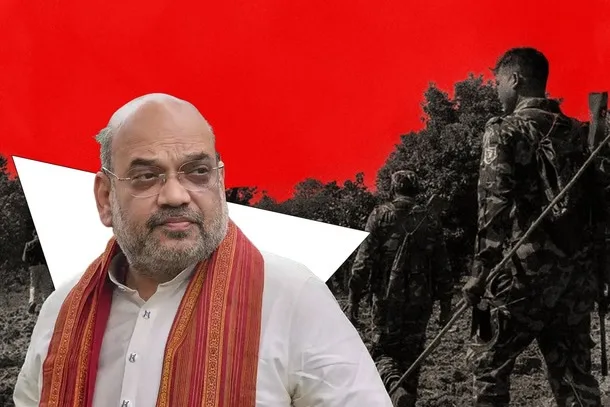
The March 31, 2026 deadline set by Union Home Minister Amit Shah to eliminate Naxalism was never just a date circled on a calendar. It represented a benchmark, a message to insurgents, and a declaration of intent to bring one of India’s longest-running conflicts to a decisive conclusion. Now, with the deadline behind us, the question has gained sharper urgency: is India finally on the verge of becoming Naxal-free? The answer, drawn from data and ground realities, is both encouraging and cautious.
The country is undeniably closer than ever before, but the conclusion of such a decades-old insurgency cannot be defined by a single deadline; it is shaped by a sustained transition from conflict to stability.
Entering the final phase
In Parliament, Amit Shah stated that India’s anti-Naxal operations have entered their “final phase,” stating that the insurgency has been “almost wiped out,” particularly in the Bastar region, once considered the epicentre of what was often described as “Red Terror.” This claim reflects a remarkable shift in conditions on the ground.
Areas that were once inaccessible due to Maoist dominance are now witnessing the expansion of road networks, the reopening of schools and health centres, improved access to ration systems, and the deeper penetration of welfare schemes. These are not merely administrative milestones; they represent the restoration of governance in regions that had, for decades, existed beyond the effective reach of the state.
Recognising these gains is essential, as they are the result of sustained and coordinated efforts involving security forces, policymakers, and local communities working in tandem.
From Naxalbari to a nationwide insurgency
To truly appreciate the scale of this transformation, one must revisit the origins of the movement. Naxalism began in 1967 in the village of Naxalbari, where a peasant uprising laid the foundation for what would evolve into a full-fledged Maoist insurgency. Over time, the movement spread across vast and underdeveloped regions, forming the so-called “Red Corridor” that extended through states like Chhattisgarh, Jharkhand, Odisha, Maharashtra, Andhra Pradesh, Telangana, and Madhya Pradesh.
At its peak, Naxalism affected as many as 126 districts, establishing parallel systems of control in remote forest areas. The insurgency was marked by violent attacks on security forces, destruction of public infrastructure, extortion networks, and coercive recruitment, including minors. It was not merely a law-and-order issue but a sustained challenge to the authority and legitimacy of the Indian state.
The shrinking red corridor
Over the past decade, one of the clearest indicators of progress has been the steady contraction of the insurgency’s geographical footprint. From a peak of 126 districts, the number fell to 90 by 2018, then to 70 in 2021, and further down to 38 by 2024.
Today, the number has reduced to just seven core districts, largely concentrated in the Bastar region, along with limited pockets in Jharkhand and Odisha.
Even within these areas, the intensity of violence has significantly declined. What was once a vast and continuous “Red Corridor” has now been reduced to fragmented and isolated forest zones, signalling the near-collapse of its territorial dominance.
This decline is not only administrative but also spatial and strategic. Naxal-affected territory, which once spanned over 18,000 square kilometres in 2014, shrank to around 4,200 square kilometres by 2024, and further reduced to a few hundred square kilometres by 2025.
Such a dramatic contraction indicates that Maoist groups are no longer capable of controlling large territories. Instead, they remain confined to isolated pockets, severely limiting their operational capabilities and strategic influence.
Leadership decapitation as a turning point
A critical factor behind this transformation has been the systematic targeting of Maoist leadership. The elimination of key figures, including CPI (Maoist) General Secretary Nambala Keshava Rao, senior commander Madvi Hidma, and several top leaders in early 2026, has significantly weakened the insurgency’s command structure.
Without a cohesive leadership, coordination becomes fragmented and ideological clarity diminishes. This phase of “leadership decapitation” is widely regarded as a decisive turning point in India’s fight against Naxalism.
Statistical trends further reinforce the scale of this decline. Between 2004-2014 and 2014-2024, violent incidents dropped from 16,463 to 7,744, security personnel deaths declined from 1,851 to 509, and civilian deaths reduced from 4,766 to 1,495.
In 2025 alone, around 270 Naxals were neutralised, 680 were arrested, and 1,225 surrendered.
Over the past decade, more than 8,000 cadres have laid down arms. These numbers illustrate not just a loss of territory, but a deeper erosion of the insurgency’s manpower, morale, and relevance.
Why the deadline matters
The March 31 deadline holds significance beyond symbolism. As Amit Shah emphasised, Naxalism was not just about violence, it was about obstructing governance.
In regions like Bastar, the presence of insurgents meant that roads could not be constructed, schools could not function, healthcare remained inaccessible, and economic activity was severely stunted.
The fight, therefore, was not only against armed groups but also for restoring the state’s developmental and administrative presence. The deadline served as a strategic marker, accelerating efforts and focusing national attention on resolving a long-standing challenge.
India’s approach to tackling Naxalism has evolved into a comprehensive, multi-dimensional strategy. Security operations have been strengthened through the expansion of camps, deployment of specialised forces, and the use of advanced technologies such as drones and satellite-based intelligence.
Parallelly, development initiatives have transformed infrastructure, with thousands of kilometres of roads sanctioned and mobile connectivity significantly improved. Welfare schemes targeting tribal communities, skill development programmes, and the establishment of residential schools have aimed to address socio-economic gaps.
Civic engagement initiatives have further helped rebuild trust between local populations and the state, ensuring that governance is not just restored but sustained.
Behind these achievements lies the immense sacrifice of security personnel. Operating in dense forests under harsh and unpredictable conditions, forces have conducted prolonged operations, faced ambushes and improvised explosive device (IED) attacks, and maintained a continuous presence in hostile territories.
Their role has been central to weakening the insurgency, and any evaluation of progress must acknowledge the human cost that underpins these gains.
The remaining challenge
Despite the progress, the situation is not entirely resolved. An estimated 130 to 150 armed cadres remain active, with some senior operatives still evading capture. Residual networks may continue to exist in remote forested areas. While these do not pose the large-scale threat seen in previous decades, they indicate that the insurgency has not been completely eliminated.
However, the nature of the challenge has fundamentally changed, from a widespread and entrenched insurgency to a more contained and manageable security concern.
India now appears to be entering a post-conflict phase, where the focus shifts from elimination to consolidation. This phase involves strengthening governance in reclaimed areas, ensuring consistent delivery of welfare schemes, addressing long-standing local grievances, and preventing any resurgence of extremist networks.
The emphasis is on stability, development, and trust-building, which are crucial for ensuring that the gains made are not reversed.
The passing of the March 31 deadline does not signify a definitive end, but it does mark a historic milestone. India today stands closer than ever to eliminating organised Naxal violence.
The collapse of Maoist leadership, the shrinking geographical footprint, and the restoration of governance in previously inaccessible areas all point towards a decisive shift. At the same time, residual elements and the need for sustained efforts remind us that the journey is not yet fully complete.
As the forests of Chhattisgarh witness this symbolic transition, the message is clear: India has reached a crucial turning point in its fight against Naxalism. What was once considered an intractable challenge is now nearing resolution.
By the government’s own assessment, the country has effectively entered a Naxal-free phase in structural terms.
Yet, the true measure of success will not lie solely in the absence of violence, but in the presence of governance, development, and trust in regions that were once beyond the state’s reach. India may not have completely eradicated Naxalism, but it is, unmistakably, closer than ever before.