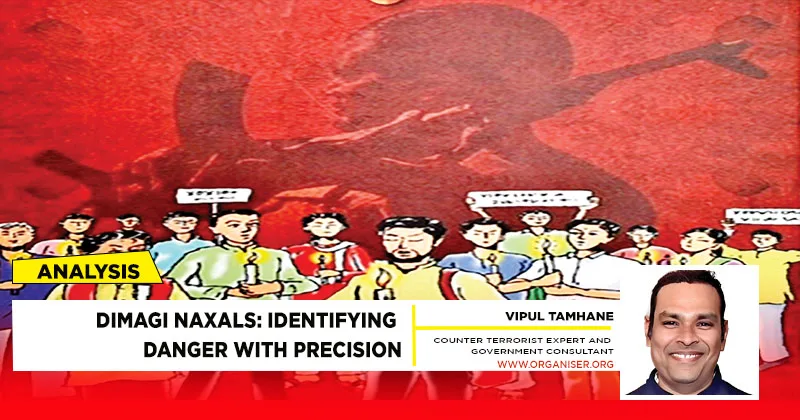
When Prime Minister Narendra Modi used the phrase Dimagi Naxal, a section of the commentariat erupted as if a sacred taboo had been breached. The anger was kind of predictable; the substance was thinner than it should have been, as the term isn’t a casual insult; it’s more like a diagnosis. It points to a mindset that treats the unity and wholeness of India as negotiable, conditional, or even, frankly, undesirable. Anyone who can’t affirm those two principles cleanly without caveats has the intellectual residue of an ideology that once tried to dismantle the Indian state through violence and now tries to hollow it out through storytelling and narrative. The characteristics are neither mysterious nor new. They form a coherent pattern.
Danger Posed by Dimagi Naxal
First is the sustained sympathy extended to figures such as Sharjeel Imam and Umar Khalid. These are not abstract free-speech cases. Imam’s recorded calls for the disruption of India’s territorial continuity and Khalid’s ideological ecosystem have been a matter of public record. The father of one of them, SQR Iliyas of the All India Muslim Personal Law Board, has openly framed nationalism itself as a fascist idea and spoken of converting the entire country. When such voices are defended as “dissent,” the line between criticism of government and rejection of the nation is deliberately blurred. The Dimagi Naxal provides intellectual oxygen.
Second is the selective egalitarianism on display when conversion and reservation collide. Christian missionaries have long argued that Hindu society is irredeemably caste-ridden and that Christianity offers a caste-free alternative. The same voices then demand that Dalit converts retain reservation benefits originally designed for Hindu Scheduled Castes. The logic is transparent: conversion is presented as liberation from hierarchy, yet the material privileges of the old hierarchy must travel with the convert. This is not social justice. It is opportunistic theology married to identity politics. Those who defend both the conversion narrative and the transfer of benefits are not fighting discrimination; they are gaming it.
The Naxal of the forest used the gun. The Dimagi Naxal uses the seminar, the editorial, the courtroom petition, and even the international conference circuit. The goal is the same: to keep the idea of India permanently provisional
Third is the reluctance to confront conversion by fraudulent or coercive means. The “conversion mafia” is not a Hindutva invention. Documented cases of inducement, misrepresentation, and social pressure exist across several States. When these practices are waved away as “freedom of religion,” the freedom of the weaker party is erased. A mindset that cannot distinguish genuine choice from engineered exit from the majority tradition is not secular. It is partisan.
Forth is the opposition to a Uniform Civil Code while simultaneously invoking secularism. Secularism, properly understood, requires the state to treat citizens equally before the law, regardless of religion. Personal laws that create different rights and obligations on the basis of faith are the opposite of that principle. The Dimagi Naxal treats any move toward uniformity as majoritarian aggression while treating the continuation of parallel legal systems as progressive. The contradiction is obvious once the fog of rhetoric is cleared.
Fifth is the forgotten attempt, under the UPA, to introduce a so-called Communal Violence Bill. Drafted by the National Advisory Council, an extra-constitutional body heavy with activists later identified with the same intellectual current, the bill would have mandated demographic quotas in police stations and inverted the burden of proof in cases of sexual violence depending on the religion of the accused. The proposal collapsed under opposition even within the Congress. Its very existence revealed a governing philosophy that viewed the majority community as the permanent suspect and minority communities as permanent victims requiring structural preference. That philosophy did not vanish; it merely retreated into civil society and academia.
Sixth is the intellectual cover provided to left-wing extremism. When CRPF personnel were massacred by Naxal groups in 2010, some parts of the commentariat came back with analysis that kind of treated the dead as collateral, and the killers as if they were representatives of a legitimate grievance. People like Hidma have also been romanticised, in certain corners, as resistance leaders, rather than terrorists. The Dimagi Naxal does not plant landmines.
Selective Amnesia
Seventh is this selective memory around the 2002 Gujarat violence. The burning of the Sabarmati Express at Godhra, where 59 kar sevaks were killed, is often soft-pedalled, or else it just gets slid into a side context, almost irrelevant. And somehow people keep treating it like it happened in the background, not as the core, even though it clearly wasn’t. The subsequent riots then get treated as the original sin. Meanwhile, there are efforts to shield those involved in the train burning, while still demanding the harshest accountability for the later violence, and that combination exposes a clear moral double standard. Justice needs the law applied evenly, not narrative engineering that spreads collective guilt based on community.
Taken together, these stances are not just ordinary political disagreement. They amount to a worldview, where the Indian state is always being put on trial, the majority community is always the aggressor, and anything that sounds like civilisational continuity is automatically suspect. The Naxal of the forest used the gun. The Dimagi Naxal uses the seminar, the editorial, the courtroom petition, and even the international conference circuit. The goal is the same: to keep the idea of India permanently provisional.
Critics of the term claim it is a crude attempt to silence dissent. That claim collapses under examination. Dissent about policy, tax rates, foreign policy, farm laws, is the oxygen of democracy. What is being named is something else: a principled refusal to accept the territorial and constitutional finality of the Indian Union, coupled with a consistent pattern of sympathy for forces that weaken it. The distinction is not subtle. Those who cannot see it are either not looking or do not wish to.
PM Modi’s use of the term is not an invitation to hatred. It is a demand for clarity. Clarity is uncomfortable for those who have built careers on ambiguity. That discomfort is not an argument against the diagnosis. It shows the diagnosis has landed.