Maoism in India: From UPA paralysis to Modi-era containment
July 21, 2026
  • Read Ecopy
  • Circulation
  • Advertise
  • Careers
  • About Us
  • Contact Us
Android AppiPhone AppArattai
Organiser
  • ‌
  • Bharat
    • Assam
    • Bihar
    • Chhattisgarh
    • Jharkhand
    • Maharashtra
    • View All States
  • World
    • Asia
    • Europe
    • North America
    • South America
    • Africa
    • Australia
  • Editorial
  • International
  • Opinion
  • RSS @ 100
  • More
    • Op Sindoor
    • Analysis
    • Sports
    • Defence
    • Politics
    • Business
    • Economy
    • Culture
    • Special Report
    • Sci & Tech
    • Entertainment
    • G20
    • Azadi Ka Amrit Mahotsav
    • Vocal4Local
    • Web Stories
    • Education
    • Employment
    • Books
    • Interviews
    • Travel
    • Law
    • Health
    • Obituary
  • Subscribe
    • Subscribe Print Edition
    • Subscribe Ecopy
    • Read Ecopy
  • ‌
  • Bharat
    • Assam
    • Bihar
    • Chhattisgarh
    • Jharkhand
    • Maharashtra
    • View All States
  • World
    • Asia
    • Europe
    • North America
    • South America
    • Africa
    • Australia
  • Editorial
  • International
  • Opinion
  • RSS @ 100
  • More
    • Op Sindoor
    • Analysis
    • Sports
    • Defence
    • Politics
    • Business
    • Economy
    • Culture
    • Special Report
    • Sci & Tech
    • Entertainment
    • G20
    • Azadi Ka Amrit Mahotsav
    • Vocal4Local
    • Web Stories
    • Education
    • Employment
    • Books
    • Interviews
    • Travel
    • Law
    • Health
    • Obituary
  • Subscribe
    • Subscribe Print Edition
    • Subscribe Ecopy
    • Read Ecopy
Organiser
  • Home
  • Bharat
  • World
  • Operation Sindoor
  • Editorial
  • Analysis
  • Opinion
  • Culture
  • Defence
  • International Edition
  • RSS @ 100
  • Magazine
  • Read Ecopy
Home Bharat

Red Terrorism: From policy paralysis under UPA to strategic containment in the Modi era

India’s battle against Maoism reflects a deeper story of governance failures during the Indian National Congress-led UPA era and the strategic shift under Narendra Modi’s leadership. From the expansion of the Red Corridor to its gradual containment, the contrast highlights how policy clarity and coordinated action reshaped internal security

Adv Karan ThakurAdv Karan Thakur
Apr 1, 2026, 07:00 pm IST
in Bharat
Follow on Google News
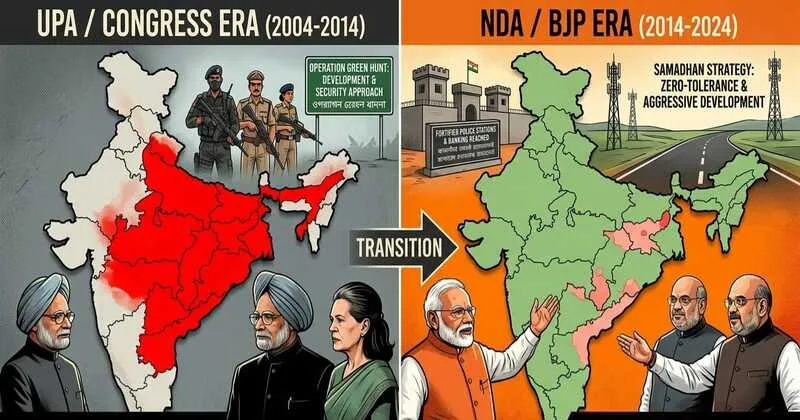
The changing face of Maoism between the UPA and Modi governments

The changing face of Maoism between the UPA and Modi governments

FacebookTwitterWhatsAppTelegramEmail

The trajectory of Maoism in India is not merely a question of internal security; it is a test of governance, political will, and institutional coherence. During the tenure of the United Progressive Alliance led by the Indian National Congress, with Sonia Gandhi as a central figure, India witnessed a phase where the writ of the State weakened across vast regions, allowing parallel systems of authority to emerge. To understand the present claim of controlling Maoism, it is essential to revisit how lapses in both policy and execution during that period contributed to its expansion and how a coordinated approach in recent years has helped contain it.

When the presence of the State is reduced to paperwork, and a parallel authority begins to function on the ground, the issue ceases to be merely one of security; it becomes a failure of governance. This is precisely what unfolded during the peak years of Maoism under the Congress-led regime, when both policy direction and implementation appeared inconsistent and weak.

At its height, Maoism had spread across what came to be known as the “Red Corridor,” encompassing large parts of Chhattisgarh, Jharkhand, Odisha, Maharashtra, Andhra Pradesh and Bihar. In many of these regions, the State’s presence was minimal, and administrative structures existed largely in form rather than substance. Real control often lay in the hands of Naxalite groups.

The Bastar region of Chhattisgarh exemplified this failure. Infrastructure development was obstructed, schools could not function, healthcare systems collapsed, and formal judicial mechanisms were rendered ineffective. Local disputes were frequently resolved in so-called Naxalite courts, which lacked transparency and due process. Government schemes could only be implemented with their approval, and contractors were often compelled to pay hefty sums to operate.

This situation was not merely an administrative weakness; it was a direct challenge to the sovereignty of the State. Naxalite groups evolved beyond armed insurgents into operators of a parallel governance structure. Villages were gripped by fear, with people unable to rely fully on either the State or to resist the insurgents.

Also Read: Language Without Borders: How the Brahuis carry Tamil and Telugu culture into the northwest

One of the gravest concerns was the lack of a clear and consistent response from the government. While some states adopted a strict approach, others initiated operations only to halt them midway. In Bastar, for instance, security forces had once pushed back insurgents effectively, but the discontinuation of operations allowed them to regroup and regain strength.

This inconsistency stemmed not only from administrative issues but also from political and ideological pressures. Certain intellectual and activist groups portrayed Maoism as a socio-political movement, creating hesitation within the government. As a result, decisive action was often delayed or diluted.

Compounding the problem was the weakness of the intelligence and security framework. Despite operating in significant numbers, Naxalite groups were not effectively monitored or countered in time. This highlighted deeper institutional shortcomings beyond the ground-level challenges.

A comparison with other regions further underscores this gap. In areas like Punjab and the Northeast, the State maintained sustained pressure and presence to counter insurgency. In contrast, Maoist-affected regions often reflected a withdrawal or inconsistency in state control, exacerbating the crisis.

However, the situation today presents a markedly different picture. In recent years, there has been a clear strategic shift in addressing Maoism. Under the Bharatiya Janata Party, led by Narendra Modi with key strategic leadership from Amit Shah, the approach has transformed from reactive containment to proactive control.

Improved coordination between the central and state governments, enhanced capacity of security forces, and strengthened intelligence networks have played a critical role in reversing the trend. The geographical spread and influence of Maoism have significantly reduced. What was once a widespread challenge across numerous districts has now been confined to limited pockets. Continuous operations by security forces have weakened the insurgent infrastructure, while administrative control has been gradually restored.

Strategically, the approach now emphasises planned, coordinated action, combining security measures with development initiatives and community engagement. This integrated model has addressed the root causes and reduced the operational space for Naxalite groups.

It would not be an exaggeration to say that Maoism today is in its final phase, though not entirely eliminated. Its scale, influence, and operational capacity have diminished considerably. From controlling large territories, insurgents are now confined to isolated areas, struggling to sustain relevance.

Viewed in a broader perspective, the contrast is stark. There was a time when the State appeared to retreat, policies were unclear, and responses were inconsistent. Today, there is a defined strategy, institutional coherence, and sustained action aimed at restoring full control.

Ultimately, this journey offers a crucial lesson: internal security challenges cannot be resolved by force alone. They require clear policy direction, strong institutions, and consistent execution. Where these elements are absent, crises deepen. Where they align, even the most complex threats can be effectively contained. The contrast between the Congress-led UPA era and the BJP-led present underscores a deeper truth of governance: clarity, continuity, and conviction are the cornerstones of national security.


 

Topics: NaxalismUPA governmentBastar regionRed CorridorCongress Policy FailureInternal Security IndiaAmit ShahNarendra Modi
ShareTweetSendShareSend
✮ Subscribe Organiser YouTube Channel. ✮
✮ Join Organiser's WhatsApp channel for Nationalist views beyond the news. ✮
Previous News

Understanding the March 24, 2026, Supreme Court Ruling: Why conversion erases Scheduled Caste (SC) status

Next News

UP: Gym trainer Shehzad drugged, raped Hindu nursing student; Mukarram tracked victim, both arrested

Related News

Union Home Minister Amit Shah

Parliament Monsoon Session: Union Home Minister Amit Shah to introduce Bill criminalising insult to ‘Vande Mataram’

Amit Shah Reviews Criminal Justice System In West Bengal

West Bengal: Union HM Amit Shah reviews implementation of new criminal laws, calls for higher conviction rate

Security forces arrested Maoist leader Ajay Mahto in Jharkhand

Jharkhand: Top Maoist leader with Rs 25 lakh bounty nabbed, wanted by four states & central forces

1,668 MT mega cargo reaches Bihar via National Waterway-1, Sonowal hails Ganga logistics milestone

Union Minister for Communications and Development Jyotiraditya M. Scindia

India Post creates history, crosses Rs 4,000 crore Q1 revenue milestone for first time; Scindia hails record growth

Representative Image

Cabinet approves Rs 62,500 crore mobile phone manufacturing scheme to boost domestic production

Load More

Latest News

New Delhi, Jul 20 (ANI): Protesters seen pelting stones at Delhi Police during CJP protest at Connaught Place, in New Delhi on Monday. (Delhi Police/ANI Video Grab)

Parliament March: CJP-led anarchy- Can these really be India’s youth?

NTA debunks five viral NEET 2026 OMR claims, forbids ai-edited answer sheets

NTA clears air on five viral NEET 2026 OMR cases, warns against fake answer sheets submission

VHP Central Committee Adopts Resolutions on Family Values, Kandhamal Probe

VHP’s Central Managing Committee passes resolutions on family system, seeks action in Swami Laxmanananda murder probe

Keralam Minister moves to stop free food distribution by NGOs in government hospitals, sparks backlash

NEET 2026 | Abhay Yadav Case: NTA warns against AI generated OMR sheets & scorecards; Reiterates strict legal action

Former Aam Aadmi Party (AAP) councillor Tahir Hussian with AAP leader and former Delhi Chief Minister Arvind Kejriwal. Notably, Delhi court convicted Tahir Hussain and four others for the 2020 murder of Intelligence Bureau (IB) staffer Ankit Sharma, who was brutally killed and his body was dumped into a drain in the Chand Bagh area during anti-Hindu Delhi riots

Anti-Hindu Delhi Riots 2020: When evidence outlasted narratives

NCUI Elections: Sahakar Bharati–BJP registers historic victory; Wins 19 of 20 seats & 10 candidates elected unopposed

Representative Image

Tamil Nadu: Authorities ‘demolish’ Annadaana Satram in Thiruvannamalai; Sparks outrage from public

India's BioE3 Policy aims to build a $2.6 trillion bioeconomy by 2047 through biotechnology-driven innovation, jobs and growth

India’s Bioeconomy Revolution: How NITI Aayog’s roadmap seeks to make the country a global biotechnology leader by 2047

Tri-Services Exercise 2025 was led by the Western Naval Command of the Indian Navy along with the Southern Command of the Indian Army and the South Western Air Command of the Indian Air Force as the principal participating formations

Theatre Command: Military reforms for integrated Actions

Load More
  • Privacy
  • Terms
  • Cookie Policy
  • Refund and Cancellation
  • Delivery and Shipping

© Bharat Prakashan (Delhi) Limited.
Tech-enabled by Ananthapuri Technologies

  • Home
  • Search Organiser
  • Bharat
    • Assam
    • Bihar
    • Chhattisgarh
    • Jharkhand
    • Maharashtra
    • View All States
  • World
    • Asia
    • Africa
    • North America
    • South America
    • Europe
    • Australia
  • Editorial
  • Operation Sindoor
  • Opinion
  • Analysis
  • Defence
  • Culture
  • Sports
  • Business
  • RSS @ 100
  • Entertainment
  • More ..
    • Sci & Tech
    • Vocal4Local
    • Special Report
    • Education
    • Employment
    • Books
    • Interviews
    • Travel
    • Health
    • Politics
    • Law
    • Economy
    • Obituary
  • Subscribe Magazine
  • Read Ecopy
  • Advertise
  • Circulation
  • Careers
  • About Us
  • Contact Us
  • Policies & Terms
    • Privacy Policy
    • Cookie Policy
    • Refund and Cancellation
    • Terms of Use

© Bharat Prakashan (Delhi) Limited.
Tech-enabled by Ananthapuri Technologies