West Bengal is gearing up for one of its most closely watched assembly elections in recent years, with polling scheduled in two phases on April 23 and April 29, and counting slated for May 4. The stakes extend beyond simply forming the next government; they reflect the broader political narrative the state will follow over the next five years.
As campaigning intensifies, certain constituencies have emerged as high-stakes battlegrounds that could decisively influence the overall outcome, highlighting a mix of prestige contests, ideological clashes, demographic significance, and localised concerns.
Bhabanipur
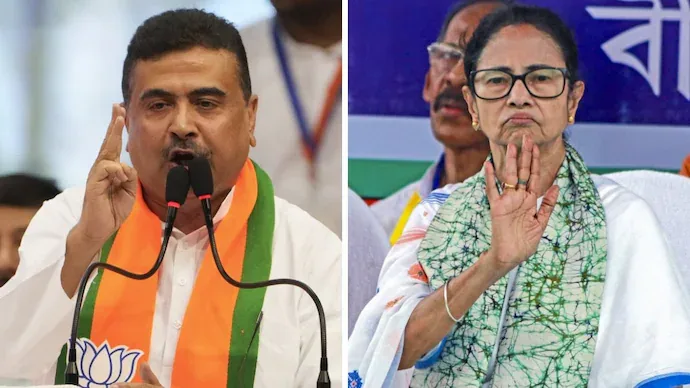
Bhabanipur in south Kolkata continues to hold immense political significance as Chief Minister Mamata Banerjee’s bastion. Historically a Trinamool Congress (TMC) stronghold, the constituency has become the focal point of the 2026 elections, with the Bharatiya Janata Party (BJP) fielding Suvendu Adhikari against her.
Seen as a sequel to the dramatic 2021 Nandigram battle, where Adhikari defeated Banerjee, the Bhabanipur contest carries symbolic weight, making it a high-pressure test of political clout and voter loyalty.
Nandigram: Seat of political legacy
Nandigram in Purba Medinipur remains a politically charged constituency. The site of the 2007 anti-land acquisition movement that ended the Left Front’s decades-long rule, Nandigram helped catapult Mamata Banerjee to power.
Its significance was reaffirmed in 2021 when Suvendu Adhikari claimed a landmark victory over Banerjee. In 2026, Nandigram continues to symbolise prestige, ideological contests, and voter sentiment, making it a seat to watch closely.
Sandeshkhali
Sandeshkhali, located in the Sunderbans delta, has emerged as a sensitive constituency due to localised issues around law and order and women’s safety.
Allegations of violence and atrocities have amplified its political relevance, and the BJP has sought to leverage these issues, framing the constituency as a test case for governance and protection of vulnerable communities.
Gaighata
Gaighata in North 24 Parganas carries unique demographic importance due to its significant Matua population. The constituency has become central to debates around citizenship and refugee rights, particularly following discussions linked to the Citizenship Amendment Act.
Both the TMC and BJP are actively seeking to consolidate the Matua vote, making Gaighata a key electoral indicator for the region.
Kharagpur Sadar and Asansol Dakshin
Urban constituencies like Kharagpur Sadar, home to diverse electorates including railway employees, traders, and students from institutions like IIT Kharagpur, represent a blend of academic influence and working-class concerns. Similarly, Asansol Dakshin, located in the industrial heartland of Paschim Bardhaman, reflects urban and industrial voter dynamics.
Both seats are crucial for understanding trends in Bengal’s urban and industrial belts, with implications for party performance in larger towns and cities.
Sujapur, Dinhata, Siliguri, and Dabgram-Fulbari
North Bengal is witnessing intense electoral activity in constituencies such as Sujapur, Dinhata, Siliguri, and Dabgram-Fulbari. Sujapur, with its mixed demographic profile and substantial minority population, often mirrors broader political currents in the region.
Dinhata, with a notable Scheduled Tribe presence, has historically swung between TMC and BJP, reflecting local issues like agriculture and rural development. Siliguri and Dabgram-Fulbari, strategic gateways to the Northeast, have become key battlegrounds where governance, infrastructure, and development narratives dominate the campaigns.
Samserganj
Samserganj in Murshidabad has gained attention following unrest in 2025 linked to the Waqf (Amendment) Act. A Muslim-majority constituency, it witnessed TMC dominance in 2021 with Congress as the runner-up. This year, the BJP aims to expand its influence by capitalising on polarisation, turning Samserganj into a volatile and unpredictable contest.
The 2026 West Bengal Assembly elections are shaping up as a complex interplay of political legacies, identity-based voting, local issues, and high-profile contests between party heavyweights.
With constituencies such as Bhabanipur, Nandigram, Sandeshkhali, Gaighata, Kharagpur Sadar, Asansol Dakshin, and North Bengal seats like Sujapur and Dinhata in sharp focus, the state’s political future will likely be determined by a combination of voter sentiment, campaign strategies, and demographic mobilisation.
As parties intensify efforts in the final weeks before polling, these constituencies will serve as the litmus test for both governance narratives and the broader direction of West Bengal politics over the next five years.