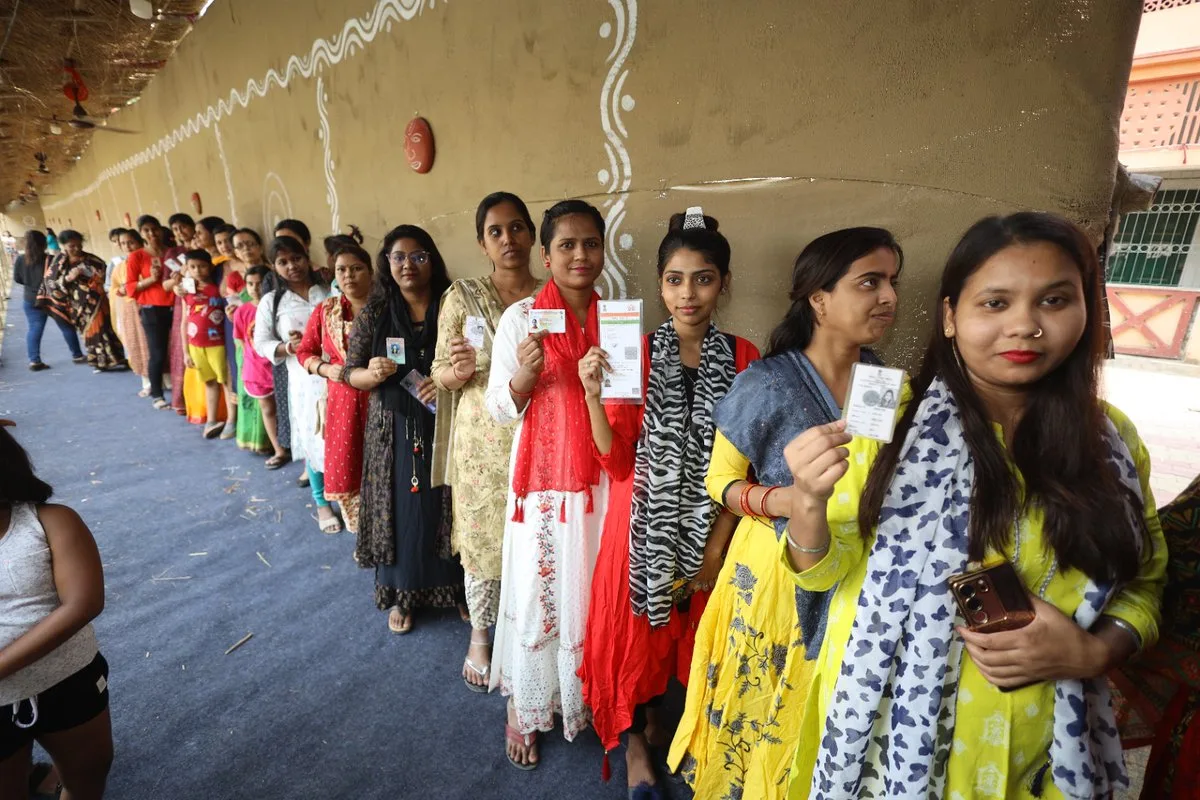
In a political landscape often dominated by loud rhetoric and male-centric narratives, West Bengal stands apart. Here, it is the women voters who are silently but decisively shaping electoral outcomes. With the 2026 Assembly elections approaching, this powerful demographic has become the focal point of every major political strategy, redefining how campaigns are designed and executed.
The numbers themselves tell a compelling story. Out of nearly seven crore eligible voters in the state, over 3.44 crore are women, accounting for almost half the electorate. More importantly, women in Bengal are not passive participants. They consistently turn out in large numbers, often surpassing male voter turnout. This high level of engagement has transformed them into the single most influential voting bloc in the state.
Reports point out that this shift did not happen overnight. Over the past decade, targeted welfare schemes, particularly those aimed at women, have significantly altered voting patterns. Among these, the Lakshmir Bhandar scheme introduced by the Trinamool Congress government has emerged as a game changer.
Under this scheme, direct cash transfers are made into the bank accounts of women beneficiaries every month. With nearly 2.5 crore women currently covered, the initiative has created a direct financial link between the state government and female voters. For many women, especially in rural and economically weaker sections, this assistance provides a stable source of income that supports household expenses and enhances financial independence.
For the 2026 elections, the ruling party has promised to further increase this benefit. The proposed hike would raise the monthly allowance to Rs 1,500 for general category women and Rs 1,700 for women belonging to Scheduled Castes and Scheduled Tribes. On an annual basis, this translates into a substantial financial support that directly reaches beneficiaries without intermediaries.
The political impact of such schemes is already visible. According to data from CSDS-Lokniti, around 53 percent of women voters supported the Trinamool Congress in the 2024 Lok Sabha elections. This marked an 11 percent increase compared to 2019, indicating a growing consolidation of women voters in favor of the ruling party. Such a consistent and expanding support base has played a crucial role in sustaining the party’s dominance in the state.
However, the opposition Bharatiya Janata Party is making determined efforts to break this trend. Recognising the centrality of women voters in Bengal’s electoral dynamics, the BJP has countered with its own promise. The party has pledged to increase the Lakshmir Bhandar allowance to Rs 3,000 per month if it comes to power. This aggressive positioning highlights a broader consensus across political lines that winning over women voters is no longer optional but essential for electoral success in Bengal.
Beyond immediate electoral gains, the developments in West Bengal carry significant implications for national politics. The state is increasingly being seen as a testing ground for a new electoral model, where direct financial support to women translates into political loyalty. If this approach continues to yield results, it could reshape campaign strategies across India.
States preparing for upcoming elections are closely observing Bengal’s experiment. The idea that targeted welfare, particularly direct benefit transfers to women, can create a reliable and stable voter base is gaining traction. Political strategists believe that replicating this model could offer a competitive edge in other regions as well.
At the same time, there is an ongoing debate about whether welfare-driven politics can sustain long-term voter loyalty or if aspirations related to employment, education, and economic growth will eventually take precedence. Some experts argue that while financial assistance addresses immediate needs, voters may increasingly seek broader opportunities and structural improvements in the future.
Despite these debates, one fact remains undisputed. Women voters in West Bengal have become a decisive force capable of altering electoral outcomes. Even a small shift within this demographic can significantly change the political arithmetic, making them the most closely watched segment in the run-up to the elections.
Their influence is not always visible in public discourse, yet it is deeply felt in the results. Unlike traditional vote banks that are mobilised through identity or ideology, this segment is shaped by everyday realities, household economics, and tangible benefits. This makes it both powerful and unpredictable.
As West Bengal moves closer to the 2026 Assembly elections, the spotlight will remain firmly on its women voters. Political parties may differ in ideology and approach, but they are united in recognising one crucial truth. The road to power in Bengal runs through its women.