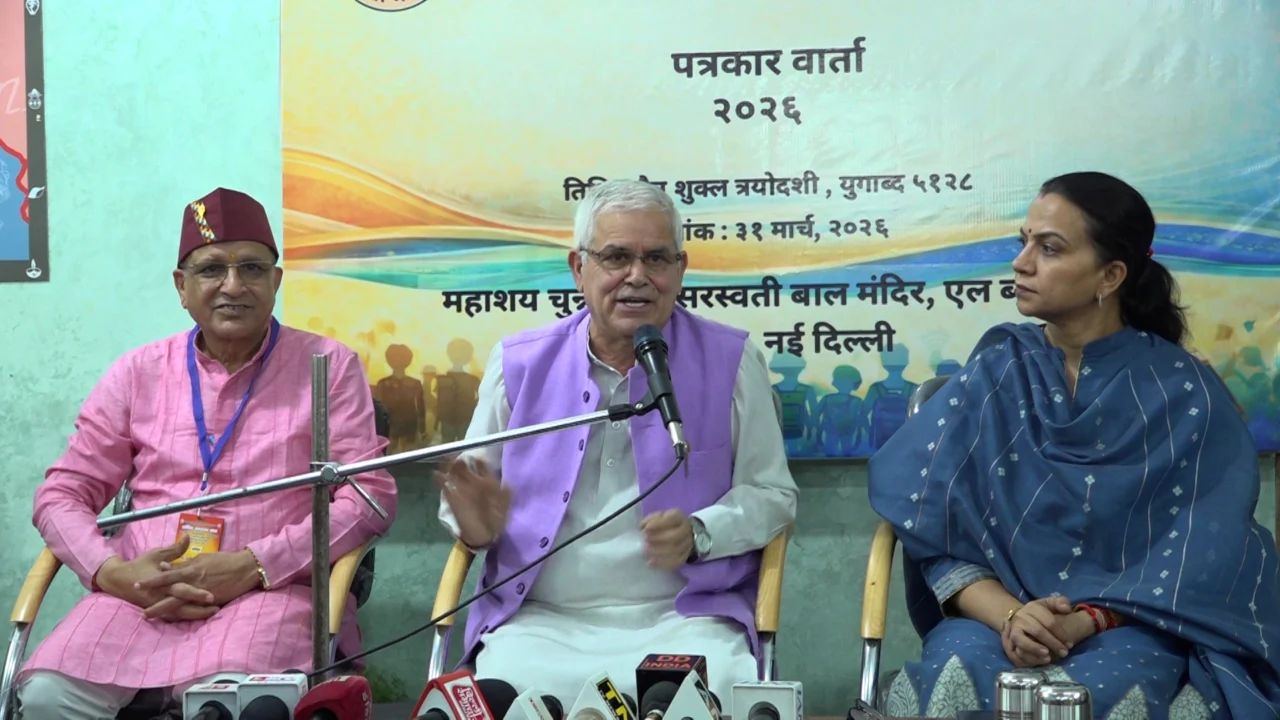
NEW DELHI: “Education must be aligned with India’s cultural values and traditions, enabling students to remain rooted in their heritage while contributing effectively to nation-building, said Deshraj Sharma, All India General Secretary of Vidya Bharati, while addressing the media at Mahashay Chunnilal Saraswati Bal Mandir Senior Secondary School, Hari Nagar, operated by the Samarth Shiksha Samiti of Delhi Prant.
On this occasion, he shared detailed insights into the country’s current education system, its educational initiatives, achievements over the past year, and future goals.
The objective of the press conference was to present Vidya Bharati’s new educational resolutions and to showcase its academic, social, and organisational contributions before society and the media.
He further stated that Vidya Bharati aims to nurture future generations who are culturally grounded and globally competent.
It was highlighted that Vidya Bharati currently provides value-based, holistic education through approximately 24,000 formal and informal institutions across the country, making it one of the largest non-governmental educational organisations in India. The institution operates through 11 regional offices, 46 provincial committees, and a presence in 684 districts, ensuring wide outreach.
More than 3.3 million students are currently enrolled in Vidya Bharati institutions, supported by over 150,000 teachers (Acharyas). Additionally, under its service initiatives, more than 250,000 students are provided with free, basic (foundational) education through thousands of Sanskar Kendras.
Through these Sanskar Kendras, the organisation is reaching the most underprivileged sections of society, providing essential literacy and numeracy skills and integrating them into the mainstream. In rural, tribal, and remote areas, Ekal Vidyalayas are also playing a significant role in spreading education, social awareness, and community empowerment.
Vidya Bharati’s education system emphasises holistic development through physical education, yoga, music, Sanskrit, and moral and spiritual education. Special emphasis is placed on mother tongue-based learning and the Panchpadi teaching methodology, ensuring balanced and comprehensive student development.
To promote scientific temperament and innovation, Atal Tinkering Labs (ATL) have been established in 507 schools across the country, encouraging creativity and innovation among students.
The organisation also informed that it is actively working towards the effective implementation of the National Education Policy (NEP) and the development of an India-centric modern education system. Subject experts are being trained and deployed at the school level to ensure that Bharat-centric education reaches the grassroots effectively.
Furthermore, the Annual General Meeting (AGM) will be held from April 3-6, 2026 at the same campus in Hari Nagar, where around 350 representatives from across the country will participate. Important decisions regarding future academic plans, policies, and organisational matters will be taken during this meeting.
The event was attended by All India Organisation Secretary Govind Chand Mahant, North Zone President Sukhraj Sethia, Zonal Secretary Geeta Ahuja, Zonal Organisation Secratary Vijay Nadda, Delhi Prant General Secretary Dr Satish Maheshwari, along with several senior officials and karyakartas.