Bhubaneswar: The Odisha government has announced that it will provide completely error-free textbooks to students of Classes I to VIII at the earliest after a controversy erupted over mistakes in the newly introduced books for the 2026–27 academic session. The decision comes amid widespread criticism over factual, typographical and printing errors in textbooks prepared under the National Education Policy (NEP) framework.
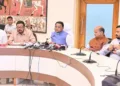
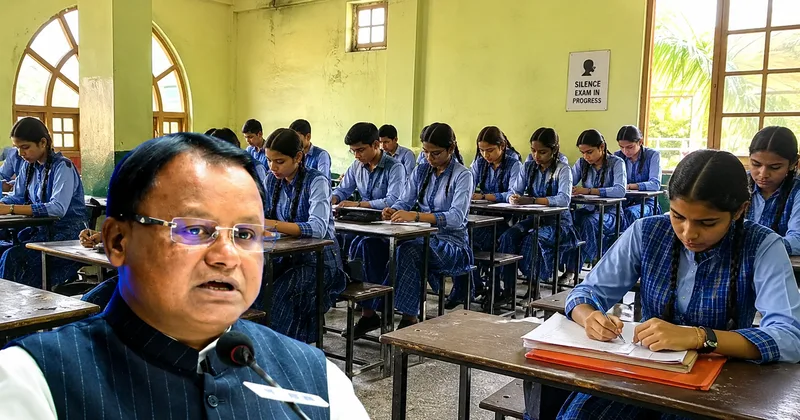
Addressing the media, School and Mass Education Department Commissioner-cum-Secretary Dr N Thirumala Naik said the state government is treating the issue with utmost seriousness and has initiated both corrective and disciplinary measures to ensure that such lapses do not recur.
He said the government has decided to replace the existing textbooks with revised, error-free editions after completing a comprehensive review by subject experts and incorporating feedback from academicians and the public.
Dr. Naik said Chief Minister Mohan Charan Majhi took serious note of the errors immediately after they came to light and directed the constitution of a high-level inquiry committee under the chairmanship of Development Commissioner D.K. Singh.
The committee was tasked with examining how the errors occurred, identifying those responsible and recommending corrective as well as long-term systemic reforms.
Acting on the committee’s recommendations, the government has already initiated disciplinary action against officials found responsible for the lapses. The Commissioner-cum-Secretary said further action would be taken wherever necessary based on the ongoing review.
“The Chief Minister has viewed the issue with utmost seriousness and directed the department to provide completely error-free textbooks to all students at the earliest,” Dr Naik said.
Revised Textbooks to be Uploaded for Public Feedback
The School and Mass Education Department has initiated a detailed verification of all identified errors in consultation with subject experts.
Dr Naik informed that revised versions of the textbooks will soon be uploaded on the Department’s official website as well as the Odisha School Education Programme Authority (OSEPA) website to invite suggestions from academicians, educationists and the general public.
The feedback received will be examined before the revised textbooks are finalised and sent for printing.
The move is aimed at making the textbook revision process more transparent while ensuring that the final editions are academically accurate and free from mistakes.
Teachers to Receive Corrected Content Until New Books Arrive
The government has assured that classroom teaching will not be affected during the transition period.
Until the revised textbooks are printed and distributed, corrected content and correction sheets will be supplied to teachers so that students continue learning without disruption.
Dr Naik said all students studying in government and aided schools across Odisha will receive the revised textbooks once the correction process is completed.
OSEPA has also published a correction list on its website to maintain transparency and enable teachers, parents and students to access the corrected information.
Government Rejects Claim of 1,678 Errors
While acknowledging that mistakes had been detected in the textbooks, Dr. Naik rejected allegations that the books contained 1,678 errors, as claimed by opposition parties and circulated on social media.
He said the actual number of errors is significantly lower than the figure being widely reported, although he did not disclose the exact number.
According to him, several figures circulating in the media and social media platforms are exaggerated.
The department, however, maintained that every identified mistake is being carefully examined and corrected through a systematic review involving experts and senior officials.
Officials Face Suspension and Disciplinary Action
The controversy has already led to major administrative action. On June 26, the Odisha government suspended former SCERT Director Manoj Padhi, who is currently serving as Special Secretary in the Higher Education Department. Padhi was heading the State Council of Educational Research and Training (SCERT) when the textbooks were finalised.
Three Assistant Directors of SCERT—Pralipta Mishra, Dilip Kumar Sahu and Bharati Tudu—were also placed under suspension for their alleged role in the lapses.
In addition, disciplinary proceedings have been initiated against six Assistant Directors—Bandita Pattnaik, Manas Ranjan Rout, Manoranjan Mohapatra, Prashant Kumar Sahu, Manas Kumar Nayak and Sudarshan Santara.
The action was taken after the inquiry committee headed by Development Commissioner D.K. Singh submitted its report to the Chief Minister.
Accepting the committee’s recommendations, the Chief Minister approved stringent disciplinary action against the officials concerned and directed the implementation of comprehensive reforms in the textbook preparation process.
Fourteen Reforms Approved to Prevent Future Errors
The state government has accepted all 14 recommendations submitted by the inquiry committee to strengthen textbook development, review and publication mechanisms.
Among the immediate measures, SCERT has been directed to prepare a master errata register within seven days and distribute printed correction sheets to students.
Replacement pages or reprinted inserts will be provided wherever serious errors have been detected.
Corrected PDF versions of textbooks will serve as the official teaching material until fresh printed editions become available.
The committee has also recommended orientation programmes for teachers so they can effectively explain the corrections in classrooms. A responsibility matrix will be prepared to fix accountability for every error identified in future textbook publications.
Quality Assurance Mechanism to be Strengthened
As part of long-term reforms, the government has decided to establish a dedicated Textbook Quality Assurance Cell within SCERT.
Subject-wise Curricular Area Groups and book-wise Textbook Development Committees will also be constituted on the lines of the National Council of Educational Research and Training (NCERT).
The committee has recommended introducing a four-stage proof-reading mechanism before printing, along with a final locked PDF system to eliminate printing errors.
A public errata portal will also be launched to enable teachers, students and citizens to report mistakes in textbooks.
Further recommendations include performance evaluation of printers, penalties for poor-quality work and blacklisting provisions for erring printing agencies and DTP vendors.
The committee has additionally proposed mandatory pilot testing of all newly developed textbooks before large-scale publication and stipulated that no textbook will be approved for printing without final academic, language, factual, illustration and production clearance.
With the government initiating disciplinary action, introducing systemic reforms and committing to supply completely revised textbooks, the School and Mass Education Department hopes to restore confidence in the state’s school education system while ensuring that students receive accurate and high-quality learning material.