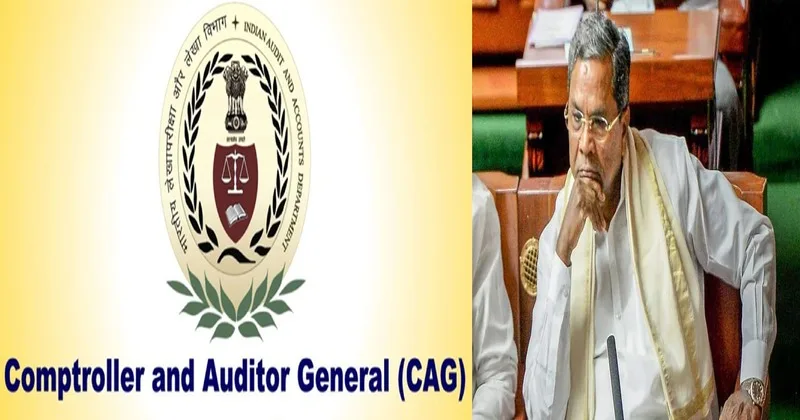
Bengaluru: The latest report by the Comptroller and Auditor General of India(CAG) has triggered intense criticism of the Karnataka government, with opposition leaders and policy experts accusing it of pushing the state towards a financial crisis through its aggressive welfare spending. The report has raised red flags over the sustainability of the government’s flagship guarantee schemes, calling into question the long-term fiscal management of the administration.
The audit examined five key schemes Gruha Lakshmi Scheme, Gruha Jyothi Scheme, Anna Bhagya Scheme, Shakti Scheme and Yuva Nidhi Scheme—and found that their universal implementation has significantly inflated state expenditure without corresponding revenue support. Critics have seized upon the CAG’s findings to allege fiscal irresponsibility. They argue that the government, in a bid to fulfill electoral promises, has rolled out large-scale “freebie” schemes without a sustainable funding roadmap. According to the report, these schemes alone account for nearly 20 per cent of the state’s revenue receipts and 27 per cent of total revenue—figures that many economists describe as “alarming”.
What has drawn the sharpest criticism is the widening gap between revenue growth and expenditure. While Karnataka’s revenue increased by 10.63 per cent in 2024–25, its expenditure surged by nearly 15 per cent. Experts say this imbalance reflects poor financial planning and an over-reliance on subsidies rather than productive investments. The CAG has clearly pointed out that the state is increasingly depending on borrowings to finance these recurring expenses. Karnataka’s net market borrowing rose to ₹71,525 crore, a significant jump from the previous year. Opposition leaders have termed this a “debt trap in the making”, warning that future generations may bear the burden of today’s populist policies.
Another major concern highlighted in the report is the diversion of funds from critical sectors. With a growing share of resources being allocated to guarantee schemes, allocations to local bodies, infrastructure agencies and welfare boards have reportedly been reduced. Critics argue that this could stall developmental projects and weaken urban and rural infrastructure.
“The government is prioritising short-term political gains over long-term economic stability”, said a policy analyst, reacting to the report. “When capital expenditure is compromised, it directly impacts growth, jobs, and investment climate”. The report also flags a worrying trend in capital expenditure. Although there is a nominal increase in spending, the actual investment in infrastructure has risen only modestly. Economists warn that this “compression in capital formation” could slow down Karnataka’s growth trajectory, especially at a time when the state competes with others for industrial investments.
Perhaps the most serious warning from the CAG pertains to future financial risks. Rising debt levels mean higher repayment obligations, including interest payments, which could crowd out essential development spending. This could leave the government with limited fiscal space to respond to future challenges. There are also concerns that continued borrowing to fund welfare schemes could lead to a breach of fiscal discipline norms under the Karnataka Fiscal Responsibility Act. Experts caution that crossing these limits could affect the state’s credit rating and increase borrowing costs further.
While the government has defended the schemes as pro-poor initiatives aimed at social equity, critics argue that poorly targeted subsidies are inefficient and wasteful. They contend that universal schemes benefit even those who may not need assistance, thereby inflating costs unnecessarily. The political fallout of the report is already visible, with opposition parties demanding a comprehensive review of the schemes and greater transparency in public spending. Calls are growing for the government to rationalise subsidies, target beneficiaries more effectively, and prioritise infrastructure investment.
The CAG report has effectively intensified the debate over welfare versus fiscal prudence in Karnataka. While social support measures remain important, the findings suggest that unchecked expansion without financial discipline could have serious long-term consequences.