
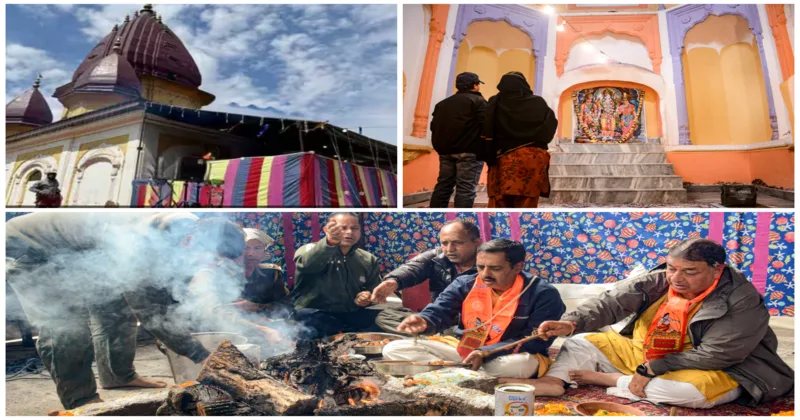
JAMMU: After more than three decades of closure, the reopening of the Raghunath Temple in the Habba Kadal area has become a landmark moment for the Kashmir Valley. Built in 1857, the temple is among the oldest in the region and has remained shut since the early 1990s, when insurgency and the mass exodus of Kashmiri Hindus forced the closure of many such religious and cultural sites.
The reopening ceremony was marked by a grand Maha Yagya organised by the Raghunath Mandir Committee, drawing devotees from across the country. The occasion was not merely religious but deeply emotional, as it revived memories of a time when communities in the Valley coexisted in harmony.
#WATCH | Jammu & Kashmir: Raghunath Temple in Srinagar’s Habba Kadal celebrates Ram Navami after 36 years. The temple committee organises a grand celebration on the auspicious occassion. (26.03) pic.twitter.com/YqSSpY9hZI
— ANI (@ANI) March 27, 2026
Ram Navami Celebrations
The timing of the reopening on Ram Navami added to its significance. Devotees gathered in large numbers to offer prayers, participate in rituals, and celebrate the return of worship at the temple after 36 years.
Members of the Kashmiri Hindu community travelled from different parts of India to attend the event. What stood out, however, was the participation of local residents, many of whom joined the celebrations and extended their support, reflecting a shared sense of belonging.
On Ram Navami at the Raghunath Mandir, General Secretary Raghunath Mandir Committee, Sunil says, ”Ram Navami used to be the main festival of this temple. Every year, about a month before Ram Navami, I remember when I was a child, we used to go to Ghar-Ghar. To collect rice from people, we used to collect wood from people. And this same wood and rice was used in this Havan. And after 36 years, this thing is happening again. I think this is an indication from God that things are back to normal and we should come back to Kashmir…”
Srinagar, Jammu and Kashmir: On Ram Navami at the Raghunath Mandir, General Secretary Raghunath Mandir Committee, Sunil says, ''Ram Navami used to be the main festival of this temple. Every year, about a month before Ram Navami, I remember when I was a child, we used to go to… pic.twitter.com/RvOhjhWNKA
— IANS (@ians_india) March 26, 2026
For many, the day evoked memories of pre-1990s Kashmir, when festivals were celebrated collectively, transcending religious boundaries.
Voices of Emotion and Nostalgia
The reopening stirred deep emotions among attendees. Sunil, General Secretary of the temple committee, described the moment as a blessing and expressed hope for the gradual return of Kashmiri Pandits to the Valley. He highlighted the role of both the government and the local community in making the reopening possible.
Dr Mukhti Sharma, a Kashmiri Hindu devotee, said the occasion was one of immense joy and hope. She noted that the reopening of temples across Kashmir signals improving conditions and inspires confidence among displaced families to consider returning to their homeland.
Srinagar, Jammu and Kashmir: On Ram Navami at the Raghunath Mandir, Dr. Mukti says, ''It's been 36 years since this temple was inaugurated. It's a matter of great joy and pride for all of us. We are so happy that I can't even express it in words. Yes, today was the first puja.… pic.twitter.com/NtrZ9tDYAA
— IANS (@ians_india) March 26, 2026
Restoration Under Smart City Initiative
The temple’s restoration was carried out in phases under the government’s Smart City initiative. Efforts were made to preserve the historical essence of the structure while ensuring its stability and usability for future generations.
Authorities and organisers see this restoration as part of a broader effort to revive Kashmir’s cultural heritage. Plans are also underway for the installation of idols in the coming months, which will further enhance the temple’s religious significance.
Why Srinagar’s Raghunath Temple Reopening Matters
At a time when Kashmir continues to navigate the legacy of decades of violence, the temple’s doors opening once again signal a deeper shift: the reclaiming of a shared cultural past that was once disrupted by fear and displacement.
For over three decades, the closed gates of the Raghunath Temple stood as a quiet reminder of a turbulent period in Kashmir’s history. The silence within its walls reflected not just the absence of worship, but the disruption of a centuries-old cultural rhythm.
Its reopening now marks the return of that continuity. It reaffirms that while violence may interrupt traditions, it cannot erase them. The temple’s revival underscores the enduring presence of a community whose roots in the Valley stretch back generations.
The years following the late 1980s were marked by upheaval, displacement, and a shrinking of shared public spaces. Religious sites that once thrived became symbols of uncertainty and fear.
Reopening the temple represents a reversal of that narrative. It signals that the conditions which once forced silence are no longer absolute. The return of rituals, prayers, and gatherings indicates a gradual restoration of confidence among communities that had been displaced or marginalised.
More Than Worship: A Restoration of Memory
Places of worship often carry meanings beyond their physical structure—they hold memories, traditions, and collective identity. The reopening of the Raghunath Temple brings back those intangible elements.
For many, it revives memories of a time when Kashmir’s social fabric was defined by coexistence. It reconnects present generations with a past where religious and cultural diversity was part of everyday life, not a point of contention.
One of the most significant aspects of the reopening has been the participation and support of local communities across faiths. This shared acknowledgement reinforces the idea that Kashmir’s identity has never been singular or exclusionary.
The temple’s revival sends a broader message—that coexistence remains central to the Valley’s ethos. It challenges narratives that seek to define Kashmir solely through conflict, instead highlighting its long-standing traditions of mutual respect and cultural interdependence.
Challenging the Legacy of Violence
The reopening also carries a deeper implication: it challenges the idea that violence can permanently alter the cultural landscape of a region. While conflict can cause disruption and displacement, it cannot establish lasting ownership over history or identity.
By restoring the temple, authorities and communities alike are asserting that the legacy of fear does not define Kashmir’s future. It is a reminder that cultural and spiritual heritage can endure even the most difficult periods.
For displaced communities, especially Kashmiri Pandits, such developments hold emotional and symbolic significance. The reopening is seen as a step toward rebuilding trust and encouraging the possibility of return.
While the process of reconciliation is complex and ongoing, gestures like these help create an environment where dialogue, inclusion, and shared heritage can take precedence over division.