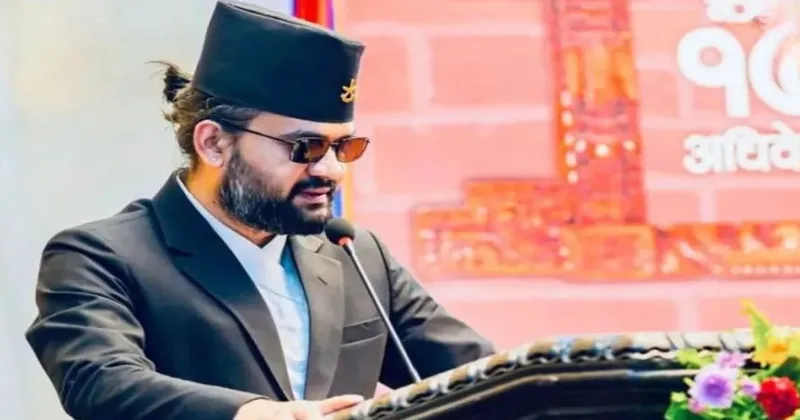
Kathmandu: Balendra Shah sworn in as the 47th Prime Minister of Nepal at a special ceremony held at the Office of the President on March 27, Friday. Nepal President Ramchandra Paudel administered the oath of office and secrecy after appointing Shah earlier in the day under Article 76(1) of the Constitution. The oath-taking ceremony was attended by Vice President Ram Sahaya Prasad Yadav, Chief Justice Prakash Man Singh Raut, National Assembly Chair Narayan Prasad Dahal, Former Prime Ministers, senior officials, security chiefs and members of the diplomatic community.
As the 47th Prime Minister of Nepal, Balendra Shah is one of the youngest persons to be at the helm of the political structure of the Himalayan nation. Earlier on Marh 26, Thursday afternoon, Balendra Shah also took the oath of secrecy as a member of the House of Representatives(HoR). In 2022, a structural engineer with a signature pair of black rectangular sunglasses and a history in the underground rap scene did the unthinkable. Balendra Shah dismantled the established political machinery of Nepal to become the Mayor of Kathmandu.
Running as an independent candidate under the symbol of a walking stick, Balendra Shah secured 61,767 votes, comfortably outstripping veterans from the Nepali Congress. Sirjana Singh secured 38,341 votes, while CPN-UML candidate Keshav Sthapit, also the former Mayor of the capital, got 38,117 votes. Now, just four years later, the 35-year-old is no longer just a local phenomenon; he is one of the youngest Prime Ministers in the nation’s history. Meanwhile, the first meeting of Nepal’s new Parliament after the elections early this month convened on March 26, Thursday, with newly elected members taking the oath of office and secrecy.
The previous Parliament was dissolved in September 2025 after the Gen-Z protest. Nepali Congress parliamentarian Arjun Narsingh KC, the senior-most member of the House of Representatives, administered the oath to the MPs. In the House of Representatives elections held on March 5, the Rastriya Swatantra Party emerged as the largest party with 182 seats, followed by the Nepali Congress with 38 seats, CPN-UML with 25, Nepali Communist Party with 17, Shram Sanskriti Party with seven and the Rastriya Prajatantra Party with five seats.
Under the Proportional Representation system, 57 lawmakers were elected from the Rastriya Swatantra Party (RSP), 20 from the Nepali Congress (NC), 16 from the CPN (UML), nine from the Nepali Communist Party (NCP) and four each from the Shram Sanskriti Party and the Rastriya Prajatantra Party (RPP). The Election Commission had announced the PR election results on March 16. Under the First-Past-the-Post (FPTP) system, the RSP secured 125 seats, followed by the NC with 19, UML with 9, NCP with 8, Shram Sanskriti Party with 3, RPP with 1 and one independent candidate. As per constitutional provisions, the House of Representatives, the lower house of the Federal Parliament, consists of a total of 275 members, including 165 elected through the FPTP system and 110 through the PR system.
Key portfolios assigned in the Balendra Shah cabinet
As Balendra Shah took oath as the Prime Minister of Nepal the key portfolio distribution is also finalized. Balendra Shah will lead a 15-member cabinet as per the latest updates. Accordingly, Balendra Shah has himself held Ministry of Defence and Ministry of Industry. Swarnim Wagle will lead the Ministry of Finance, a pivotal department to accelerate the economic growth of Nepal which is currently in doldrums and which was a pivotal reason for the Gen Z protest. Sudhan Gurung will hold the Ministry of Home Affairs and Shishir Khanal is appointed as the Minister for Foreign Affairs.
Sunil Lamsal is appointed as the Minister for the Ministry of Physical Infrastructure and Transport and Urban Development. Biraj Bhakta Shrestha holds the Ministry of Energy, Water Resources and Irrigation. Khadka Raj Poudel(Ganesh) is in-charge for the Ministry of Tourism. Sasmit Pokharel is responsible for Ministry of Education, Science and Technology and Youth and Sports. Nisha Mehta is appointed as the Minister for Health and Population. Bikram Timilsina is given with the Ministry of Communications and Pratibha Rawal is responsible for the Ministry of General Administration.
Deepak Sah is appointed as the Minister for Labour and Sobita Gautam is the Minister for Law. Sita Badi is responsible for the Ministry of Women, Children and Senior Citizens. The people of Nepal thus has high hopes and stakes on the newly formed cabinet. Will the new cabinet led by Balendra Shah fulfill the aspirations of the Himalayan state? Will it carve an inclusive governance ecosystem and accelarate economic growth? Will the anger and frustration of the youth that was the reason for the Gen Z protest be solved? The answers are awaited as the new cabinet takes charge in Nepal.
(With Inputs from ANI)