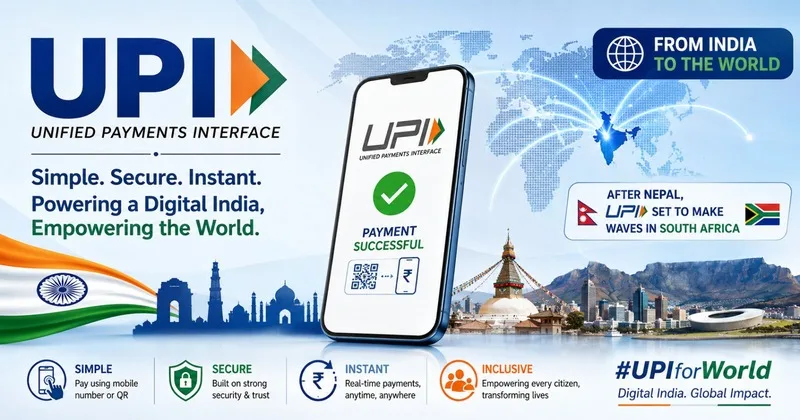
Unified Payments Interface (UPI), the shining face of India’s digital revolution, is now establishing a strong identity on the global stage. Originally developed for the convenience of Indian consumers, this payment system has today become a source of inspiration for many countries around the world.
Following the recent launch of a cross-border digital payment system with Nepal, South Africa is now seriously considering adopting India’s UPI model. South African Reserve Bank Governor Lesetja Kganyago’s description of UPI as an ideal digital payment model makes it clear that India’s financial technology is becoming a cornerstone of global transformation.
Towards a more connected world.
UPI reflects India’s vision of leveraging technology as a force for inclusion, bringing together policy, innovation and execution at an unprecedented scale.
Now extending beyond borders, it is strengthening digital linkages and enabling seamless… pic.twitter.com/HaOkjWGlbB
— Randhir Jaiswal (@MEAIndia) June 13, 2026
Why the Indian Model Appeals to South Africa
South Africa is striving to transition from a cash-based economy to a digital payment system. In this process, it is seeking a model that is low-cost, simple and accessible to ordinary citizens. India’s UPI appears to meet these criteria perfectly.
The South African Reserve Bank Governor acknowledged that many countries have moved far ahead of South Africa in the shift towards a cashless economy. Specifically citing India’s UPI, he noted that it is a platform that eliminates the need for expensive Point-of-Sale (POS) terminals and enables instant payments using only a mobile number or QR code. This simplicity is what places UPI among the world’s most successful digital payment models.
A Catalyst for Change for Women and the Poor
The South African Reserve Bank Governor also highlighted that an over-reliance on cash creates practical challenges for vulnerable sections of society, particularly women. Digital payments can prove to be more transparent and convenient for managing family expenses or handling child-support payments.
India’s Global Standing in Digital Payments
The achievements India has made in the digital payments sector over the past few years are unprecedented. Today, UPI has become the backbone of India’s payment ecosystem. India’s UPI network alone accounts for nearly half of all real-time digital transactions taking place globally.
According to data from the Reserve Bank and NPCI, UPI recorded approximately 185.8 billion transactions in the 2024-25 fiscal year. In March 2025 alone, a record was set with 19.78 billion transactions and payments valued at ₹24.77 lakh crore. This is undoubtedly a testament to the changing lifestyles and growing digital trust of millions of people.
Towards a more connected world.
UPI reflects India’s vision of leveraging technology as a force for inclusion, bringing together policy, innovation and execution at an unprecedented scale.
Now extending beyond borders, it is strengthening digital linkages and enabling seamless… pic.twitter.com/v5OfVZDVI3
— Indian Diplomacy (@IndianDiplomacy) June 13, 2026
UPI Network Expanding from Nepal to Europe
The cross-border digital payment facility launched with Nepal on June 6 has given fresh momentum to UPI’s international expansion. Through the collaboration between NPCI International Payments Limited (NIPL) and Nepal Clearing House Limited (NCHL), citizens of both nations can now make seamless payments using mobile apps and digital wallets.
Currently, UPI is accepted in nine countries, including Singapore, the United Arab Emirates, France, Mauritius, Bhutan, Nepal, Qatar, Sri Lanka and Cambodia. Indian travelers are able to make payments abroad using the familiar UPI apps they use at home. This achievement places India among the leading nations in the global digital payment landscape.
Domestically, UPI, alongside the ‘JAM’ trinity (Jan Dhan, Aadhaar, and Mobile), has strengthened financial inclusion. Small shopkeepers, vegetable vendors, rickshaw pullers and millions of self-employed individuals have now become part of the digital economy.
Why the World is Talking About UPI
UPI’s greatest strengths are its simplicity and low cost. Users do not require additional hardware or need to navigate complex procedures; secure payments are made possible simply through a smartphone and an internet connection.
Furthermore, a robust security system underpins UPI’s success. Every payment undergoes a two-factor authentication process. Mobile devices, UPI PINs, encryption technology and real-time monitoring mechanisms ensure its security. The government, the Reserve Bank and the NPCI are continuously strengthening cybersecurity measures to maintain user trust. This is why more than eight out of every ten digital payments in India are made via UPI. It has become a symbol not just of technology, but of trust.
India’s Digital Economic Infrastructure
India’s infrastructure revolution is increasingly driven by digital innovation!
▶️ From #UPI-powered instant payments and PFMS-enabled transparent governance to #ONDC and #GeM expanding economic opportunities, Digital Public… pic.twitter.com/2KN8ke3hqX
— PIB India (@PIB_India) June 12, 2026
India Moving Towards a Global Digital Future
With countries like South Africa, following Nepal, showing interest in adopting the UPI model, it is evident that India’s digital payment system is rapidly moving towards becoming a global standard. Through this, India has demonstrated to the world that if technology is made simple, accessible and affordable, it can bring about positive change in the lives of millions. The growing global acceptance of UPI is proof that “Made in India” innovation now has the potential to shape the direction of the global economy.