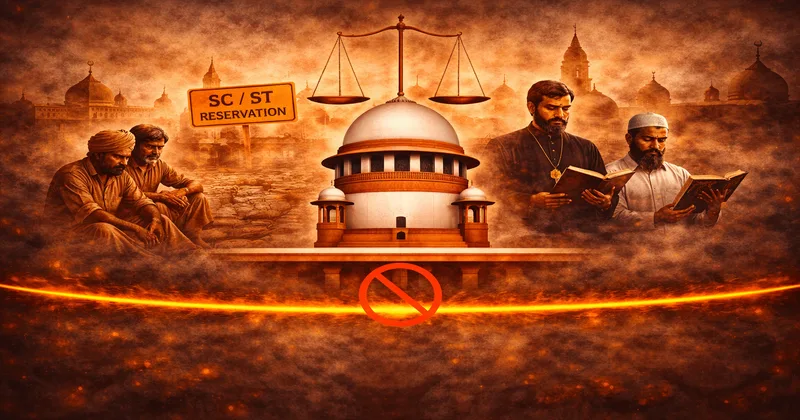
In a judgment of far-reaching constitutional consequence, the Supreme Court of India, through a Bench comprising Justice PK Mishra and Justice Manmohan, has decisively reaffirmed that the Scheduled Caste status and the consequential benefits of SC/ST reservation cannot survive religious conversion to any religion other than Hinduism, Sikhism, or Buddhism. Delivered in Chinthada Anand v. State of Andhra Pradesh & Ors., the ruling restores doctrinal clarity to a question that has long lingered at the intersection of faith, identity, and constitutional entitlement.
Anchored firmly in the framework of the Constitution (Scheduled Castes) Order, 1950, the Court has drawn a clear and uncompromising boundary: that affirmative action in India is not an abstract right flowing from ancestry alone, but a carefully structured remedy tied to historically situated social disadvantage within a defined civilizational context. In doing so, the Court has not merely resolved a legal dispute, it has reaffirmed the integrity of the constitutional vision governing SC/ST reservation, ensuring that its benefits remain aligned with the very conditions that justified their creation.
In a decisive reaffirmation of constitutional discipline, the Supreme Court of India, speaking through a Bench comprising and, has once again clarified a foundational principle of India’s affirmative action framework: that Scheduled Caste status is inseparably linked to a specific civilizational and social context, and does not survive conversion to religions outside Hinduism, Sikhism, or Buddhism. In doing so, the Court has not ventured into new terrain, but has instead restored clarity to an area increasingly clouded by competing claims and interpretive ambiguities.
The ruling draws its strength from the constitutional architecture itself, particularly the provision, which explicitly confines Scheduled Caste recognition to persons professing certain faiths. This limitation is neither incidental nor exclusionary in the abstract; rather, it reflects the historical reality that caste-based disabilities, which the Constitution sought to remedy through reservations and protective legislation, were embedded within a particular social order. The extension of this recognition to Sikhism and Buddhism over time did not alter the core principle; it merely acknowledged parallel social continuities within closely related traditions.
Against this backdrop, the Court’s reasoning acquires both precision and inevitability. Conversion, the Bench has emphasised, is not a superficial act but a conscious and voluntary departure from one’s previous religious identity. When an individual adopts and professes a new faith, he or she necessarily exits the social framework within which caste-based disabilities were historically situated and constitutionally recognised. To permit the continued claim of Scheduled Caste status in such circumstances would be to detach constitutional entitlement from its foundational rationale, thereby transforming a carefully structured remedy into a portable privilege.
It is this potential for disjunction that the Court has firmly foreclosed. The judgment leaves no room for the notion of dual identity, where one may simultaneously profess a religion outside the recognised framework and yet invoke the benefits reserved for the Scheduled Castes. Such a position, the ruling implicitly recognises, would not only erode the integrity of affirmative action but also introduce an element of arbitrariness into a system designed to address specific and historically grounded disadvantages. By declaring the bar to be absolute, the Bench has ensured that constitutional identity cannot be selectively invoked to secure legal advantage.
The implications of this clarity extend beyond the immediate question of reservation. The Court has also affirmed that statutory protections, including those under the law, are inextricably linked to constitutionally recognised Scheduled Caste status. Once that status ceases, so too does the legal basis for invoking such protections. This conclusion, while perhaps contested in certain sociological discourses, flows logically from the constitutional scheme and preserves the coherence of the legal framework.
Importantly, the judgment does not in any way curtail the individual’s fundamental right to freedom of religion. It does not question the legitimacy of conversion, nor does it impose any barrier upon it. What it does, however, is to reaffirm that rights and consequences are often intertwined within the constitutional order. The freedom to adopt a new faith entails a corresponding realignment of legal identity, particularly when that identity is tied to historically specific social conditions.
In an era where questions of identity are increasingly fluid and often strategically asserted, the Supreme Court’s ruling serves as a reminder that the Constitution operates within defined boundaries. It is not merely a repository of entitlements, but a carefully calibrated instrument that balances rights with structure, and compassion with discipline. By reaffirming the limits inherent in the Court, it has drawn a clear constitutional Lakshman Rekha, one that preserves the integrity of affirmative action while maintaining fidelity to the principles upon which it was founded.
In the final analysis, the message of the judgment is both simple and profound: constitutional benefits cannot be divorced from the social realities that justify them, and identity, in the eyes of the law, cannot be a matter of selective invocation.