SC/ST Reservation and Religious Conversion
June 4, 2026
  • Read Ecopy
  • Circulation
  • Advertise
  • Careers
  • About Us
  • Contact Us
Android AppiPhone AppArattai
Organiser
  • ‌
  • Bharat
    • Assam
    • Bihar
    • Chhattisgarh
    • Jharkhand
    • Maharashtra
    • View All States
  • World
    • Asia
    • Europe
    • North America
    • South America
    • Africa
    • Australia
  • Editorial
  • International
  • Opinion
  • RSS @ 100
  • More
    • Op Sindoor
    • Analysis
    • Sports
    • Defence
    • Politics
    • Business
    • Economy
    • Culture
    • Special Report
    • Sci & Tech
    • Entertainment
    • G20
    • Azadi Ka Amrit Mahotsav
    • Vocal4Local
    • Web Stories
    • Education
    • Employment
    • Books
    • Interviews
    • Travel
    • Law
    • Health
    • Obituary
  • Subscribe
    • Subscribe Print Edition
    • Subscribe Ecopy
    • Read Ecopy
  • ‌
  • Bharat
    • Assam
    • Bihar
    • Chhattisgarh
    • Jharkhand
    • Maharashtra
    • View All States
  • World
    • Asia
    • Europe
    • North America
    • South America
    • Africa
    • Australia
  • Editorial
  • International
  • Opinion
  • RSS @ 100
  • More
    • Op Sindoor
    • Analysis
    • Sports
    • Defence
    • Politics
    • Business
    • Economy
    • Culture
    • Special Report
    • Sci & Tech
    • Entertainment
    • G20
    • Azadi Ka Amrit Mahotsav
    • Vocal4Local
    • Web Stories
    • Education
    • Employment
    • Books
    • Interviews
    • Travel
    • Law
    • Health
    • Obituary
  • Subscribe
    • Subscribe Print Edition
    • Subscribe Ecopy
    • Read Ecopy
Organiser
  • Home
  • Bharat
  • World
  • Operation Sindoor
  • Editorial
  • Analysis
  • Opinion
  • Culture
  • Defence
  • International Edition
  • RSS @ 100
  • Magazine
  • Read Ecopy
Home Bharat

SC/ST Reservation and Religious Conversion: Supreme Court Draws the Constitutional Lakshman Rekha

Delivered in the case of Chinthada Anand v. State of Andhra Pradesh, the Supreme Court ruling underscores that affirmative action under the SC/ST framework is rooted in historically specific social conditions and cannot be retained after conversion to other religions

Adv Karan ThakurAdv Karan Thakur
Mar 25, 2026, 07:00 pm IST
in Bharat
Follow on Google News
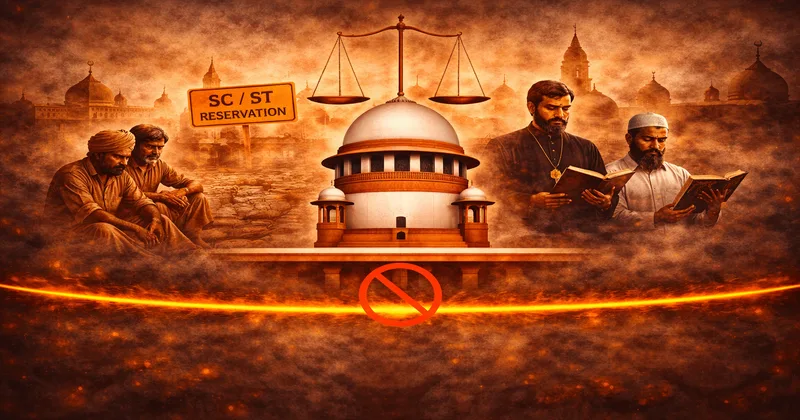
Representative Image (Image generated from AI)

Representative Image (Image generated from AI)

FacebookTwitterWhatsAppTelegramEmail

In a judgment of far-reaching constitutional consequence, the Supreme Court of India, through a Bench comprising Justice PK Mishra and Justice Manmohan, has decisively reaffirmed that the Scheduled Caste status and the consequential benefits of SC/ST reservation cannot survive religious conversion to any religion other than Hinduism, Sikhism, or Buddhism. Delivered in Chinthada Anand v. State of Andhra Pradesh & Ors., the ruling restores doctrinal clarity to a question that has long lingered at the intersection of faith, identity, and constitutional entitlement.

Anchored firmly in the framework of the Constitution (Scheduled Castes) Order, 1950, the Court has drawn a clear and uncompromising boundary: that affirmative action in India is not an abstract right flowing from ancestry alone, but a carefully structured remedy tied to historically situated social disadvantage within a defined civilizational context. In doing so, the Court has not merely resolved a legal dispute, it has reaffirmed the integrity of the constitutional vision governing SC/ST reservation, ensuring that its benefits remain aligned with the very conditions that justified their creation.

In a decisive reaffirmation of constitutional discipline, the Supreme Court of India, speaking through a Bench comprising and, has once again clarified a foundational principle of India’s affirmative action framework: that Scheduled Caste status is inseparably linked to a specific civilizational and social context, and does not survive conversion to religions outside Hinduism, Sikhism, or Buddhism. In doing so, the Court has not ventured into new terrain, but has instead restored clarity to an area increasingly clouded by competing claims and interpretive ambiguities.

Also Read: Prajna Pravah to go ahead with ‘Ekatma Manava Darshan’ conference from March 25 despite cancellation reports

The ruling draws its strength from the constitutional architecture itself, particularly the provision, which explicitly confines Scheduled Caste recognition to persons professing certain faiths. This limitation is neither incidental nor exclusionary in the abstract; rather, it reflects the historical reality that caste-based disabilities, which the Constitution sought to remedy through reservations and protective legislation, were embedded within a particular social order. The extension of this recognition to Sikhism and Buddhism over time did not alter the core principle; it merely acknowledged parallel social continuities within closely related traditions.

Against this backdrop, the Court’s reasoning acquires both precision and inevitability. Conversion, the Bench has emphasised, is not a superficial act but a conscious and voluntary departure from one’s previous religious identity. When an individual adopts and professes a new faith, he or she necessarily exits the social framework within which caste-based disabilities were historically situated and constitutionally recognised. To permit the continued claim of Scheduled Caste status in such circumstances would be to detach constitutional entitlement from its foundational rationale, thereby transforming a carefully structured remedy into a portable privilege.

It is this potential for disjunction that the Court has firmly foreclosed. The judgment leaves no room for the notion of dual identity, where one may simultaneously profess a religion outside the recognised framework and yet invoke the benefits reserved for the Scheduled Castes. Such a position, the ruling implicitly recognises, would not only erode the integrity of affirmative action but also introduce an element of arbitrariness into a system designed to address specific and historically grounded disadvantages. By declaring the bar to be absolute, the Bench has ensured that constitutional identity cannot be selectively invoked to secure legal advantage.

The implications of this clarity extend beyond the immediate question of reservation. The Court has also affirmed that statutory protections, including those under the law, are inextricably linked to constitutionally recognised Scheduled Caste status. Once that status ceases, so too does the legal basis for invoking such protections. This conclusion, while perhaps contested in certain sociological discourses, flows logically from the constitutional scheme and preserves the coherence of the legal framework.

Importantly, the judgment does not in any way curtail the individual’s fundamental right to freedom of religion. It does not question the legitimacy of conversion, nor does it impose any barrier upon it. What it does, however, is to reaffirm that rights and consequences are often intertwined within the constitutional order. The freedom to adopt a new faith entails a corresponding realignment of legal identity, particularly when that identity is tied to historically specific social conditions.

In an era where questions of identity are increasingly fluid and often strategically asserted, the Supreme Court’s ruling serves as a reminder that the Constitution operates within defined boundaries. It is not merely a repository of entitlements, but a carefully calibrated instrument that balances rights with structure, and compassion with discipline. By reaffirming the limits inherent in the Court, it has drawn a clear constitutional Lakshman Rekha, one that preserves the integrity of affirmative action while maintaining fidelity to the principles upon which it was founded.

In the final analysis, the message of the judgment is both simple and profound: constitutional benefits cannot be divorced from the social realities that justify them, and identity, in the eyes of the law, cannot be a matter of selective invocation.


Topics: Supreme CourtReligious ConversionSC ST reservation
ShareTweetSendShareSend
✮ Subscribe Organiser YouTube Channel. ✮
✮ Join Organiser's WhatsApp channel for Nationalist views beyond the news. ✮
Previous News

VHP welcomes Supreme Court verdict safeguarding Scheduled Caste rights; says will not allow misuse of SC rights

Next News

LPG to be discontinued in areas with PNG access in next three months: Govt order

Related News

Accused in the Love Jihad Case in Bhopal Ausaf Khan and Maaz

Love Jihad Horror in Bhopal: Charge sheet alleges rape, blackmail and conversion pressure by Ausaf Khan and Maaz

Supreme Court remarks have revived the UAPA bail debate, with supporters citing national security concerns

UAPA Bail Debate: Striking a delicate balance between individual liberty and national security

Supreme Court invokes Article 142, issues strict timelines to curb delay in High Court judgments

Supreme Court invokes Article 142, orders strict timelines for High Court judgments to end delays in justice delivery

SIR and Article 324: Supreme Court strengthens the constitutional spine of Indian Democracy; Reaffirms ECI’s authority

Christian pastor arrested for allegedly luring villagers with jobs and marriage promises

UP Conversion Row: Christian Pastor arrested for allegedly luring villagers with jobs & marriage promises

Accused Nida Khan in Nashik TCS Jihad case

TCS Nashik Corporate Jihad Case: SIT claims chats show Hindu victim was renamed “Hania” after conversion by Nida Khan

Load More

Latest News

FIR filed against the Islamists in the Love Jihad case in Bhopal

Love Jihad again in Bhopal: Minor Hindu girl forced to drink beer, trapped and pressured to convert by Islamists

The ₹100 Crore Dhaba: How Amrik Sukhdev Revolutionised Highway Dining in India

The Dhaba Story: The family that changed highway dining

After TCS Controversy, Wipro Faces Fresh 'Corporate Jihad' Allegations as Former Employee Details Harassment, Religious Pressure and Forced Resignation

Exclusive | Corporate Jihad at Wipro? Hindu employee says Shahina told her, ‘Accept Islam, I’ll marry you to a Sheikh’

Mizoram CM Lalduhoma says Myanmar refugee influx has become a burden

Myanmar refugee influx has become a burden on Mizoram: CM Lalduhoma

Prime Minister Narendra Modi

PM Modi to launch Rs 21,770 cr mega projects in Surat & Daman; Infrastructure, healthcare among key projects

Ebola medical countermeasures that were sent by Bharat arrived at Africa’s Ebola Continental Supply Chain mechanism in Entebbe, Uganda bringing the total to just under 50MT

Ebola Crisis in Uganda: India delivers life-saving medical supplies to African nation

Cabinet approves Rs 9,585 crore scheme to replace old trucks and buses in Delhi-NCR

Delhi-NCR gets major pollution relief push as centre clears Rs 9,585 cr vehicle replacement scheme for trucks and buses

A representative image generated using AI

BHAVYA Scheme to transform India’s Manufacturing Landscape: DPIIT secretary calls for investment-ready industrial parks

Keralam: Madrasa Ustad Shemeer Asari sends Obscene video to Girls in WhatsApp Group, asks if they can do the same

Keralam: Madrasa Ustad Shemeer Asari sends Obscene video to Girls in WhatsApp Group, asks if they can do the same

Board outside the office of Karnataka Lokayukta

Karnataka government accused of shielding tainted officials as Lokayukta probes remain stalled

Load More
  • Privacy
  • Terms
  • Cookie Policy
  • Refund and Cancellation
  • Delivery and Shipping

© Bharat Prakashan (Delhi) Limited.
Tech-enabled by Ananthapuri Technologies

  • Home
  • Search Organiser
  • Bharat
    • Assam
    • Bihar
    • Chhattisgarh
    • Jharkhand
    • Maharashtra
    • View All States
  • World
    • Asia
    • Africa
    • North America
    • South America
    • Europe
    • Australia
  • Editorial
  • Operation Sindoor
  • Opinion
  • Analysis
  • Defence
  • Culture
  • Sports
  • Business
  • RSS @ 100
  • Entertainment
  • More ..
    • Sci & Tech
    • Vocal4Local
    • Special Report
    • Education
    • Employment
    • Books
    • Interviews
    • Travel
    • Health
    • Politics
    • Law
    • Economy
    • Obituary
  • Subscribe Magazine
  • Read Ecopy
  • Advertise
  • Circulation
  • Careers
  • About Us
  • Contact Us
  • Policies & Terms
    • Privacy Policy
    • Cookie Policy
    • Refund and Cancellation
    • Terms of Use

© Bharat Prakashan (Delhi) Limited.
Tech-enabled by Ananthapuri Technologies