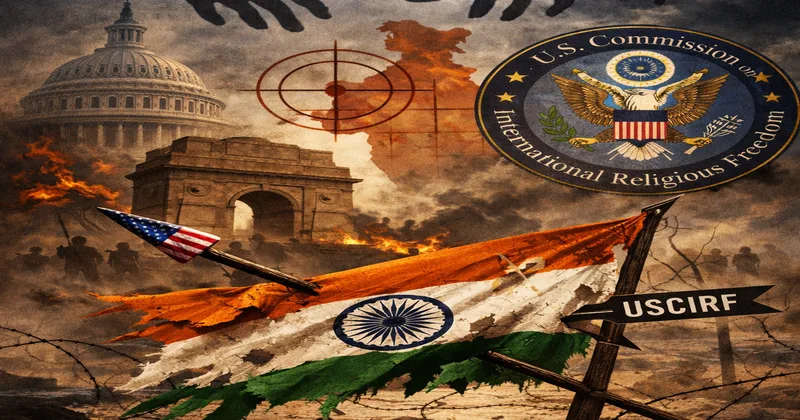
The global landscape of the 21st century has moved far beyond conventional territorial wars and has evolved into complex dimensions of hybrid warfare, information warfare, and lawfare. In the contemporary era, the sovereignty and democratic legitimacy of nations are increasingly undermined not by direct military aggression but by legal narratives, sponsored human rights reports, and institutional pressures at the international level.
In this context, the annual report released on March 4, 2026, by the United States Commission on International Religious Freedom (USCIRF) must not be viewed merely as an assessment of religious freedom. Such an interpretation would constitute a serious analytical error. This document is not just a recommendation to designate India, for the seventh consecutive year, as a “Country of Particular Concern” (CPC); rather, it represents a coordinated legal offensive targeting India’s ideological foundation—namely, the Rashtriya Swayamsevak Sangh (RSS)—and its strategic shield, the Research and Analysis Wing (R&AW).
The Legal Framework of USCIRF: Authority versus Institutional Overreach
USCIRF was established under the International Religious Freedom Act (IRFA), 1998, as an advisory body. Legally, it functions only as a consultative institution meant to guide U.S. foreign policy and does not possess any binding authority under international law, nor does it enjoy the status of an international judicial body.
Despite these limitations, the Commission’s commentary on the internal legislative policies, security architecture, and cultural institutions of a sovereign democracy like India amounts to a clear case of ultra vires action—beyond its lawful authority. Evaluating the domestic policies of an independent nation lies outside its statutory jurisdiction, thereby transforming it into an instrument of external interference in international politics.
Composition of USCIRF: Conflict of Interest and Ideological Bias
The credibility of any legal or quasi-legal report rests upon the impartiality of its authors. However, the present composition of USCIRF raises serious concerns of conflict of interest and violates the foundational principle of natural justice—nemo judex in causa sua, meaning no one should be a judge in their own cause.
The ideological inclinations of its members, including Chairman Stephen Schneck, Vice-Chair Dr Asif Mahmood—whose background is linked to Pakistan—and figures such as David Curry, are widely known. When individuals influenced by religious lobbying groups or narrow geopolitical perspectives prepare such reports, objectivity inevitably gives way to bias. This undermines the principle that justice must not only be done but must also be seen to be done.
Chronological Evolution of USCIRF Reports: From Monitoring to Legal Aggression (1998–2026)
A chronological analysis of USCIRF’s narrative on India reveals a pattern of escalating legal aggression. Between 1998 and 2013, the Commission primarily focused on major communal incidents, such as the 2002 Gujarat riots. However, after 2014, its approach shifted significantly, targeting India’s legislative measures, including the abrogation of Article 370, the Citizenship Amendment Act (CAA), proposed Waqf reforms, and anti-conversion laws.
The 2026 report marks the peak of this trajectory. For the first time, it labels RSS as a “Hindu supremacist paramilitary group” and characterises R&AW as an instrument of “transnational repression.” Furthermore, it recommends restricting arms sales to India under the Arms Export Control Act and linking security assistance to conditions on religious freedom. This is not merely a report but a strategic attempt to undermine India’s strategic autonomy.
Legal Status of RSS: Judicial Recognition versus Foreign Misrepresentation
The portrayal of RSS as a paramilitary or supremacist organisation is not only historically inaccurate but also contrary to established Indian judicial principles. Under Article 19(1)(c) of the Constitution, the freedom to form associations guarantees the legality of RSS as a cultural organisation.
The Supreme Court of India, in Ramesh Yeshwant Prabhoo v. Prabhakar Kunte (1996), recognised “Hindutva” as a “way of life.” Equating cultural identity with religious extremism constitutes a form of judicial mischaracterisation. The allegations against RSS in the USCIRF report lack credible legal evidence and rely on vague expressions such as “responsibility” and “tolerance,” thereby attempting to criminalise an entire organisation without due process.
R&AW and International Law: The Question of Sovereignty
The accusations against R&AW regarding “transnational repression” violate Article 2(7) of the United Nations Charter and principles of customary international law, which prohibit interference in the internal affairs of sovereign states.
The report’s call for legislative measures such as the Transnational Repression Reporting Act of 2024 is aimed at constraining legitimate intelligence activities of India. These allegations are primarily based on secondary sources and inputs from NGOs with questionable credibility. From a legal standpoint, demanding targeted sanctions against a sovereign nation’s intelligence agency without judicial evidence undermines the very foundations of international order.
Comparative Legal Analysis: The Hypocrisy of Double Standards
A significant contradiction emerges when USCIRF criticises India’s laws, such as UAPA, FCRA, and anti-conversion statutes, even as the United States itself enforces stringent legal frameworks, including the Patriot Act, the Foreign Agents Registration Act (FARA), and the Arms Export Control Act.
Standards deemed legitimate for U.S. national security are labelled oppressive when applied by India. This reflects a clear case of double standards, where international legal norms are selectively applied to regulate developing nations.
ICCPR and the Doctrine of Reasonable Restrictions
India is a signatory to the International Covenant on Civil and Political Rights (ICCPR). While Articles 18, 19, and 21 guarantee religious and expressive freedoms, they also explicitly permit reasonable restrictions on grounds of national security, public order, and morality.
All contested Indian laws operate within this internationally recognised legal framework. Therefore, portraying them as violations of international obligations is both misleading and legally untenable.
International Lobbying Networks and Narrative Engineering
The USCIRF report is not an independent academic exercise but a product of deliberate narrative engineering. The influence of organisations such as IAMC (Indian American Muslim Council) and Hindus for Human Rights is evident, which operate through foreign influence mechanisms to shape U.S. policy discourse.
Research bodies such as The Disinfo Lab have highlighted how selective incidents are amplified to project India as an intolerant state. This reflects a coordinated ecosystem where lobbying, media narratives, and institutional reports converge.
Indian Opposition and Constitutional Responsibility
The response of sections of the Indian opposition in this matter appears both short-sighted and detrimental to national interest. Utilising foreign reports as political tools without legal scrutiny undermines the sovereignty and credibility of national institutions.
Article 51A(a) of the Constitution mandates every citizen, especially public representatives, to uphold the sovereignty, unity, and integrity of India. While dissent is integral to democracy, it must not erode the nation’s institutional legitimacy or aid external narratives that seek to weaken it.
Official Response of the Government of India (MEA, 16 March 2026)
India’s Ministry of External Affairs has categorically rejected the USCIRF report as a “motivated and biased characterization” presenting a “distorted picture” of the country. It has urged the Commission to introspect on issues within the United States itself, including rising racial tensions and attacks on Hindu temples. This firm response reflects India’s commitment to safeguarding its legal sovereignty.
A Call to Defend Legal Sovereignty
It may be concluded that the USCIRF 2026 report is not an impartial evaluation but a politically motivated document intended to challenge India’s cultural identity, legal framework, and strategic autonomy.
As citizens, it is imperative to recognise that India’s unity and sovereignty do not depend on certification from foreign commissions. Confidence in our constitutional institutions, judiciary, security apparatus, and cultural organisations must remain unwavering. At the same time, India must adopt a proactive legal diplomacy strategy on the global stage.
Collaboration with platforms such as QUAD, the Global South, and like-minded nations can help build an alternative human rights discourse free from colonial biases. The defence of India’s sovereignty today extends beyond territorial borders into the domains of information and legal warfare.