The geopolitical wildfire is engulfing rigorously across the West Asian mosaic causing severe scar to the lives of the common people. The people of Iran in particular are stuck amid a double-edged sword as they deal with geopolitical targets from the encircling region and the rigid Islamic theocracy within the country. Amid such a jeopardized scenario, the people of Iran are revisiting their Persian roots by observing Nowruz, the Persian New Year. The festival mirrors the spring of resistance, revival and rejuvenation. Nowruz this year, marks greater emotional significance for the inhabitants of ancient Persia, as they cluelessly and helplessly stand amidst an escalating conflict to fulfil hegemonic ambitions across the hard-nosed geopolitical chessboard.
Significance of Nowruz in ancient Persian culture
Nowruz translates to “New Day” in the Persian language. It is the Iranian festival marking the beginning of spring season that symbolizes rejuvenation and regeneration. It is the first day in the Iranian solar calendar aligning with the spring equinox. Nowruz is celebrated across West Asia where Persian culture is practiced. It is observed in regions that were once part of the Iranian empire. This includes Turkey, Iran, Iraq, Afghanistan, Pakistan and the Caucasus region that is particularly in Azerbaijan.
Nowruz was first observed during the pre-Islamic period under the Sassanian dynasty(224-651CE). It was largely celebrated all across the Persian empire. Nowruz is also part of the UNESCO list of intangible cultural heritage. The practice and rituals associated with Nowruz traces its roots to Zoroastrianism(the Parsi culture). Interestingly, as the lead up to the Nowruz festival people indulge in vigorous spring cleaning symbolising clearing or sweeping away the old and lingering negativity.
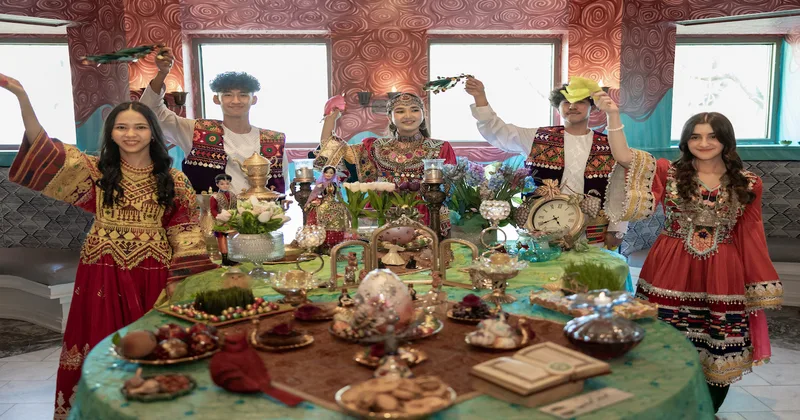
Nowruz is a much anticipated and highly celebrated ritual in Persian culture with deep significance encircling the ancient faith system. The last Wednesday previous to Nowruz is called Chaharshanbeh Soori, which literally translates to “Scarlet Wednesday”. Chaharshanbeh Soori is a ritual signifying purification. During Nowruz, Persians decorate the houses and streets, light lamps in public places, burst crackers and fireworks, render prayers and rich, delicious Persian food is served.
Also, during the first few days of Nowruz, people visit the houses of friends and family and gifts are exchanged. In Central Asian countries such as Kyrgyzstan, Uzbekistan and Tajikistan traditional athletic competitions are held as well. On day 13 after the spring equinox Nowruz comes to an end. People again gather in public spaces to share food, gifts and thus pray for good luck and prosperity in the coming year.
Nowruz post 1979 revolution & the rise of Islamic clergy
The grandeur, significance and the religious pride of Nowruz began to fade and lose its importance in public domain with the Iranian Revolution of 1979 and the rise of Islamic theocracy. In the pre-Islamic Iran the Safavid rulers, Pahlavi dynasty and other Iranian monarchies had embraced and cherished Nowruz. Even today, though the scale of Nowruz celebrations have reduced, the Persian ritual still acts as a weight to counterbalance the spiking clerical rule of Shia Muslim clergy.
In fact, post the 1979 revolution, many Islamic clerics aimed to destroy and downplay Nowruz due to its non-Islamic character. However, the festival and the ancient Persian culture has been sustained and is thriving till today, despite all the suppression. This reflects the deep, intangible and eternal Persian roots present in Iran. However, in 2026, Nowruz is different for the people of Iran as the country and its people are entangled in existential threat.
The Persian message of resistance & regeneration amid conflict & clerical rule
The Nowruz for the Persians in 2026 is a question of identity, resistance and regeneration as Iran and the larger geopolitical landscape of West Asia is embroiling in a massive conflict with no sign of de-escalation. The people of Iran are leading a life of uncertainty amid steep economic crisis, iron fist of clerical rule and rising geopolitical tensions. Many people are protesting on the streets against the theocracy in Tehran. However, they are mercilessly and brutally suppressed at the hands of Iranian Revolutionary Guard Corps(IRGC). The Persian identity, ancient wisdom and practices are hanging in doldrums.
As Nowruz symbolizes the spirit of resistance, regrowth and regeneration, the people of Iran must stand up against hegemonic atrocities, resolve to fight against the despotic rule and strive to preserve and further nourish Persian culture. Because, the future generation deserves an Iran that is free from autocracy and an Iran that is rooted in ancient culture, tradition and principles.