Balidan Diwas: Untold Story of Bhagat Singh’s trials and ideology
June 13, 2026
  • Read Ecopy
  • Circulation
  • Advertise
  • Careers
  • About Us
  • Contact Us
Android AppiPhone AppArattai
Organiser
  • ‌
  • Bharat
    • Assam
    • Bihar
    • Chhattisgarh
    • Jharkhand
    • Maharashtra
    • View All States
  • World
    • Asia
    • Europe
    • North America
    • South America
    • Africa
    • Australia
  • Editorial
  • International
  • Opinion
  • RSS @ 100
  • More
    • Op Sindoor
    • Analysis
    • Sports
    • Defence
    • Politics
    • Business
    • Economy
    • Culture
    • Special Report
    • Sci & Tech
    • Entertainment
    • G20
    • Azadi Ka Amrit Mahotsav
    • Vocal4Local
    • Web Stories
    • Education
    • Employment
    • Books
    • Interviews
    • Travel
    • Law
    • Health
    • Obituary
  • Subscribe
    • Subscribe Print Edition
    • Subscribe Ecopy
    • Read Ecopy
  • ‌
  • Bharat
    • Assam
    • Bihar
    • Chhattisgarh
    • Jharkhand
    • Maharashtra
    • View All States
  • World
    • Asia
    • Europe
    • North America
    • South America
    • Africa
    • Australia
  • Editorial
  • International
  • Opinion
  • RSS @ 100
  • More
    • Op Sindoor
    • Analysis
    • Sports
    • Defence
    • Politics
    • Business
    • Economy
    • Culture
    • Special Report
    • Sci & Tech
    • Entertainment
    • G20
    • Azadi Ka Amrit Mahotsav
    • Vocal4Local
    • Web Stories
    • Education
    • Employment
    • Books
    • Interviews
    • Travel
    • Law
    • Health
    • Obituary
  • Subscribe
    • Subscribe Print Edition
    • Subscribe Ecopy
    • Read Ecopy
Organiser
  • Home
  • Bharat
  • World
  • Operation Sindoor
  • Editorial
  • Analysis
  • Opinion
  • Culture
  • Defence
  • International Edition
  • RSS @ 100
  • Magazine
  • Read Ecopy
Home Bharat

Balidan Diwas: How Bhagat Singh redefined the freedom struggle of Bharat

The life of Bhagat Singh remains one of the most powerful and enduring symbols of sacrifice, courage, and ideological conviction in India’s freedom struggle. Remembered every year on Balidan Diwas (March 23), Bhagat Singh’s legacy continues to inspire generations, transcending political boundaries and ideological debates

WEBDESKWEBDESK
Mar 23, 2026, 07:00 am IST
in Bharat
Follow on Google News
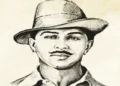
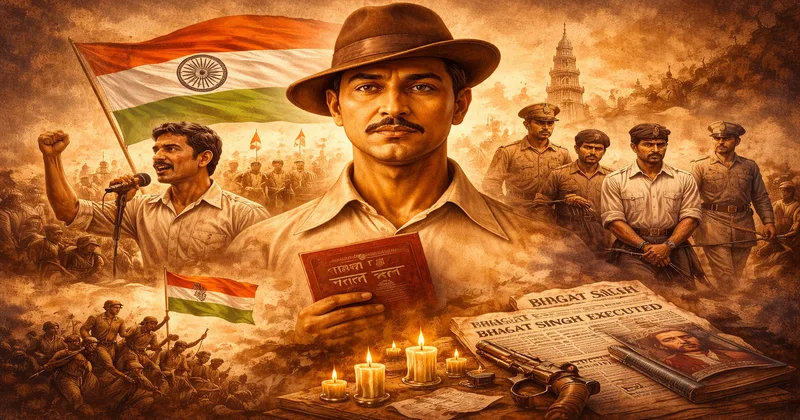
Balidan Diwas: Untold Story of Bhagat Singh’s trials and ideology (The image is generated from AI)

Balidan Diwas: Untold Story of Bhagat Singh’s trials and ideology (The image is generated from AI)

FacebookTwitterWhatsAppTelegramEmail

Bhagat Singh was born on September 28, 1907, in British India (now in Pakistan). From a young age, he was deeply influenced by the nationalist environment around him. During his student years, he came into contact with prominent thinkers and revolutionaries such as Jugal Kishore, Bhai Parmanand, and Jai Chand Vidyalankar, who played a significant role in shaping his ideological outlook.

In 1923, Bhagat Singh left his home for Kanpur, marking the beginning of his active involvement in revolutionary activities. He was well-versed in Hindi, Urdu, and Punjabi and demonstrated remarkable literary skills. His writings were published in journals like Kirti (Amritsar), Akali (Urdu), and Chand, reflecting his intellectual depth and political awareness.

During his time in Kanpur, he adopted the pseudonym “Balwant Singh” and worked in the editorial department of the newspaper Pratap, founded by Ganesh Shankar Vidyarthi. As police surveillance intensified, he moved to Aligarh, where he briefly worked as a teacher.

Returned to Lahore and Expanded the Network To Give Boost To Freedom Struggle

After six months, Bhagat Singh returned to Lahore and later moved to Delhi, where he worked with the newspaper Arjun. His journey between cities reflects the fluid and secretive nature of revolutionary activity at the time.

He soon reconnected with Kanpur and established links with several prominent revolutionaries, including Batukeshwar Dutt, Ajay Ghosh, Vijay Kumar Sinha, and Yogesh Chandra Chatterjee.

Also Read: Freedom of Religion Bill 2026: Renewing the legacy of Dilip Singh Judev

In 1926, during a Dussehra fair in Lahore, a bomb blast occurred, and Bhagat Singh was arrested despite having no involvement in the incident. The High Court released him on a bail of ₹60,000 due to lack of evidence, and the case was eventually dismissed.

The foundation of a nationwide revolutionary organisation had been laid earlier by leaders such as Sachindra Nath Sanyal, Ram Prasad Bismil, and Yogesh Chandra Chatterjee, who established the Hindustan Republican Association (HRA) in 1923.

Bhagat Singh joined this organisation under the alias “Balwant.” However, after the Kakori incident, the organisation weakened significantly, with many leaders imprisoned.

Determined to revive the revolutionary movement, Bhagat Singh, along with Vijay Kumar Sinha and Sukhdev Thapar, reorganised the group. A crucial meeting was held on September 8–9, 1928, at Feroz Shah Kotla in Delhi. Representatives from various provinces attended, though Chandrashekhar Azad stayed away for security reasons.

During this meeting, the Hindustan Socialist Republican Association (HSRA) was formed, marking a shift towards a more structured and ideologically driven revolutionary movement.

Discontent with the Indian National Congress

Bhagat Singh’s ideological journey also involved critical engagement with mainstream politics. In December 1928, he attended the Congress session in Calcutta. He was disappointed with what he perceived as a retreat from the demand for complete independence to dominion status.

This shift, according to him, represented a step backwards rather than progress. His critique highlighted the divergence between revolutionary and moderate approaches within the freedom struggle.

Bhagat Singh and Veer Savarkar: Intellectual Interactions

Bhagat Singh shared an intellectual connection with Vinayak Damodar Savarkar. Though Savarkar was under house arrest in Ratnagiri, Bhagat Singh respected his ideas and drew inspiration from his writings, particularly on the 1857 revolt.

Historian Y.D. Phadke noted that Bhagat Singh included multiple references to Savarkar’s works in his prison diary. Among Indian authors, Savarkar was one of the few whose writings appeared more than once in Singh’s notes.

Bhagat Singh also wrote about several revolutionaries such as Madan Lal Dhingra, Ambaprasad, and Sachindra Nath Sanyal. His engagement with literature reflects his deep intellectual grounding and commitment to ideological clarity.

The Trials: Assembly Bomb Case and Saunders Murder Case
Bhagat Singh was tried in two major cases:

1. Central Assembly Bomb Case (1929)
The trial began on May 7, 1929, in Delhi under Judge F.B. Pool. The prosecution was represented by Rai Bahadur Suraj Narayan. Later, in the Sessions Court under Judge Middleton, Bhagat Singh and Batukeshwar Dutt issued a joint statement, read by Asaf Ali.

They were sentenced to life imprisonment and sent to Mianwali and Multan jails. Appeals in the Lahore High Court were rejected.

2. Saunders Murder Case
On July 10, 1929, Bhagat Singh and his associates were presented before a special magistrate in Lahore Central Jail. The British prosecution was led by Carden Noad, while several Indian lawyers, including Lala Duni Chand and Malik Barkat Ali, provided legal assistance.

A special tribunal was established on June 21, 1930, which ultimately sentenced Bhagat Singh to death.

Legal Developments and Misconceptions

Several legal efforts were made to save Bhagat Singh, including a mercy petition filed before the Privy Council, which was rejected.

There has been a claim that a lawyer named Suraj Narayan was associated with the RSS and played a role in Bhagat Singh’s sentencing. However, historical evidence does not support this assertion:

  • Suraj Narayan appeared only in early proceedings as a government lawyer.
  • He was not involved in the Sessions Court or tribunal proceedings.
  • No credible historical records link him to the RSS.

This clarification is important in understanding the factual accuracy of historical narratives.

Bhagat Singh, along with Shivaram Rajguru and Sukhdev, was imprisoned in Lahore Jail. During this period, the Lahore Congress session was held under Jawaharlal Nehru.

There was widespread public demand for clemency. Leaders like Subhas Chandra Bose, Baba Gurudutt Singh, and others met the revolutionaries.

Bhagat Singh met his family for the last time on March 3, 1931. His legal advisor, Pran Nath Mehta, suggested seeking mercy from the Governor-General, but Bhagat Singh refused.

Despite multiple appeals, the execution proceeded. On March 23, 1931, at 7:33 PM, Bhagat Singh, Rajguru, and Sukhdev were hanged.

Philosophical Reflections on Sacrifice

Prominent leader Purushottam Das Tandon wrote in support of Bhagat Singh, reflecting on the age-old debate of violence versus non-violence. He argued that both creation and destruction are inherent in nature, and those responsible for society must sometimes engage in both.

Bhagat Singh’s life represents this philosophical tension—between idealism and action, thought and sacrifice.

The story of Bhagat Singh is not merely one of rebellion but of intellectual courage, ideological conviction, and ultimate sacrifice. His writings, actions, and martyrdom continue to resonate in contemporary India, reminding citizens of the price of freedom.

As India observes Balidan Diwas each year, it is not just a remembrance of a martyrdom but a reaffirmation of values—justice, courage, and unwavering commitment to the nation.
Topics: Bhagat SinghVeer SavarkarRajgurubalidan diwasShivaram Rajguru
ShareTweetSendShareSend
✮ Subscribe Organiser YouTube Channel. ✮
✮ Join Organiser's WhatsApp channel for Nationalist views beyond the news. ✮
Previous News

Giant leap in indigenous naval capabilities: BrahMos armed warship INS Taragiri to be commissioned into Indian Navy

Next News

Vibrant Villages Programme Expands: Transforming Bharat’s borders into growth hubs

Related News

Freedom Fighter Durga Devi Vohra

Durga Bhabhi: The fearless revolutionary who helped Bhagat Singh outsmart the British & fought for India’s freedom

Freedom fighter Vinayak Damodar Savarkar

PM Modi remembers Veer Savarkar on birth anniversary, says “his courage & patriotism will always inspire people”

Veer Savarkar

Veer Savarkar Birth Anniversary: Remembering the revolutionary who endured double life sentences for India’s freedom

Swa-based economy inspired by Savarkar and promoted through RSS-linked Aatmanirbhar Bharat focuses on strengthening India’s self-reliance and overall resilience

Swa-based economy: The legacy of Veer Savarkar perpetuated by the RSS

Union Home Minister Amit Shah and other leaders paid tributes to revolutionary Sukhdev Thapar on his birth anniversary

Sukhdev Thapar Birth Anniversary: Amit Shah and other leaders pay tribute to fearless revolutionary hero

The soldiers surrounded the garden and started firing on unarmed people without giving any warning and a total of 1650 rounds were fired in 10 minutes

Anniversary of Jallianwala Bagh Massacre: From bloodshed to national awakening; Turning point in freedom struggle

Load More

Latest News

Mohammad Faraz remanded to custody as ATS probes alleged terror links (This is an AI generated image)

ATS Crackdown in Bhopal: Mohammad Faraz detained; Foreign links under investigatio

New congressional boundaries have reshaped the 2026 House battleground, leaving Republicans in a stronger position as both parties compete for control of Congress

Delimitation in America: Republicans seize edge over Democrats in redistricting push ahead of 2026 midterms

(Left) Russian President Vladimir Putin (Right) Prime Minister Narendra Modi (Image Credit: ANI)

Russia Day 2026: The ancient civilisational bond between India and Moscow

After the conclusion of the 11th Governing Body meeting of NITI Aayog, the Chief Minister of Tamil Nadu, Joseph Vijay, met Prime Minister Narendra Modi in Delhi

Tamil Nadu: At first NITI Aayog meet, CM Joseph Vijay charts cooperative course with Modi govt unlike DMK

Keralam ex- CM Pinarayi Viajayan and his daughter Veena Vijayan

Keralam: Former CM Pinarayi Vijayan’s daughter Veena Vijayan gets fresh ED summons in Rs 2.78 crore CMRL case

Radical Islamists forced to stop the construction of Bhagwan Ram idol in Bangladesh

Bangladesh: Construction of Bhagwan Ram murti halted amid threats by Islamists; Reflects spiking anti-Hindu hostility

Subash Chander of Bajrang Dal Telangana

Telangana Shocker: VHP demands strict punishment for Md Ghouse in Khammam 12-year-old girl sexual assault case

Rare Rashtrakuta-Era inscription unearthed in Karnataka

Karnataka: Rare Rashtrakuta-Era inscription unearthed, reveals extraordinary bond between king and servant

RBI revokes registration of 135 NBFCs over regulatory violations; 125 financial entities were from West Bengal

Prime Minister Narendra Modi

Even the US bows to PM Modi’s long-standing leadership!

Load More
  • Privacy
  • Terms
  • Cookie Policy
  • Refund and Cancellation
  • Delivery and Shipping

© Bharat Prakashan (Delhi) Limited.
Tech-enabled by Ananthapuri Technologies

  • Home
  • Search Organiser
  • Bharat
    • Assam
    • Bihar
    • Chhattisgarh
    • Jharkhand
    • Maharashtra
    • View All States
  • World
    • Asia
    • Africa
    • North America
    • South America
    • Europe
    • Australia
  • Editorial
  • Operation Sindoor
  • Opinion
  • Analysis
  • Defence
  • Culture
  • Sports
  • Business
  • RSS @ 100
  • Entertainment
  • More ..
    • Sci & Tech
    • Vocal4Local
    • Special Report
    • Education
    • Employment
    • Books
    • Interviews
    • Travel
    • Health
    • Politics
    • Law
    • Economy
    • Obituary
  • Subscribe Magazine
  • Read Ecopy
  • Advertise
  • Circulation
  • Careers
  • About Us
  • Contact Us
  • Policies & Terms
    • Privacy Policy
    • Cookie Policy
    • Refund and Cancellation
    • Terms of Use

© Bharat Prakashan (Delhi) Limited.
Tech-enabled by Ananthapuri Technologies