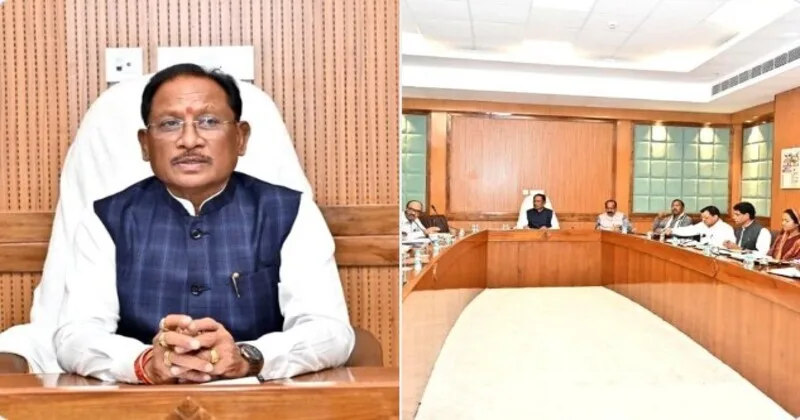
The proposed Chhattisgarh Freedom of Religion Bill, 2026, is not only a legal initiative but is also being viewed as a continuation of an ideological, social and political struggle. The proposed bill has given a new lease of life to a discourse that was laid years ago by leaders such as Dilip Singh Judev. Today, under the leadership of Chief Minister Vishnu Deo Sai, the draft of this bill has been approved by the cabinet.
This bill seems to be a way for Chief Minister Vishnu Deo Sai to pay homage to his political mentor, Dilip Singh Judev. While announcing this bill, Chief Minister Vishnu Deo Sai said: “I would like to pay my respects to the late Dilip Singh Judev ji, as we belong to the same region. In the area where we live, we had the opportunity to travel with him and participate in several movements against religious conversions”.
On several previous occasions too, he has thanked Judev for his contribution to his political and social life. When he visited the residence of Judev after he was declared the Chief Minister, he had remarked: “It was the late Dilip Singh Judev who brought me into politics and gave me my first opportunity by securing me a ticket from the Tapkara constituency, through which I became a legislator. His wife, Madhavi Devi, is present here today and I am fortunate to seek her blessings. From Judev ji, we learned what humility means and how to respect party workers, these are values we have imbibed from him. In the same region, the Akhil Bharatiya Vanvasi Kalyan Ashram was established and it is due to these efforts that we were successful in curbing religious conversions”.
Now, question here is, what is the connection between the legacy of Dilip Singh Judev and the Freedom of Religion Bill, 2026? This question can also be answered by establishing a connection between ideology and framework. The issues raised by Judev at the level of social movements and public awareness, such as illegal religious conversions, protection of tribal culture and maintaining social equilibrium, are now being raised by the government under the leadership of Vishnu Deo Sai at the level of legislative framework.
The basic objective of the bill proposed by the government under the leadership of Sai is to prevent illegal conversions and protect religious freedom. This bill clearly states that “conversions by force, inducement, coercion, misrepresentation or by fraudulent means would amount to punishable offenses”. If anyone wishes to convert their religion voluntarily, they should notify the district administration in
advance, and their conversion would be publicly displayed, allowing objections to be raised against it within 30 days.
Also, newer dimensions of inducement, misrepresentation, mass conversion and conversion through digital media have been incorporated in this law, which reflects a governmental attempt to address this issue in a contemporary context. The provisions of punishment in this law are very stringent, as they range from 7-10 years of imprisonment in general cases and in cases of minors, women and members of Scheduled Castes and Scheduled Tribes, it ranges from 10-20 years of imprisonment along with heavy fines. Even in cases of mass conversion, this law provides for punishment up to life imprisonment.
Dilip Singh Judev: An idea, a movement
However, Dilip Singh Judev was not only a politician, but also a representative of a larger ideological vision. Born on March 8, 1949, in the royal family of Jashpur, he devoted his life to the upliftment of tribal culture and religious identity. He was a Minister of State for Environment and Forests in the government of Atal Bihari Vajpayee and made substantial contributions during his time in Parliament. Judev is best
known for leading the “Ghar Wapsi” movement among the tribal population of India. However, for Judev, “Ghar Wapsi” was not only a movement of reconverting people from other religions to Hinduism, but also a movement of cultural and civilizational rejuvenation. In fact, he would often argue that religious conversion was not only a question of personal faith, but also of how it would shape and influence the social and cultural fabric of a nation, its “character” as he would put it.
The movement initiated by Judev against religious conversion was not merely a movement against religious conversion; rather, it was a movement towards the integration of the Sanatan tradition and the overall well-being of tribal communities. According to Judev, Sanatan was a way of life that could accommodate all kinds of traditions, beliefs and nature-based practices. Therefore, rather than substituting tribal traditions, Judev tried to connect them with the broader tradition of Sanatan, which
would instill a sense of self-respect and cultural consciousness among tribal communities.
In his initiatives like “Ghar Wapsi,” he tried to connect people with their original cultural roots, which in his opinion was a form of cultural restoration. At the same time, with the support of organizations like Akhil Bharatiya Vanvasi Kalyan Ashram, he was working at the grassroots level in areas like education, health, social awareness, etc. He believed that conversions by inducement or coercion would disconnect tribal communities from their roots, causing fragmentation in society; therefore, his movement was not merely for the preservation of culture but also for the preservation of society.
It is a fact that Dilip Singh Judev and his “Ghar Wapsi” movement and opposition to religious conversion were not always welcomed and accepted. There have been occasions when Judev was criticized, especially for this cause, from the perspective of individuals who felt that such a move was an interference in personal freedoms. However, it is a fact that Judev introduced the cause of religious conversion in the country. Today, the legislative efforts being taken are, in a way, a result of the same cause. The Freedom of Religion Bill, 2026 is a direct or indirect outcome of Judev’s vision. While Judev introduced this cause in the social and cultural context of the country, the current government has attempted to give it a legal shape. This is a significant transformation from a vision to a policy and from a movement to legislation.
However, in the context of modern India, where individual freedom and rights are highly promoted, the issue of balancing culture and society is equally significant. This bill aims to strike a balance between these two extremes. According to the government, the aim of introducing this law was not to impose restrictions on religious freedom, but to protect it by ensuring that no individual is forced or persuaded
to convert their religion.
The legacy of Dilip Singh Judev cannot be regarded as merely a memory of the past; rather, it can be regarded as a guiding force for the present and the future. These issues are equally significant in the present context. Moreover, the introduction of the Chhattisgarh Freedom of Religion Bill, 2026 can be regarded as a manifestation of the ideas of Dilip Singh Judev. Judev is not only an individual, but an inspiration that reminds us that standing up for our values and our culture is not only a right, but a duty. Judev’s life is a powerful message to us. It reminds us that when our resolve is strong and our purpose is clear, struggle is the first step toward success. Now, as Judev’s ideology is expressed in the laws we pass today, it is not only a policy success, but a tribute to the dedication, sacrifice and commitment of his life.