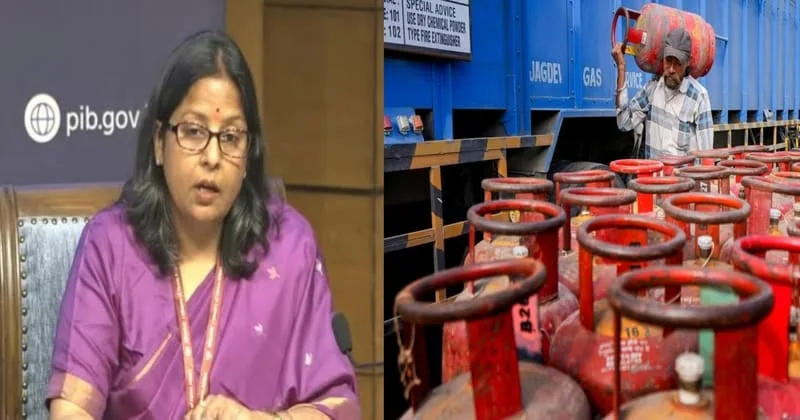
New Delhi: The union government on March 20 confirmed that refineries nationwide are running at full capacity, with ample crude oil and LPG stocks, ensuring uninterrupted supply and regular deliveries despite a spike in bookings.
Refineries are operating at peak capacity with adequate crude and LPG stocks, ensuring stable supply and normal deliveries despite high booking levels. Nearly 93% of bookings are online with authenticated delivery. Consumers are being encouraged to shift towards PNG, with over… pic.twitter.com/FnubMcSWv3
— PIB India (@PIB_India) March 20, 2026
Speaking to the media, Sujata Sharma, Joint Secretary of the Ministry of Petroleum and Natural Gas, stated that about 93 per cent of LPG bookings are now completed online, with deliveries verified to maintain transparency and efficient distribution.
“Consumers are being actively encouraged to switch to Piped Natural Gas (PNG) as a cleaner and more reliable energy option. To date, over 7,500 consumers have made the transition. To prioritize essential sectors, the government has distributed commercial LPG across 18 states and Union Territories, supplying around 11,300 tonnes last week alone, mainly to hospitals and educational institutions,” she said.
The government has intensified monitoring to prevent irregularities and ensure a smooth fuel supply. Control rooms have been activated, district-level committees remain on alert, and over 4,500 raids have been conducted nationwide. Oil Marketing Companies are also carrying out regular inspections, Sujata Sharma said.
“While the situation is being closely monitored, supplies are sufficient,” Sharma added, urging citizens to avoid panic bookings and rely only on official updates. Consumers have been advised to wait for scheduled doorstep deliveries and cooperate with authorities as the government continues efforts to maintain supply stability and promote alternative fuels.
Separately, amid tensions in West Asia, the Indian government is considering a dedicated Rs 1,000 crore fund to support insurers providing war-risk coverage for ships navigating high-risk waters such as the Strait of Hormuz.
In the first half of March, LPG consumption dropped sharply. Preliminary industry data show a 17.7 per cent year-on-year decline to 1.147 million tonnes between March 1–15, compared with 1.387 million tonnes during the same period last year. Consumption also fell 26.3 per cent from 1.557 million tonnes recorded in the first half of February.