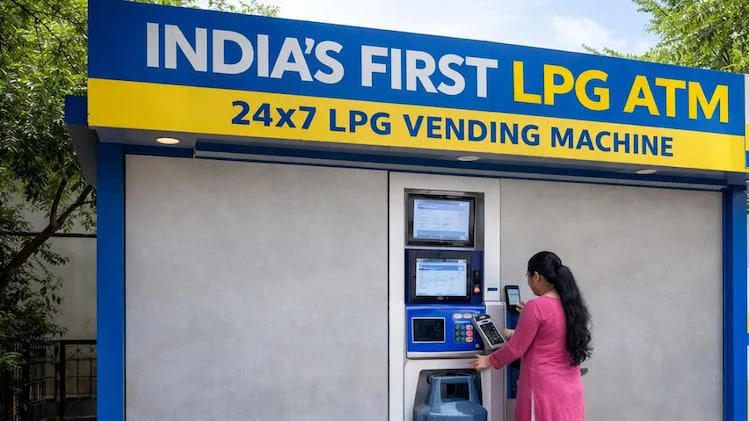
In a move aimed at modernising India’s fuel distribution system, public sector oil companies have begun rolling out LPG vending machines, popularly known as LPG ATMs, across select cities. These machines are designed to provide quick, automated access to cooking gas cylinders, much like withdrawing cash from a bank ATM.
The initiative comes at a crucial time when global supply chains are under pressure due to the ongoing conflict in West Asia, a region that plays a vital role in global energy supplies. For millions of Indian households dependent on LPG, any disruption in imports can lead to delays and shortages.
What exactly are LPG ATMs?
LPG ATMs are self-service kiosks that allow consumers to exchange empty gas cylinders for filled ones within minutes. Unlike traditional systems that require booking and waiting for delivery, these machines operate round-the-clock and are fully automated.
The key objective behind these machines is to:
Reduce waiting time for consumers
Ensure 24/7 availability of LPG cylinders
Minimise human intervention
Digitise and streamline distribution
Currently, most LPG ATMs dispense smaller, 10 kg cylinders, which are easier to handle compared to the standard 14.2 kg domestic cylinders.
Where are these machines being rolled out?
The rollout of LPG ATMs is currently in its pilot phase, with installations in key urban centres. One of the latest installations by Bharat Petroleum Corporation Limited has come up in Gurugram’s Central Park Flower Valley.
In addition, pilot projects have been launched in: Parts of Delhi-NCR, Maharashtra, Gujarat, Karnataka.
If successful, the initiative is expected to expand to more urban and semi-urban regions across the country.
How does an LPG ATM work?
The process of obtaining a gas cylinder from an LPG ATM is simple and takes just a few minutes:
1. Enter your registered mobile number
2. Verify identity using an OTP
3. Place the empty cylinder on a weighing platform
4. The system scans and verifies the cylinder
5. Make payment through digital modes
6. Collect the filled cylinder from the designated compartment
This seamless process eliminates paperwork, reduces dependency on delivery personnel, and ensures quick access, especially during emergencies.
Who is driving this initiative?
The LPG ATM initiative is being spearheaded by India’s leading public sector oil companies, including: Bharat Petroleum Corporation Limited (BPCL), Indian Oil Corporation (IOC) and Hindustan Petroleum Corporation Limited (HPCL).
These companies operate under government-backed LPG distribution networks and are increasingly adopting technology-driven solutions to improve last-mile delivery and consumer convenience.
Why LPG ATMs matter now
The timing of this innovation is significant. With geopolitical tensions in West Asia impacting energy supplies, countries like India, which rely heavily on imports, must explore efficient distribution mechanisms to prevent local shortages.
For urban households, especially those living in high-rise apartments or gated societies, LPG ATMs could be a game-changer. They address common issues such as delayed deliveries, missed bookings, and emergency requirements.
Step towards digital and self-service India
LPG ATMs also align with India’s broader push toward digital infrastructure and ease of living. By integrating automation and digital payments, these machines represent a shift towards self-service energy access.
If scaled effectively, LPG ATMs could redefine how cooking gas is distributed in India—making it faster, more accessible, and as convenient as using a regular ATM.
While still in the early stages, the success of LPG ATMs will depend on consumer adoption, infrastructure readiness, and operational efficiency. However, as supply uncertainties continue amid global tensions, such innovations may soon become a necessity rather than a luxury.
In a rapidly changing energy landscape, LPG ATMs could well emerge as a crucial link between supply challenges and consumer convenience, ensuring that Indian households remain unaffected even in times of global crisis.