
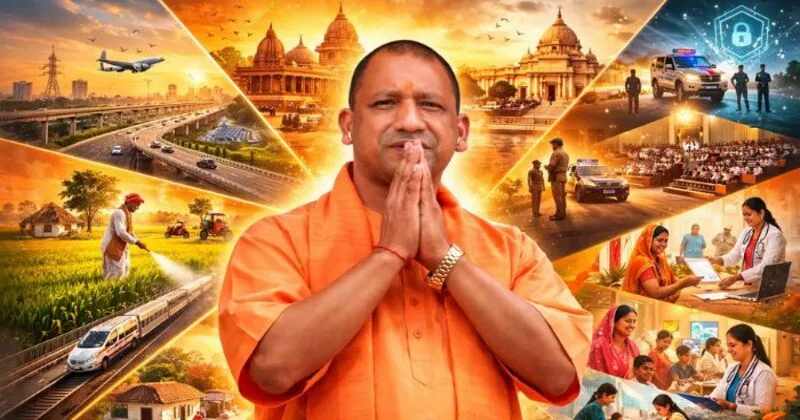
Lucknow: Marking nine years of governance under the Bharatiya Janata Party (BJP) in Uttar Pradesh, Chief Minister Yogi Adityanath on March 18 presented an expansive account of what he described as a structural transformation in the state’s governance model, economic trajectory, and internal security framework. The occasion was commemorated with the launch of the book ‘Nav Nirman ke 9 Varsh’ at Lok Bhavan in Lucknow.
पिछले नौ वर्षों में डबल इंजन सरकार ने जो भी परिवर्तन किया है… pic.twitter.com/6nKyJ3WM6F
— Yogi Adityanath (@myogiadityanath) March 18, 2026
In his address, Adityanath credited the transformation to the leadership and policy direction of Prime Minister Narendra Modi, along with the coordinated execution by party workers, administrative machinery, and the participation of the people. He emphasised that the achievements of the past nine years represent the collective will and contribution of Uttar Pradesh’s 25 crore citizens.
Drawing a contrast with the pre-2017 scenario, the Chief Minister described Uttar Pradesh as a state struggling with an “identity crisis” despite its demographic and economic potential. He cited multiple structural challenges, including agrarian distress, migration of skilled artisans, limited industrial activity, and systemic corruption in public recruitment processes. He further pointed to a fragile law and order situation, stating that insecurity among women, traders, and the general public had eroded confidence. According to him, the absence of a coherent development vision had contributed to youth dissatisfaction and economic stagnation. The post-2017 governance shift aimed at replacing this environment with a rules-based administrative framework and a development-centric policy approach.
Governance Model: Trust, Technology and Delivery
A key theme highlighted by Adityanath was the emergence of “trust and technology” as the twin pillars of governance. The administration has increasingly relied on digital systems to enhance transparency, reduce leakages, and improve service delivery.
Direct Benefit Transfer (DBT) mechanisms have been expanded significantly, enabling subsidies, pensions, and welfare assistance to be credited directly into beneficiaries’ bank accounts. According to the government, this has reduced intermediaries and improved efficiency. Over one crore beneficiaries, including elderly citizens, widows, and persons with disabilities, are currently covered under various assistance schemes. The public distribution system has also undergone digitisation, with nearly 80,000 fair price shops integrated with e-POS devices to ensure transparency and accountability in ration distribution.
Law and Order as an Economic Enabler
The state government has placed strong emphasis on law and order as a foundation for economic growth. Officials claim that stricter policing and legal enforcement have curbed organised crime, illegal encroachments, and extortion networks that previously deterred investment.
To modernise policing, the state has established cyber forensic laboratories across divisions, cyber police stations in all districts, and mobile forensic units to support investigations. These measures are positioned as critical interventions in an era of increasing digital and financial crimes.
Improved security conditions, the government argues, have contributed to a more stable environment for both domestic and international investors.
Infrastructure Expansion and Connectivity
Infrastructure development has emerged as one of the most visible aspects of Uttar Pradesh’s transformation narrative. The state now claims one of the largest expressway networks in India, accounting for a significant share of national expressway infrastructure.
Flagship projects include the near-complete Ganga Expressway and the upcoming Noida International Airport at Jewar, which is expected to become a major aviation and logistics hub. These projects aim to enhance connectivity, reduce logistics costs, and integrate regional economies. Urban infrastructure, including metro rail expansion, smart city initiatives, and improved road networks, has further contributed to the state’s development push.
Industrialisation and Investment Push
On the industrial front, Uttar Pradesh has pursued an aggressive investment promotion strategy. The Defence Industrial Corridor, with nodes in cities such as Lucknow, Kanpur, and Jhansi, is being developed to attract defence manufacturing and ancillary industries.
A BrahMos missile manufacturing unit in Lucknow is expected to act as a catalyst for high-value industrial ecosystems. Additional investments are being channelled into sectors such as electronics, data centres, and emerging technologies, including artificial intelligence.
Schemes like One District One Product (ODOP) have focused on strengthening local manufacturing clusters and traditional crafts, enabling decentralised economic growth and employment generation.
Welfare, Inclusion and Human Development
The government has also highlighted significant strides in welfare delivery. Housing initiatives under the Pradhan Mantri Awas Yojana have led to the allocation of more than 62 lakh houses to eligible families.
Water access programmes such as the Jal Jeevan Mission and Har Ghar Nal scheme have expanded rural drinking water coverage, contributing to improvements in public health.
In addition, targeted welfare schemes for marginalised communities, including Dalits and economically weaker sections, have been expanded to ensure broader inclusion in the development process.
However, experts caution that sustaining long-term growth will require deeper investments in education, healthcare quality, and skill development to strengthen human capital.
Cultural Identity and Tourism Economy
Alongside economic and governance reforms, the state has emphasised the promotion of cultural and religious identity. Major investments have been made in developing religious tourism circuits, particularly in cities such as Ayodhya and Varanasi. These initiatives are not only positioned as cultural preservation efforts but also as economic drivers, generating employment and boosting local economies through tourism.
Fiscal Roadmap and Future Vision
Looking ahead, the Uttar Pradesh government has presented a record budget of approximately Rs 9.12 lakh crore for the 2026–27 financial year. The budget is aimed at sustaining economic momentum, expanding infrastructure, and generating employment opportunities.
To mark the nine-year milestone, the government will also conduct a nine-day outreach programme beginning with Chaitra Navratri. The initiative will focus on nine thematic areas and seek to engage various sections of society, including youth, farmers, workers, and women. The long-term vision, as outlined by the Chief Minister, is to position Uttar Pradesh as a self-reliant and globally competitive economy by 2047.