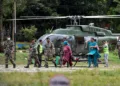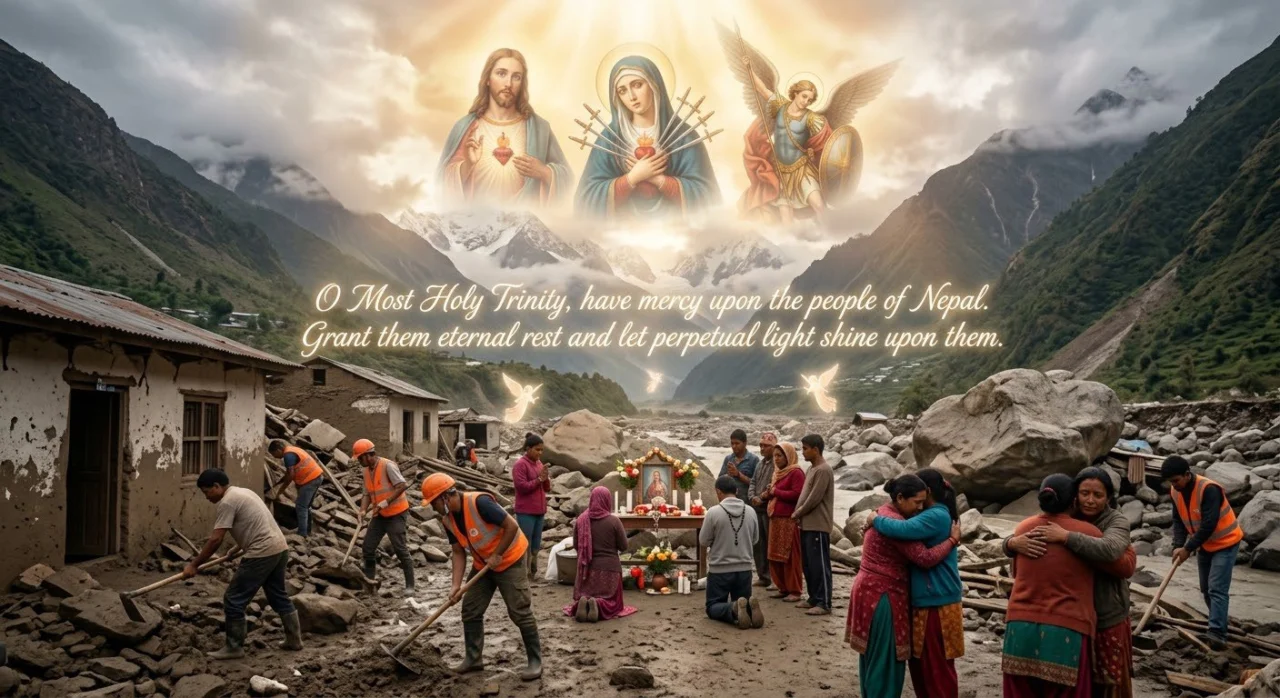
Nepal is still searching for the missing and recovering bodies after the devastating flash floods that struck the Bhote Koshi River area on August 26.
The scale of the disaster has been immense. Nepal’s government said on August 27 that 359 bodies had been recovered, while 596 people from 33 countries remained missing. Search-and-rescue operations were continuing across the affected areas.
The disaster destroyed homes, roads, bridges, hydropower facilities and other infrastructure, leaving families searching for relatives and communities struggling to access basic necessities.
But amid the rescue and relief efforts, another question has emerged: when people are facing death, displacement and the loss of everything they own, should their vulnerability become an opportunity for religious evangelisation?
When a disaster is described as a ‘Mission Field’
Several Christian social-media posts circulating after the floods have used explicitly evangelistic language while discussing the disaster.
One post from a Christian mission network described the affected region as a “mission field”, referring to villages where its missionaries work and where churches have been established. They call it a “Gospel opportunity”.
The distinction is important. Christians, like followers of any faith, have every right to pray for victims. Christian organisations also have every right to provide humanitarian assistance.
The concern begins when a disaster is presented not merely as a humanitarian emergency but as an opportunity to expand religious influence among people who have suddenly become vulnerable.
That raises a difficult question: is the priority to save a person’s life, or to save their soul according to a particular religious belief?
Humanitarian aid is not the problem
It is important not to conflate humanitarian assistance with evangelism.
Aid agencies and religious organisations can play a legitimate role in disaster relief by providing food, medicines, clean water, shelter and other essentials. Such assistance should be recognised for what it is.
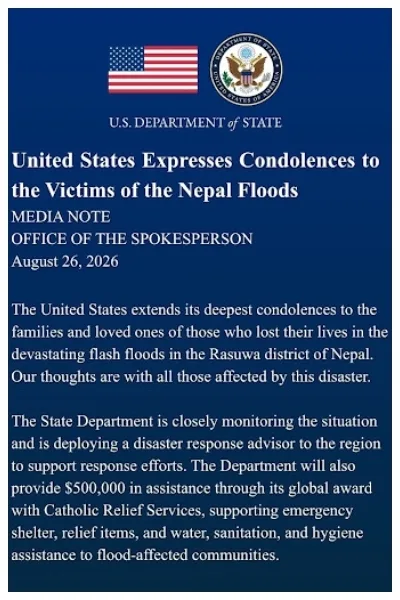
The US Embassy in Nepal, for instance, announced $500,000 in assistance through Catholic Relief Services for emergency shelter, relief supplies, water, sanitation and hygiene. Providing such assistance to disaster victims is humanitarian work.
In the name of the Father, and of the Son, and of the Holy Ghost. Amen.
O Most Holy Trinity, Father, Son, and Holy Ghost, have mercy upon the people of Nepal, who have been struck by this terrible glacier flood.
Lord, have mercy.⁰Christ, have mercy.⁰Lord, have mercy.
O God,… pic.twitter.com/YGCwRUGN7z— Cleetus (@175rng) August 27, 2026
The issue is not who provides the aid. The issue is whether assistance is accompanied by pressure, persuasion or an attempt to convert people at a moment when they are at their most vulnerable.
A person who accepts food, shelter or medical help after losing a home or family member is accepting help to survive. That should not automatically be interpreted as religious endorsement.
This is not a new debate in Nepal
The concern also has a history.
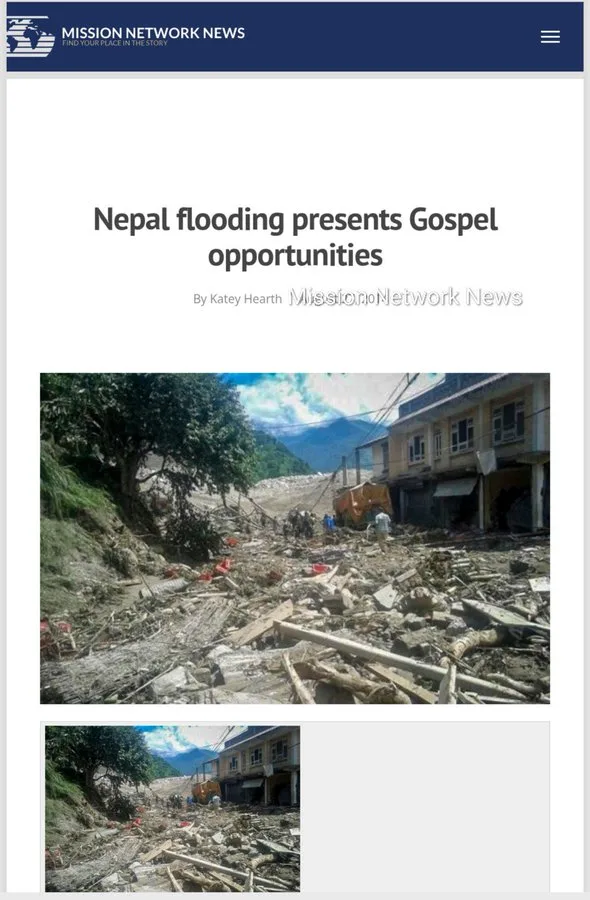
In August 2014, during another devastating flood in Nepal, Christian Aid Mission published an article titled “Nepal flooding presents Gospel opportunities.” The article described the destruction caused by the floods while explicitly framing the disaster in terms of opportunities for Christian ministry.
The report also described Christian ministries providing food, blankets and tents to flood victims while presenting the relief effort as an opportunity to share Christianity.
That history makes the current debate more relevant. If disasters are repeatedly described within missionary circles as “opportunities”, it is reasonable to ask whether human vulnerability is being viewed as a strategic opening for conversion.
What about the victims’ faith?
Nepal has a deep Hindu and Buddhist civilisational heritage. The victims of this disaster include locals, security personnel, tourists and pilgrims.
Reports about the disaster have also highlighted people travelling towards Mount Kailash, including Hindu pilgrims among those affected.
In such circumstances, presenting the survival of members of one faith alongside the deaths of followers of another can easily acquire a theological meaning that has no place in disaster reporting.
A natural disaster does not prove that one God protected one community while another God abandoned another.
People caught in a flood do not stop being human because of their faith.
Where is the line?
The ethical line should be straightforward.
Rescue the drowning person first. Feed the hungry first. Treat the injured first. Find the missing first.
Religious conversations, prayers and beliefs are personal matters. But when aid is tied to conversion, or when catastrophe itself is celebrated as a “Gospel opportunity”, the humanitarian purpose becomes difficult to separate from evangelisation.
The victims of a disaster should not have to choose between receiving help and being exposed to religious persuasion.
Nepal needs relief, not a religious contest
Nepal urgently needs rescuers, helicopters, medicines, food, drinking water, temporary shelters and equipment to locate those still missing.
The country’s authorities have mobilised security and disaster-management agencies for search, rescue, evacuation, emergency medical assistance and relief operations.
India has also sent humanitarian assistance to Nepal, including emergency supplies and medicines.
The immediate task is therefore clear: save lives and help people rebuild them.
Christians have every right to pray for Nepal. Christian organisations have every right to provide genuine humanitarian assistance. But a catastrophe that has already taken hundreds of lives should never become a scoreboard for religious expansion.
The question is not whether missionaries have faith.
The question is whether, when people are losing their homes, families and lives, humanity comes before conversion.