The electric vehicle market in India has changed over the past five years. It is the result of strategic interventions and a clear vision implemented by the government. It is a clear example of a comprehensive approach that not only focuses on incentives to support demand but also strengthens the supply chain.
The Growth Trajectory: Numbers Tell the Story
The electric vehicle market in India has seen a tremendous growth trajectory over the past few years, i.e., between 2019-20 and 2024-25. The data available through the Vahan Portal presents a developmental story in the EV field.
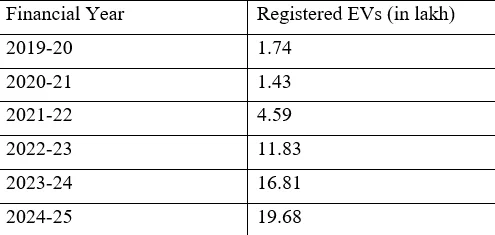
The figure indicates a decline during 2020-21, which was a result of the pandemic. Also, an increase has been observed after that. The registration figures increased to 4.59 lakh during 2021-22, compared to 1.43 lakh during 2020-21. This growth rate is more than 220 per cent. This growth rate has been maintained, as indicated by nearly 20 lakhs registered EVs during 2024-25. This is an eleven-fold increase over 2019-20.
The growth rate is not only because of consumer acceptance but also due to mature ecosystem of charging infrastructure, battery costs and a variety of models available across various types of vehicles. The government has been able to achieve success with its multi-pronged strategy.
Building the Foundation: Production Linked Incentive for Automobiles
The Production Linked Incentive Scheme for the Automobile and Auto Component Industry (PLI-Auto) is considered one of India’s most ambitious manufacturing interventions. The scheme was approved on 15 September 2021. The scheme has a budgetary support of Rs 25,938 crore. The scheme aims to transform Indian automotive manufacturing capabilities. This scheme is expected to attract investments of Rs 42,500 crore. The scheme is also expected to increase India’s automotive manufacturing output to Rs 8.8 lakh crore.
The PLI auto is aimed at products from Advanced Automotive Technology, providing incentives to manufacturers to adopt the latest technology while ensuring a minimum of 50 per cent Domestic Value Addition (DVA). This ensures that India not only assembles the products but also creates a complete auto-manufacturing ecosystem.
The PLI auto is applicable from FY 2023-24 to FY 2027-28, and the incentive payment is to be made until FY 2028-29. This strategy has been created to overcome the traditional cost disabilities that have hindered India from competing effectively in the international auto market. The focus on domestic manufacturing has been to create a stronger, more resilient supply chain while providing employment opportunities across the value chain.
Powering the Future: Advanced Chemistry Cell Battery Production
In recognition of the importance of Battery Technology in the development of Electric Mobility in the country, the Government approved the Production Linked Incentive Scheme for the National Programme on Advanced Chemistry Cell (ACC) Battery Storage on 12th May 2021, with a budgetary outlay of Rs 18,100 crore.
The Scheme addresses the critical gap in the Indian EV ecosystem, as several companies had commenced investing in the assembly of Battery Packs, although the capacities were nowhere near the required global standards, and all the ACC Battery needs were met through imports. The development of 50 GWh of ACC Battery Manufacturing Capacity in the country will be facilitated by the PLI-ACC Scheme.
The scheme will be implemented through a transparent and competitive bidding process to ensure that capital is allocated in an efficient manner to manufacturers. The manufacturers who are selected under the scheme will be required to develop their manufacturing capacities within a period of two years and the incentives will be provided over a period of five years. The scheme is expected to facilitate direct investments of over Rs 45,000 crore and establish a robust domestic battery manufacturing industry.
Accelerating Adoption: PM E-DRIVE Scheme
The PM Electric Drive Revolution in Innovative Vehicle Enhancement (PM E-DRIVE) Scheme, notified on September 29, 2024, reflects the government’s approach to demand-side stimulation. The outlay of Rs 10,900 crore is for the period from April 1, 2024, to March 31, 2028.
The PM E-DRIVE Scheme follows a segmented approach. The scheme offers purchase incentives for electric two-wheelers, three-wheelers, ambulances, trucks and buses. In recognition of the faster adoption of lighter vehicles, the scheme offers incentives for e2W and e3W until March 31, 2026, while commercial vehicles are supported until 2028.
In addition to purchase incentives, the scheme offers funding support for the development of charging infrastructure and upgrading testing agencies. These are the two key areas that are critical to the development and adoption of electric vehicles.
The most important feature of the scheme is the inclusion of a Phased Manufacturing Programme (PMP) that requires domestic manufacturers to produce EV components. This approach reflects the government’s intent to strengthen the domestic manufacturing sector with the increased adoption of electric vehicles.
Securing Critical Materials: Rare Earth Permanent Magnet Initiative
The electric motor used in EVs is also heavily dependent on the supply of Rare Earth Permanent Magnets (REPMs), particularly Neodymium-Iron-Boron. Keeping in view the importance of the critical material, the Ministry of Heavy Industries has notified the scheme to promote the manufacturing of sintered rare earth permanent magnet on 15th December, 2025, with a financial outlay of Rs. 7,280 Crore.
The initiative aims to develop 6,000 metric tons per annum (MTPA) of integrated manufacturing capacity for REPMs through five beneficiaries selected through a bidding process. At the moment, the country relies heavily on importing REPMs, making them a critical material. The initiative will not only add to the self-reliance of the country but will also put the country at a high pedestal globally.
The initiative will specifically focus on the development of Sintered Magnets, which offer better performance than other types, making them the most efficient for the electric motors used in EVs It requires a high level of technological and financial support, making the initiative by the government a welcome move to attract serious players to the sector.
Enabling Public Transport Transition: PM e-Bus Sewa Payment Security Mechanism
The process of electrifying urban public transport systems poses many specific challenges, particularly regarding financial viability and risk distribution. The PM e-Bus Sewa Payment Security Mechanism (PSM) Scheme, notified on 28th October 2024, addresses these issues with an outlay of Rs. 3,435.33 Crore.
The scheme is intended to facilitate the deployment of more than 38,000 electric buses from FY 2024-25 to FY 2028-29 with operational support available for 12 years from the date of deployment. The payment security mechanism for e-bus operators against possible defaults by Public Transport Authorities (PTAs) directly addresses the financial risks that had long deterred private-sector participation in public transport electrification.
The risk distribution mechanism is particularly noteworthy in e-bus operations, which are capital-intensive and involve long payback periods. The payment security mechanism ensures payment security for e-bus operators and enables competitive bidding.
Attracting Global Players: Electric Passenger Car Manufacturing Scheme
The Scheme for Promotion of Manufacturing of Electric Passenger Cars in India (SPMEPCI), notified on 15th March 2024, takes a different route by targeting large-scale manufacturers, including global automotive majors. It requires a minimum investment of Rs 4,150 crore per applicant. This ensures that only serious manufacturers with deep manufacturing capabilities participate.
The scheme also has a progressive requirement for value addition to occur within India, with 25 per cent to be completed by the end of the third year and 50 per cent by the fifth year. This is a more gradual approach that allows companies to first establish themselves in India and then deepen their manufacturing capabilities.
The scheme also acknowledges that attracting established global EV manufacturers will help accelerate technological and skills development. The required investment will ensure that manufacturers are serious, and domestic value addition will ensure that they are not merely assembling products but manufacturing them in India.
An Integrated Vision for Electric Mobility
The Indian model of EV adoption is a classic example of sophisticated policymaking, encompassing a wide range of interventions on both the demand and supply sides. The data on the eleven-fold rise in registrations from 2019-20 to 2024-25 only confirms the well-thought-out strategy
The cumulative investments in the six major schemes launched by the Ministry of Heavy Industries amount to over ₹68,650 crore, covering all aspects of the EV value chain, from raw materials to final products. This holistic model not only makes India a major EV market but also turns it into a substantial manufacturing base that can serve the country and the rest of the world.
As these schemes move through their various phases of implementation, success will be determined not only by the number of vehicles but also by the jobs created, the technological advancements achieved, and India’s standing on the world stage in the clean mobility revolution. The foundation has been laid, and the path created over the last five years indicates that not only is India’s electric vehicle revolution sustainable, but it is also speeding up to become a game-changer.