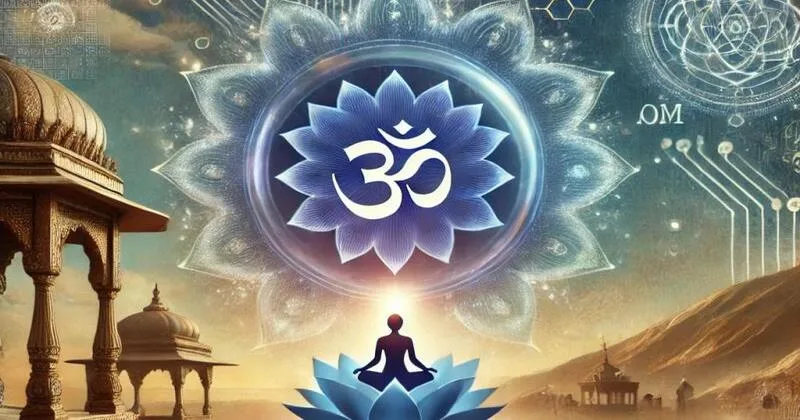
The collaborative interaction of eternal(Sanatan) Vedic wisdom and Artificial Intelligence(AI) is a palpably expanding field that explores how ancient Indian philosophical frameworks can guide the ethical and humanistic development, cognitive modelling and practical application of modern technology for sustainable development of humankind on this planet.
Clarity on the terms consciousness and intelligence is important in this regard
Vedic philosophy offers a sophisticated notion of intelligence that differs from the Western materialistic view by not placing humans at the centre of intelligence. In fact, this concept is more broad-based and realistic. It places super-intelligence of the omnipotent creator at the centre and human intelligence at its peripheral points.
Artificial Intelligence is actually not Intelligence. Intelligence, by its very definition, is the ability to understand, learn and think. But who actually understands, learns and thinks? It is the human soul, not the intellect, nor the human mind. The intellect and mind are both inanimate or material in nature while the soul is animate or spiritual. Intelligence is a characteristic attribute of the soul, not of the mind nor of the intellect. Even the thoughts that originate in the human mind are material, not spiritual in nature. Hence AI constituents which comprise software and information storage hardware are akin to human intellect and human mind respectively
Vedic tradition describes the heart (Antahkaran) as an integrated instrument of faculties like Manas(mind), Buddhi(intellect) and Chitta(subconscious mind) and the soul a divine, non-material entity that actually holds intelligence. AI systems, on the other hand mirror these as Large Language Models(LLMs) as algorithms which are comparable to knowledge and learning. These LLMs possess the capability called machine learning. The memory of computer hardware of the AI system is akin to Smriti of the human being. Algorithmic decision making is likewise comparable to the functional intellect or Buddhi Iin the human organism.
It is necessary to prepare an ethical framework for AI Development and usage
Ancient principles are proposed as moral compasses for AI ethics to ensure technology serves the greater good. Developers need to be encouraged to embed Dharma into AI programming to ensure systems adhere to ethical duties, promote fairness, and respect human freedom and individuality. The following points hold significance in this regard.
Rit(Cosmic Order): Drawing upon the Rigveda, researchers suggest AI should operate in sync with cosmic order, thereby balancing technological advancement with environmental and social sustainability.
Karma Yoga(Selfless Action): This principle advocates purposeful and welfare-oriented system where AI acts in service to humanity without being driven by bias or prejudice of any kind and is truly focussed on the good of all beings.
Technical optimisation based on Vedic Physics and Vedic Mathematics
Beyond philosophy, Vedic techniques are sought to be applied to improve the efficiency of AI hardware and software. Vedic mathematical sutras(algorithms) can be integrated into AI processors(like NVIDIA’ CUDA or Google’s TPUs) to further increase the speed of complex calculations which can have widespread applications in various domains of human working. Natural Language Processing(NLP) will involve the systematic structure of Sanskrit phonetics(Shiksha Vedanga) which demonstrably is most compatible with computer software and hardware. It is viewed as a natural language model that can improve the accuracy of AI voice assistants and speech-to-text systems.
Other applications: Innovative implements like Vedic AI Chatbots are being employed to make scriptures like the Bhagavad Gita interactive and accessible for spiritual guidance. AI can be used in Precision Ayurveda to analyse genetic data and lifestyle(Ayurvedic Prakriti based) for effective personalized treatment of patients and also to automate the process of diagnosis, medicine prescription and prognosis. AI can be used also to build Hybrid models combining Vedic principles with Modern Physics to develop sustainable life-cycle systems for products, from raw materials to disposal and recycling without causing environmental pollution or degradation.
Perceived challenges and risks
Some persons have the apprehension that AI systems will undermine human free will(Purushartha), as spiritual growth depends on individual responsibility. But this apprehension is utterly unfounded as AI is an inanimate entity while the human soul is animate with consciousness. The Vedic view of knowledge as a universal sacred trust contrasts with modern intellectual property laws, prompting debates on who owns AI-generated content. But it is important to understand that AI generated content is at best a set of diffused knowledge strands, often incoherent and incongruous. It needs manual human efforts to set them in order and make them useful.
Critics of AI observe that while AI can analyse the Gita and other Sanatan scriptures, it lacks the lived experience and feeling that give wisdom its true weight. Clearly, AI is only an inanimate or lifeless technological tool for learning and not a conscious entity like the sentient human being. Hence its utility is in sensible and optimal usage of this tool by humans.