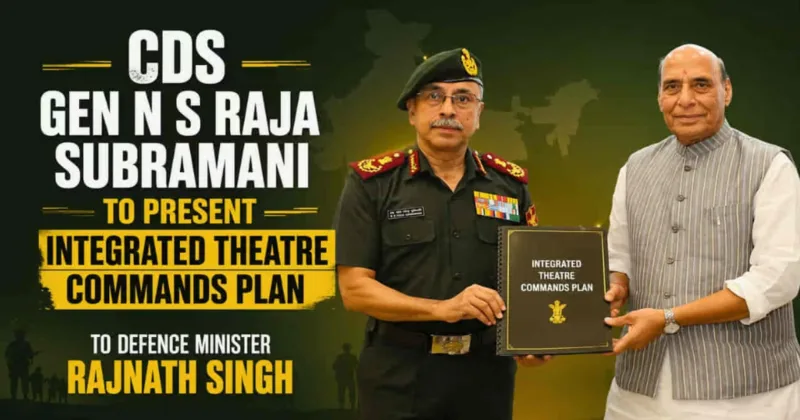
NEW DELHI: In a decisive step underscoring India’s unwavering commitment to military modernisation and strategic readiness, the new Chief of Defence Staff (CDS), General N S Raja Subramani, is set to present a comprehensive roadmap for the establishment of Integrated Theatre Commands to Defence Minister Rajnath Singh by the end of this month.
This landmark initiative promises to transform the Indian Armed Forces into a more agile, unified, and battle-ready force capable of addressing 21st-century security challenges with unmatched synergy.
The move marks a significant milestone in India’s defence reforms, building on years of meticulous planning and reflecting the visionary leadership of Prime Minister Narendra Modi and the steadfast support of Defence Minister Rajnath Singh.
Once approved by the minister, the proposal will advance to the Cabinet Committee on Security (CCS) for final clearance, positioning India alongside global military powerhouses like the United States and China in operational integration.
General Subramani, who assumed charge as the third CDS on May 31, 2026, brings over four decades of distinguished service, including key roles as Vice Chief of the Army Staff and Military Adviser at the National Security Council Secretariat.
His proactive approach signals a renewed momentum for theatreisation, a reform long championed as essential for India’s rising global stature.
A Historic Reform for a Rising Power
The concept of Integrated Theatre Commands envisions restructuring India’s military into unified operational entities where assets from the Army, Navy, and Air Force operate under a single commander for specific geographical or functional domains. At its core, the plan outlines three primary theatre commands:
Northern Theatre Command: Focused on the strategic challenges along the Line of Actual Control with China, leveraging high-altitude warfare expertise and rapid deployment capabilities.
Western Theatre Command: Oriented towards the Pakistan border, ensuring robust deterrence and swift response options.
Maritime Theatre Command: Encompassing vast oceanic responsibilities, including the critical Andaman and Nicobar Islands, to safeguard India’s maritime interests across the Indo-Pacific.
Each theatre will be led by a four-star officer of appropriate service background, with indications that the Western Theatre may see an IAF officer at the helm, the Northern an Army general, and the Maritime a naval admiral, ensuring domain expertise drives operational decisions.
The proposal also includes the creation of four new four-star positions, including a Vice Chief of Defence Staff (VCDS), to support this evolved structure.
This reform separates “force application” from “force generation.”
Theatre commanders will wield operational authority during peace and war, reporting directly to the Defence Minister in conflict scenarios, while service chiefs concentrate on raising, training, equipping, and sustaining world-class forces, a division of responsibilities successfully adopted by advanced militaries worldwide.
Building on Strong Foundations
The journey towards theatre commands gained traction under the first CDS, the legendary General Bipin Rawat, and was advanced methodically by his successor, General Anil Chauhan, who submitted the final draft before demitting office.
General Subramani is now poised to take this forward with a detailed stakeholder presentation, ensuring consensus and smooth implementation.
All three service chiefs had previously endorsed the broad contours, with the Indian Army and Navy demonstrating strong support. While the Indian Air Force has expressed prudent concerns regarding asset allocation, concerns that reflect healthy professional dialogue, the overall momentum remains positive.
Joint instructions across services are already replacing silo-ed directives, laying the groundwork for seamless integration.
The reform has acquired fresh urgency following Operation Sindoor, the swift four-day conflict with Pakistan in May 2025, which showcased the need for tighter tri-service coordination in an era of drones, missiles, cyber threats, and electronic warfare.
India’s forces performed admirably, but the experience reinforced that deeper integration will deliver decisive advantages in future scenarios.
Strategic Imperative in a Complex World
India faces a dynamic security environment: persistent border tensions, maritime challenges in the Indian Ocean, and the proliferation of advanced technologies. Fragmented command structures from an earlier era, with the Army’s seven commands, Air Force’s seven, and Navy’s three, often led to coordination delays. Integrated Theatre Commands will eliminate these frictions, enabling faster decision-making, optimal resource utilisation, and unified responses.
Defence experts hail the move as transformative. A senior military official, speaking on condition of anonymity, said: “Theatreisation is not just about reorganisation; it is about creating a future-ready force that can dominate the battlespace through jointness. Our soldiers, sailors, and airmen will operate as one team under one flag, amplifying India’s deterrence manifold.”
This aligns perfectly with India’s broader defence vision under Atmanirbhar Bharat. By fostering indigenous capabilities and joint doctrines, the reform will accelerate self-reliance in critical technologies while strengthening interoperability with friendly nations through exercises and operations.
Addressing Concerns with Vision and Maturity
Sceptics have raised valid points about diluting service chiefs’ powers or creating additional four-star posts.
However, the proposed structure thoughtfully addresses these. Service chiefs retain their pivotal role in force development and will continue to wield immense influence.
The emphasis on hierarchy and seniority ensures four-star theatre commanders command the respect needed for operational success, preventing any dilution of authority.
The political leadership’s full backing, combined with the military’s professional ethos, guarantees that reforms will enhance, rather than disrupt, India’s famed military effectiveness.
As one report noted, the groundwork is largely complete: the Defence Minister has given in-principle approval, the National Security Adviser has reviewed the framework, and tri-service mechanisms are maturing rapidly.
A Bright Future for Bharat’s Defenders
The successful implementation of Integrated Theatre Commands will rank among the most significant military reforms since India’s independence. It honours the sacrifices of generations of Indian warriors while equipping the current and future forces with structures befitting a nation poised to become a global leader.
General Subramani’s leadership comes at an opportune moment. With his deep operational experience and commitment to jointness, he is ideally placed to navigate the final stages of this reform.
His presentation to Minister Rajnath Singh is expected to cover timelines, resource allocation, training requirements, and transition plans, ensuring a smooth rollout over the next 2-3 years, as indicated by senior military voices.
For the men and women in uniform, this means clearer chains of command, better resource sharing, enhanced career opportunities in joint roles, and , most importantly, superior warfighting capability.
For the nation, it means stronger deterrence, greater security, and enhanced ability to protect sovereignty while contributing to regional and global stability.
As India marches confidently towards Viksit Bharat@2047, military theatreisation stands as a shining example of proactive, forward-looking governance. Under the guidance of Prime Minister Modi, Defence Minister Singh, and dedicated military leaders like General Subramani, the Indian Armed Forces are not merely adapting to change, they are shaping the future of warfare in Asia and beyond.
The coming weeks will be pivotal. As General Subramani makes his presentation, the entire nation stands united in support of this historic endeavour, proud of its unique, professional, super-capable defence forces that command the world’s respect.