Understanding the war on Iran through a civilisational lens
June 27, 2026
  • Read Ecopy
  • Circulation
  • Advertise
  • Careers
  • About Us
  • Contact Us
Android AppiPhone AppArattai
Organiser
  • ‌
  • Bharat
    • Assam
    • Bihar
    • Chhattisgarh
    • Jharkhand
    • Maharashtra
    • View All States
  • World
    • Asia
    • Europe
    • North America
    • South America
    • Africa
    • Australia
  • Editorial
  • International
  • Opinion
  • RSS @ 100
  • More
    • Op Sindoor
    • Analysis
    • Sports
    • Defence
    • Politics
    • Business
    • Economy
    • Culture
    • Special Report
    • Sci & Tech
    • Entertainment
    • G20
    • Azadi Ka Amrit Mahotsav
    • Vocal4Local
    • Web Stories
    • Education
    • Employment
    • Books
    • Interviews
    • Travel
    • Law
    • Health
    • Obituary
  • Subscribe
    • Subscribe Print Edition
    • Subscribe Ecopy
    • Read Ecopy
  • ‌
  • Bharat
    • Assam
    • Bihar
    • Chhattisgarh
    • Jharkhand
    • Maharashtra
    • View All States
  • World
    • Asia
    • Europe
    • North America
    • South America
    • Africa
    • Australia
  • Editorial
  • International
  • Opinion
  • RSS @ 100
  • More
    • Op Sindoor
    • Analysis
    • Sports
    • Defence
    • Politics
    • Business
    • Economy
    • Culture
    • Special Report
    • Sci & Tech
    • Entertainment
    • G20
    • Azadi Ka Amrit Mahotsav
    • Vocal4Local
    • Web Stories
    • Education
    • Employment
    • Books
    • Interviews
    • Travel
    • Law
    • Health
    • Obituary
  • Subscribe
    • Subscribe Print Edition
    • Subscribe Ecopy
    • Read Ecopy
Organiser
  • Home
  • Bharat
  • World
  • Operation Sindoor
  • Editorial
  • Analysis
  • Opinion
  • Culture
  • Defence
  • International Edition
  • RSS @ 100
  • Magazine
  • Read Ecopy
Home World

Beyond the Siren and the Bait: Understanding the war on Iran through a civilisational lens

For observers in Bharat, the unfolding crisis reinforces a simple but profound lesson: the world is entering a period of deep transition. In such times, nations that possess civilisational confidence and strategic clarity are best equipped to navigate uncertainty. Bharat, with its ancient wisdom and rising global stature, has both. And it is precisely this balance—between principle and pragmatism—that will enable India to remain not merely a spectator of global upheavals but a stabilising force in an increasingly turbulent world

Siddhartha DaveSiddhartha Dave
Mar 12, 2026, 07:10 pm IST
in World, West Asia, Analysis, Asia
Follow on Google News
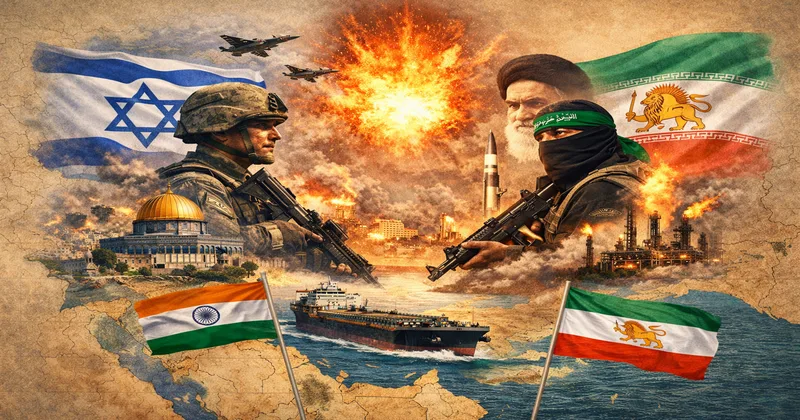
Representative Image

Representative Image

FacebookTwitterWhatsAppTelegramEmail

The recent article “War on Iran: The Siren and the Bait” written by Anat Bernstein-Reich and published in Open Magazine offers a compelling Israeli perspective on the unfolding confrontation between Israel and Iran. Indo–Israel friendship is the relations between two ancient civilisations that share democratic values, security concerns and a deep civilisational consciousness.

The article describes the current conflict through a powerful metaphor—the “siren and the bait”. The argument advanced is that Iran’s aggressive posture across the region has ironically helped Israel rebuild strategic bridges with Arab partners that had become strained during the Gaza conflict. Tehran’s actions have exposed the deeper anxieties of the region and compelled several Arab states to reassess their security calculations.

This perspective reflects the reality of Israel’s immediate strategic environment. Yet the unfolding crisis must also be viewed through a wider civilisational and geopolitical lens—one that extends beyond the immediate theatre of West Asia. The confrontation between Israel and the Iranian regime is not merely a dispute between two states. It represents a deeper ideological clash between radically different visions of political order. Israel embodies a democratic nation rooted in history, identity and civilisational continuity. The Iranian regime, born of the 1979 Islamic Revolution, represents a transnational ideological project that seeks to transcend the boundaries of the nation-state in favour of a revolutionary religious order.

The architects of the Islamic Republic explicitly rejected the idea of nationalism. The revolutionary leadership that came to power in Tehran replaced the symbols of Iranian national heritage with ideological symbols of political Islam.  This expansionist vision inevitably placed Iran on a collision course with Israel as well as with several Arab states that fear the spread of revolutionary Islamist ideology.

Yet history also teaches us that wars driven by ideological fervour rarely end in quick or simple outcomes. The Iranian state is not merely a political government; it is a complex structure sustained by the Revolutionary Guard, security institutions and a deeply entrenched ideological apparatus. External pressure alone seldom dismantles such systems. Indeed, one of the paradoxes of modern geopolitics is that regimes under external military pressure often consolidate internally rather than collapse. National sentiment can rally populations around ruling establishments, even when economic hardship or political dissatisfaction exists beneath the surface.

Also Read:BNP’s electoral victory sparks debate over future of democracy in Bangladesh

For this reason, the unfolding war must be viewed with caution and strategic sobriety. The implications of the conflict extend far beyond the borders of Israel and Iran. West Asia sits at the crossroads of global energy routes, trade corridors and civilisational interactions. Any prolonged instability in the region reverberates across the world—from energy markets to maritime security.

For Bharat, the stakes are particularly significant. India’s civilisational engagement with West Asia stretches back millennia. The region hosts millions of Indians who contribute to both economies and societies. It is also central to India’s energy security and maritime connectivity. At the same time, Bharat today enjoys strong and trusted relations with Israel while maintaining civilisational ties with Iran and deep partnerships with the Gulf states. This delicate balance reflects the essence of India’s strategic culture—one rooted not in rigid blocs but in strategic autonomy and civilisational confidence.

The leadership of Prime Minister Narendra Modi has strengthened these relationships without compromising India’s independent voice. Whether through defence cooperation and cultural ties with Israel, or connectivity initiatives with Gulf partners, Bharat has demonstrated that it can navigate complex geopolitical landscapes without surrendering its national interests. This balanced diplomacy is not a tactical convenience. It is an expression of a deeper worldview rooted in Bharat’s civilisational ethos.

The ancient Indian idea of Vasudhaiva Kutumbakam—the world as one family—does not imply passivity. Rather, it recognises that stability and balance are essential for the flourishing of nations. In a world increasingly defined by ideological conflicts and strategic rivalries, India’s approach offers an alternative model grounded in equilibrium and responsibility.

The metaphor invoked by Anat Bernstein-Reich—the siren and the bait—reminds us that conflicts often begin with a moment of temptation or provocation that draws nations into deeper struggles. The danger lies not only in the initial call but in the cascading reactions that follow. West Asia has witnessed many such moments in modern history. Wars that began with limited objectives have often expanded into prolonged regional crises. The Iran–Iraq war, the Gulf wars and the Syrian conflict each evolved in ways that their initiators could scarcely have predicted.

The current confrontation carries a similar risk. The outcome of this war will not be determined solely on the battlefield. It will depend equally on diplomacy, economic resilience and the internal political dynamics within Iran itself. The region stands at a crossroads where every decision could shape the strategic landscape for decades to come. In engaging with Anat’s thoughtful analysis, one is reminded that geopolitical events are rarely linear. They unfold through a complex interplay of ideology, power and historical memory.

For observers in Bharat, the unfolding crisis reinforces a simple but profound lesson: the world is entering a period of deep transition. In such times, nations that possess civilisational confidence and strategic clarity are best equipped to navigate uncertainty. Bharat, with its ancient wisdom and rising global stature, has both. And it is precisely this balance—between principle and pragmatism—that will enable India to remain not merely a spectator of global upheavals but a stabilising force in an increasingly turbulent world.

Topics: West AsiaConflictIranIsraelgeopolitics
Siddhartha Dave
Siddhartha Dave
Siddhartha Dave is an alumnus of the United Nations University in Tokyo and a former Lok Sabha Research Fellow. He writes on foreign affairs and national security. [Read more]
ShareTweetSendShareSend
✮ Subscribe Organiser YouTube Channel. ✮
✮ Join Organiser's WhatsApp channel for Nationalist views beyond the news. ✮
Previous News

Crime against women surge in Tamil Nadu under DMK: 14- and 17-year-old minors raped and killed, CM Stalin silent

Next News

Netflix launches Eyeline Studios in Hyderabad to boost animation, visual effects, gaming and comics (AVGC) ecosystem

Related News

Representative image

West Asia Conflict: Donald Trump announces landmark US-Iran agreement, raises hopes for peace

Iran-themed World Cup flexes in Narath, Kannur, featuring Ayatollah Khamenei and 'Free Palestine' messaging, have sparked debate over the intersection of football, religion and politics in Keralam

Keralam’s football world cup frenzy takes a religious turn with Iran, Khamenei and free Palestine flexes

America’s Friend, Pakistan’s Burden: The hidden cost of Washington’s Iran strategy

Representative Image

The Labyrinth of War: Easy to enter; Difficult to exit

West Asia Conflict: India issues advisory to citizens in Iran & Israel; Urges to avoid tarvel & exercise utmost caution

India-flagged vessel attacked near Strait of Hormuz; Seafarers send distress signal; All crew members rescued safely

Load More

Latest News

Tamil Nadu: Hindu Munnani objects to portraits of Vijay being placed inside temple sanctums

(Left) Damage to Beijing's CITIC Tower (Right) Aircraft wreckage (right) after a small plane crashed into the city's tallest skyscraper.

Aircraft Crashes into China’s highly secured CITIC Tower: Residents question Beijing’s air defence radar system

CAG Flags Rs 225 Crore worth of scam in Gruha Lakshmi scheme in Karnataka; BJP seeks CBI probe

Karnataka: Gruha Lakshmi scheme under scanner after CAG flags scam worth Rs 225 Crore; BJP seeks CBI probe

Functionaries of the Akhil Bharatiya Baithak of Vidya Bharati

Vidya Bharati charts vision 2030 roadmap at national meet, focuses on educational expansion practices

Union Home Minister Amit Shah releases "Drug Control Vision Document 2026-2029"

‘Detect, disrupt, and destroy’: Modi government’s new mantra for a drug-free India

Arrested Bangladeshis in Keralam (File Photo)

Keralam: Six illegal Bangladeshi migrants arrested near Kochi; probe into suspected network

CM Yogi inaugurates Akshaya Patra Mega Kitchen in Gorakhpur to serve one lakh schoolchildren under PM POSHAN scheme

Uttar Pradesh: CM Yogi inaugurates Akshaya Patra mega kitchen in to serve 1 Lakh schoolchildren under PM POSHAN scheme

Elon Musk Boosts ‘Citizen Vigilante’; Film on Migration and Vigilantism Dominates X

Citizen Vigilante: Uwe Boll’s thriller on Islamic radicalisation goes viral as Elon Musk’s shares full-film on X

US Trade Representative Jamieson Greer meets Union Minister of Commerce and Industry Piyush Goyal, in New Delhi

India-US Trade Deal: New Delhi pushes for Sunset Clause amid Washington’s policy uncertainty

Chhatrapati Shivaji Maharaj

Hindu Samrajya Diwas: How Chhatrapati Shivaji Maharaj built the foundation of Hindavi Swarajya

Load More
  • Privacy
  • Terms
  • Cookie Policy
  • Refund and Cancellation
  • Delivery and Shipping

© Bharat Prakashan (Delhi) Limited.
Tech-enabled by Ananthapuri Technologies

  • Home
  • Search Organiser
  • Bharat
    • Assam
    • Bihar
    • Chhattisgarh
    • Jharkhand
    • Maharashtra
    • View All States
  • World
    • Asia
    • Africa
    • North America
    • South America
    • Europe
    • Australia
  • Editorial
  • Operation Sindoor
  • Opinion
  • Analysis
  • Defence
  • Culture
  • Sports
  • Business
  • RSS @ 100
  • Entertainment
  • More ..
    • Sci & Tech
    • Vocal4Local
    • Special Report
    • Education
    • Employment
    • Books
    • Interviews
    • Travel
    • Health
    • Politics
    • Law
    • Economy
    • Obituary
  • Subscribe Magazine
  • Read Ecopy
  • Advertise
  • Circulation
  • Careers
  • About Us
  • Contact Us
  • Policies & Terms
    • Privacy Policy
    • Cookie Policy
    • Refund and Cancellation
    • Terms of Use

© Bharat Prakashan (Delhi) Limited.
Tech-enabled by Ananthapuri Technologies