In the history of South Asia, the year 1947 not only marked the date of geographical partition for Bharat, but also a moment that transformed the destiny of millions of people whose identity, culture, and religious beliefs suddenly became the center of politics. Pakistan, a country formed from that partition, prioritized an Islamic identity from its inception. Over time, this identity left such a deep impact on the social structure that the status of non-Muslim communities has become increasingly limited. Today, the question is being raised again: Is a safe and dignified life possible for non-Islamic communities in Pakistan?
The recent Sarabjit Kaur case has reignited this debate. The story of Sarabjit Kaur, a resident of Punjab, is not just one woman’s personal tragedy; it also provides a glimpse into a broader social reality where love, conversion, social pressure, and Jihadi persecution intertwine in a complex web.
A Dream of Love and a Horrifying Reality
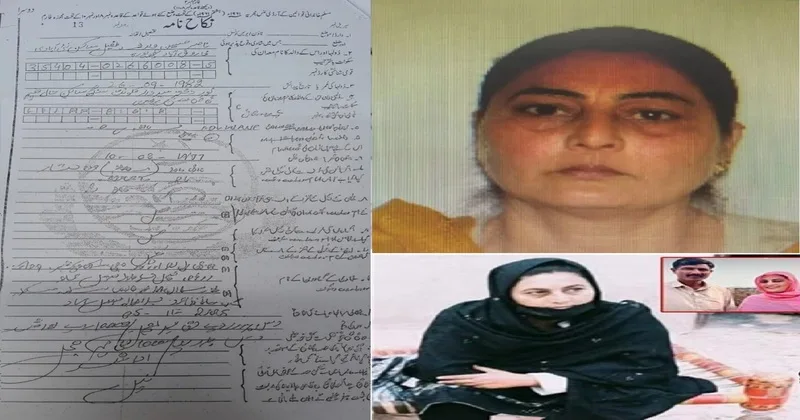
About four months ago, Sarabjit Kaur arrived in Pakistan with a group of Sikh pilgrims. Officially, the trip was religious, but there was a personal story behind it, one that linked her to her alleged love affair with a young man named Nasir Hussain. It was reported that the two had been in contact online for several years.
After arriving in Pakistan, news suddenly broke that Sarabjit Kaur had disappeared. Shortly after, it was reported that she had converted to Islam and changed her name to Noor Hussain. Subsequently, she was married to Nasir Hussain. At that time, Sarabjit’s statements stated that she had come to Pakistan of her own free will and was happy with Nasir. However, four months later, the situation appears to be completely different. Now, the same Sarabjit is saying in a video that she doesn’t feel safe in Pakistan and wants to return to India as soon as possible.
When the torture hidden behind love came to light
The allegations made by Sarabjit Kaur in a conversation with a Pakistani lawyer are extremely serious. She says that Nasir Hussain blackmailed her by taking objectionable photos and videos of her. Based on these, she was pressured to convert to Islam and marry him.
She also alleges that she was continuously harassed after arriving in Pakistan. Even when she tried to go to court to record her statement, she was not allowed to leave her house. The case was heard in the Lahore High Court on March 6. A taxi arrived that morning so Sarabjit could go to court, but Nasir and his family members stopped her. This incident raises many questions: If everything happened with her consent, why was she prevented from going to court?
Husband and Family’s Legal Battle
In India, Sarabjit’s husband, Karnail Singh, has approached the court regarding this matter. He claims that Sarabjit did not legally divorce him. Consequently, the marriage performed in Pakistan is controversial not only under Indian law but also under Islamic law. The petition also alleges that Nasir Hussain blackmailed Sarabjit and extorted money from her. He even sent the money through Dubai to prevent the release of her objectionable videos. Karnail Singh demands that Sarabjit be deported from Pakistan and sent to India, and that the entire matter be investigated impartially.
Questions of Conversion in Pakistan
The Sarabjit Kaur case is not new. Numerous cases of kidnapping, conversion, and marriage of girls from minority communities have been reported in Pakistan for years. Such incidents, particularly in Sindh province, are frequently reported. Human rights organizations claim that every year, controversies arise over the conversion of many Hindu and Sikh girls. They are forcibly converted to Islam, even minor girls being abducted for this purpose. It is also surprising that while there is hope for justice, in many cases, Pakistani courts declare that the conversion was voluntary, yet families and social organizations have repeatedly, with facts and evidence, argued that forced Islamic conversions were carried out.
Declining Non-Muslim Population
A clear trend is evident when one examines Pakistan’s demographic data. In 1947, the non-Muslim population across Pakistan was around 14 percent. However, today it has declined to between 3 and 4 percent. Hindus constitute the largest community, with the majority living in Sindh province. Christians, Sikhs, Parsis, and other smaller communities also exist.
Incidents have periodically surfaced in Sindh, alleging the kidnapping, conversion, and marriage of minority girls. The Rinkle Kumari case (Sindh, 2012) is one of the most high-profile cases. Rinkle Kumari was a 19-year-old Hindu girl from Mirpur Mathelo, Sindh. She suddenly disappeared, and after some time, it was reported that she had converted to Islam and married, while her family claimed that she had been abducted at gunpoint and forced to convert.
Similarly, last year (2025), the Sunita Kumari case came to light. In this case, a Hindu girl from the Mirpurkhas region of Sindh was kidnapped. Later, it was alleged that she was forced to convert to Islam and marry. Despite a court order, she was unable to see her family for three months.
In the Neena Kumari case, a policeman was accused of kidnapping a minor Hindu girl, Neena Kumari, who later converted her to Islam and married her. Similarly, in another case, the Lata Kumari case, a doctor in Karachi was accused of kidnapping and converting. The family alleged that she was forced into marriage. Today, thousands, if not millions, of such stories exist in Pakistan, where non-Muslims have been forcibly converted to Islam. According to human rights reports, hundreds of Hindu, Sikh, and Christian girls are converted every year. The fear of Islam is widespread in Pakistan.
Sarabjit’s call is a recent example of this. Therefore, Sarabjit Kaur’s story is not just one woman’s personal tragedy. In the context of Pakistan, it also symbolizes the psychological and social pressure that often conspiratorially reaches across borders. Today, Sarabjit’s greatest desire is to return to her country. Her words, “Just send me to India,” express a fear unbearable for any human being.
The debate over the status of non-Muslim communities in Pakistan is not new, but each new incident revives it. Sarabjit Kaur’s case has become a new link in that chain. For Pakistan, Islam is everything. Jihad, at any level, is the goal of Pakistani Islamists to convert non-Muslims to Islam through coercion, greed, fear, or trust. In India too, the Jihadi mentality of Islam keeps coming to the fore every day, there is a need to be cautious about it and to retaliate strongly.