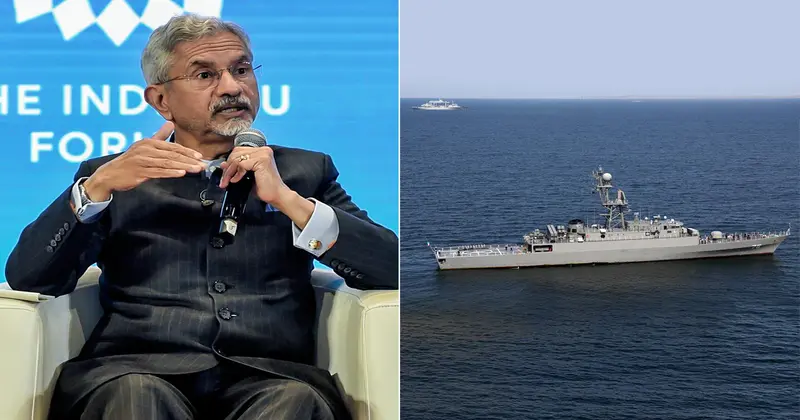
Iran-Israel conflict is escalating rigorously, spiralling into a larger regional conflict across West Asia. Meanwhile, India has taken the path of humanitarian diplomacy to avoid the spill-over of the conflict in the larger Indian Ocean Region(IOR). Thereby New Delhi has upheld regional peace, security and stability with humanitarian underpinnings in a boiling geopolitical landscape. Reacting to the humanitarian deeds of India, Iran has thanked New Delhi. Tehran thanked India for approving the docking of Naval Vessel IRIS Lavan at the Kochi port that apparently helped to thwart an existential crisis and cascading war effect in the region.
Accordingly, Iran flagged warship, IRIS Lavan is docked at the Kochi port. Interestingly, India’s humanitarian aid is not criticised by either the USA or Israel. This illustrates how India is emerging as a trusted partner in West Asia and in the larger maritime corridor. India is also actively consolidating its role as a net security provider in the Indian Ocean Region(IOR) thus continuously striving to carve humanitarian maritime corridors rather than pathways entangled in threat, security crisis and conflict. Also, EAM Jaishankar further illustrated how allowing the docking of IRIS Lavan was a “right thing to do”, in the humanitarian perspective.
How the situation unravelled
IRIS Dena, IRIS Lavan and IRIS Bushehr were sailing in the waters of the Indian Ocean as they were returning home from Exercise MILAN 2026, the naval drill hosted by India in Visakhapatnam. As the conflict in West Asia escalated further and the US-Israel axis and Iran were having an intense face-off, the fire of fight spilled into the Indian Ocean Region(IOR). The US Naval Forces blew up the Iranian Warship IRIS Dena in the Indian ocean, off the coast of Sri Lanka. This led to the death of 87 Iranian personnel who were onboard. Several others who survived were rescued by the Sri Lankan Navy.
In this backdrop, IRIS Lavan requested for a shelter with New Delhi. If continued sailing on the Indian Ocean, the Iranian warship can be an easy target to the US forces. Such a face-off in the Indian Ocean would further complicate the conflict in West Asia and would dismantle the peace, security and stability of the larger Indian Ocean. In this direction, India acknowledged the request of IRIS lavan to dock at the Kochi port, thereby upheld humanitarian diplomacy and regional peace.
EAM Jaishankar illustrated India’s humanitarian approach as a strong maritime power in the region
Reacting to the permission granted to IRIS Lavan to dock at the Kochi port, External Affairs Minister Dr. S. Jaishankar asserted that Iranian frigate IRIS Dena caught on the “wrong side of the events”, as it was sunk by the US naval forces. In this direction, India gave permission to dock IRIS Lavan at the Indian waters based on humanitarian consideration, EAM added. “We got a message from the Iranian side that one of the ships [IRIS Lavan], which was closest to our waters at that point in time, wanted to come into our port. They were reporting that they were having problems”, EAM said.
“On the first of March, we said you can come in. It took them a few days to sail in and then they docked in Kochi. The people on the ship were a lot of young cadets. They have disembarked and are now in a nearby facility”, EAM Jaishankar explained. “We approached the situation from the point of view of humanity, other than whatever the legal issues were, and I think we did the right thing”, EAM further stated. EAM Jaishankar also explained how rendering permission to IRIS Lavan was critical in terms of ensuring regional security and in humanitarian perspective.
“There are a lot of social media debates going around this. Please understand the reality of the Indian Ocean”, Dr. Jaishankar reiterated. There have been several US naval bases in the Indian Ocean Region(IOR) for a long time. For example, Diego Garcia has been a US military base for over the last five decades. Similarly, there is Djibouti, which houses foreign forces and Hambantota in Sri Lanka also has foreign military footprints, EAM Jaishankar asserted. In this direction, any minor trigger or conflict in the region could breach out into a large scale face-off, ultimately destabilising the peace and security of the entire maritime region. Considering these geopolitical sensitivities coupled with humanitarian approach, India permitted IRIS Lavan to be docked at Kochi, for the time being.