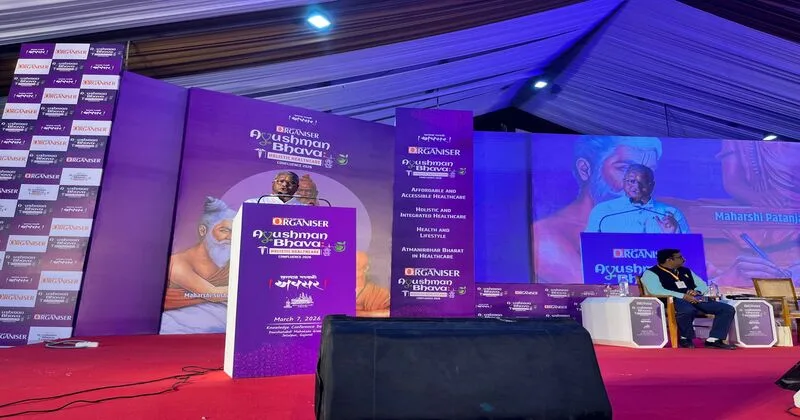
The outbreak of COVID-19 changed many perceptions and normalised several preventive practices. It proved that if a person wants to remain healthy, they must work on themselves. Prevention must begin with the individual, and by following preventive measures anyone can maintain good health, said Ashok Kumar Varshney, National organising secretary, Arogya Bharti at the inaugural session of Ayushman Bhava Holistic Healthcare Confluence 2026 held at Knowledge Conference Dome Dwishatabdi Mahotsav ground, Jetalpur, Gujarat on March 7, 2026.
When a student takes admission in the medical field, one thought usually remains in his mind, that he is becoming a doctor and his primary duty is to treat patients. On the other hand, an ordinary person believes that his job is simply to work hard; if he falls ill, he will go to a doctor. He rarely thinks about staying healthy in the first place, Ashok Kumar Varshney said.
During the pandemic, many webinars were organised on preventive measures, and at that time nearly 65 per cent of the population in United States was consuming AYUSH herbal decoction (kadha). According to records of the Government of India, about 89 per cent of people in India were using AYUSH kadha. Around 60 per cent of the population began eating home-cooked food, nearly 70 per cent started drinking lukewarm water, and around 70–80 per cent of people began adopting some form of practice to keep themselves healthy, he informed.
In India, considerable work is being done in the field of healthcare. The number of All India Institute of Medical Sciences institutions (AIIMS) has now increased to 23, and hospitals have been established in almost every district. Along with this, the number of private hospitals has also grown significantly. However, even as hospitals increase, the number of patients is also rising. Work is certainly being done on healthcare infrastructure, but the time has now come to ensure that people do not fall ill in the first place. Unfortunately, even today, basic healthcare facilities are not available in many remote areas, he said.
Today, admissions of most medical students take place through National Eligibility cum Entrance Test (NEET). Students with higher ranks usually choose MBBS. Those who take admission in Ayurveda often carry an inferiority complex, believing that their marks were lower and that is why they entered this field. However, after the pandemic, there has been a noticeable change. Students with higher marks are now also opting for Ayurveda, he said.
An ordinary person generally does not think about maintaining his own health, and because of this the doctor–population ratio remains a concern. As a result, news often highlights tensions between doctors and patients, indicating that the doctor–patient relationship is weakening, he further said.
Every medical stream has its own speciality, but each also has certain limitations. At the same time, all healthcare systems can complement one another. There are some aspects that remain common for every medical professional. First is technology, which is equally important for all. Second is ethical values, which every practitioner must follow. Third is awareness of one’s own limitations. When these principles are followed, different medical systems can respect and support each other.
According to one research study conducted at a mental healthcare facility run by psychiatrists, when yoga was added to conventional medical treatment, patient recovery became faster. When an appropriate diet (aarogya aahar) was also included, the recovery process improved even further, he informed
Similarly, when a patient undergoes surgery, he often becomes mentally stressed or depressed. Before the surgery, the doctor checks parameters such as blood pressure. If the condition is not normal, the doctor may advise counselling through the nursing staff. When counselling and yoga are introduced, both pre-operative and post-operative recovery become faster, he said.
He further said that, across the country, people are searching for ways to accelerate patient recovery. Therefore, the healthcare system must become patient-centric. This approach will help determine where Ayurveda should be integrated, where allopathy or homeopathy should be applied, and where dietary practices should be modified.
Interdisciplinary activity, a holistic approach, and an integrated health system are distinct concepts in healthcare. Interdisciplinary activity refers to the integration and collaboration between different medical disciplines, such as Allopathy and Ayurveda, in treatment and research. A holistic approach focuses on the entire spectrum of health, ranging from preventive care to curative treatment, emphasising overall well-being rather than only treating disease. An integrated health system refers to the coordinated use of different medical systems, such as Homoeopathy and Ayurveda, where treatments are applied according to the specific needs and condition of the patient, he said.
In 2017, the workers of Arogya Bharati submitted several suggestions to the Health Secretary. When the National Health Policy was later introduced, many of those suggestions were included in the policy framework.
Today, there is a need for medical professionals to understand different healthcare systems at least to some extent. One of the major challenges in this process is terminology, as each medical system uses different technical terms. In Delhi, a conference related to World Health Organisation discussions focused on how to create balance and clarity in terminology across different healthcare systems. The more such discussions take place in society, the better it will be for healthcare development. Increasingly, researchers are now studying and exploring these integrative approaches as well, he said.
Notably, Shree Swaminarayan Mandir, Jetalpur, will complete 200 years of its establishment ‘Avasar’ on March 11, 2026. The grand Bicentenary Celebrations are being held from March 5 to 11, 2026, under the chairmanship of His Holiness Pujya Bhavi Acharya 108 Vrajenndra Prasadji Maharajshree, with various religious, social, and cultural programs.
Significance of Jetalpur Dham
The Jetalpur Mandir holds special significance as one of the nine temples established during Bhagwan Shree Swaminarayan’s lifetime, spreading the message of monotheism. The temple has been a center of faith and fulfillment of devotees’ aspirations for many years, with the idol of Shree Revati Baldevji Harikrishna Maharaj being consecrated here.
As Bharat advances towards Viksit Bharat, healthcare is a critical pillar of national development. The country’s civilisational ethos emphasises holistic well-being, integrating traditional systems like Ayurveda and Yoga with modern medicine. The second edition of ‘Ayushman Bhava’ brings together stakeholders to discuss sustainable, inclusive healthcare solutions, focusing on affordability, accessibility, and integration. This event is part of Jetalpur’s 200-year celebrations of the Swaminarayan Mandir, aligning spiritual wisdom with national priorities for a healthy, self-reliant Bharat.
As Bharat advances towards the vision of Viksit Bharat, healthcare remains one of the most critical pillars of national development. The civilisational ethos of Bharat has always emphasised holistic well-being, where body, mind and spirit are seen as interconnected dimensions of health.
Ayurveda, Yoga, Naturopathy and other traditional knowledge systems of Bharat are increasingly being recognised as integral to preventive and sustainable healthcare. At the same time, modern medicine and technological advancements have significantly expanded diagnostic and therapeutic capabilities. The need of the hour is not competition between systems, but integration, an approach that sees various pathies as complementary rather than contradictory.
Despite remarkable progress, major challenges remain. The rising burden of lifestyle diseases, increasing medical costs, and persistent regional and urban-rural imbalances in healthcare infrastructure raise serious concerns about affordability and accessibility. Ensuring that quality healthcare reaches the last person in society is essential for building a strong, resilient nation.
In this context, Ayushman Bhava is envisioned as a focused platform to bring together key stakeholders of the healthcare ecosystem, medical practitioners, researchers, hospital administrators, pharmaceutical representatives, policymakers, and social organisations, to deliberate upon sustainable, inclusive and integrated healthcare solutions for Bharat.
This special event is being organised by Organiser Weekly, in collaboration with Swaminarayan Mandir, Jetalpur, as part of the historic celebrations marking 200 years of the first Swaminarayan Mandir. Organiser Weekly has been entrusted with one dedicated day of the commemorative programme to host this thematic dialogue on healthcare, rooted in Bharat’s civilisational values and contemporary national priorities.
The programme seeks to align spiritual wisdom, social responsibility and policy vision towards the goal of a healthy and self-reliant Bharat.