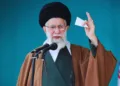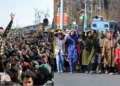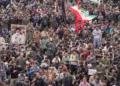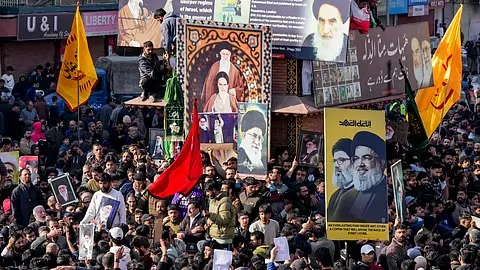
Protests and mourning gatherings were reported across several Indian states following the killing of Iran’s Supreme Leader, Ayatollah Ali Khamenei, in Israeli-US strikes. From Kashmir in the north to Karnataka in the south, members of the Shia community assembled in large numbers, expressing grief and anger over the development.
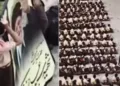
In Lucknow, Uttar Pradesh, hundreds gathered near the historic Bara Imambara, raising slogans during the protest. Visuals showed women holding photographs of Khamenei, some breaking down in tears. Demonstrators also shouted slogans condemning the United States and Israel, terming the killing an attack on Muslim leadership.
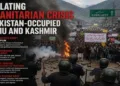
Similar scenes unfolded in Kashmir, where large gatherings were reported in Srinagar and other areas. Protesters expressed both sorrow and anger, describing Khamenei’s death as a major loss for the global Shia community. In several places, black flags were displayed as a mark of mourning.
Why are Shias protesting?
For many within the Shia community, Iran’s Supreme Leader is not seen merely as a political head of state. He is regarded as a Marja-e-Taqlid, a “Source of Emulation” a senior religious authority whose interpretations of Islamic law guide followers in spiritual and social matters.
As a result, several protesters described Khamenei’s killing not simply as a geopolitical event but as martyrdom, a concept that carries deep religious significance in Shia theology. “This is a message for all that wherever the oppressed are killed, we will raise our voice for them. Khamenei has been killed, but after him, thousands of Khameneis have been born today,” one protester told reporters.
Kashmir has historically maintained cultural and religious links with Iran. It has often been referred to as “Iran-e-Sagheer” or “Little Iran,” a phrase popularised by poet Muhammad Iqbal. Persian served as the official language of the region for centuries before being replaced by Urdu during Dogra rule in the late 19th century. These historical connections continue to shape sections of religious sentiment in the Valley.
Protests were also reported in New Delhi, Bihar, Jharkhand and Telangana. In Hyderabad and parts of Karnataka, gatherings were organised where participants carried posters of Khamenei and raised slogans against US and Israeli military action.
Several Indian Muslim organisations issued statements condemning the strike, calling it a violation of international law and national sovereignty. Many groups have announced multiple days of mourning and further protest programmes in memory of the Iranian leader.
Long before assuming Iran’s highest office in 1989, Khamenei had visited India in 1980-81, shortly after the 1979 Islamic Revolution led by Ruhollah Khomeini. Records indicate he travelled to parts of Karnataka and Kashmir during outreach efforts by the new Iranian government. In later years, he publicly spoke about Indian leaders such as Mahatma Gandhi and Jawaharlal Nehru and praised India’s religious diversity.
Many protesters view the Iranian leadership as a strong supporter of the Palestinian cause and one of the few powers challenging Western and Israeli influence in West Asia. The intensity of protests in India reflects not only religious reverence but also broader geopolitical alignments held by sections of the community.