A wave of protests and mourning rallies was witnessed across Ladakh after the reported killing of Iran’s Supreme Leader, Ayatollah Ali Khamenei, in joint US-Israel strikes amid the ongoing West Asia conflict. The development triggered a strong reaction from sections of the Shia Muslim community in the Union Territory, leading to large public gatherings and demonstrations of solidarity with Iran.
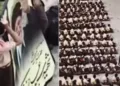
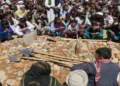
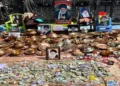
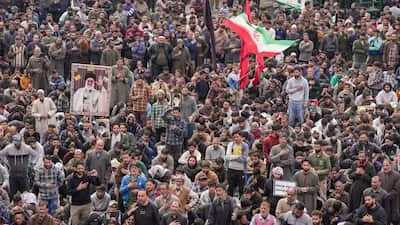
In the capital city of Leh, thousands assembled for processions that disrupted traffic and brought key areas to a standstill. Participants, many dressed in black, marched through main roads carrying portraits of Khamenei and waving black flags. Religious chants and slogans were raised as the procession moved across commercial and residential areas.
Religious rituals, including rhythmic chest-beating and recitation of elegies, were performed as part of what organisers described as a formal mourning period. Community leaders addressed gatherings, terming the killing a significant moment for the global Shia community. However, the scale of the mobilisation and the overt political slogans raised during the rallies have drawn attention beyond the religious aspect of the events.
Several protesters were heard raising slogans against the United States and Israel, condemning the military action that led to Khamenei’s death. While organisers maintained that the rallies were peaceful and religious in nature, the strong anti-West rhetoric signalled that the demonstrations were not limited to spiritual observances alone.
Local religious body Anjuman Imamia coordinated many of the events and announced Gayibana Namaz-e-Janaza in Khamenei’s honour. Majlis and condolence meetings were scheduled across different localities as part of an extended mourning programme.
In Kargil, large gatherings were held outside mosques and community centres. Religious organisations declared a seven-day mourning period and announced protest processions against the US-Israel strikes. Special prayers were offered at Jamia Masjid Kargil, where community leaders said condolence meetings would continue for 40 days. Similar rallies were reported from Drass, another Shia-majority area.
Meanwhile, in neighbouring Jammu and Kashmir, security forces were placed on high alert after protests broke out in parts of the Kashmir Valley. Movement restrictions were imposed in certain districts as a precautionary measure. Visuals from Budgam showed gatherings despite curfew-like conditions.
Officials confirmed that protests in Ladakh remained largely peaceful, with no major incidents reported. However, the scale of the mobilisation over developments in a foreign conflict has sparked quiet discussions in administrative circles about the political undertones of the demonstrations.
It is to be noted that while religious solidarity is a constitutional right, the intensity of public reaction over the killing of a foreign political leader raises broader questions. Was the mobilisation purely religious, or did it reflect deeper ideological alignments with Iran’s political establishment? As Ladakh remains under watch, authorities are likely to closely monitor whether the mourning period stays within peaceful bounds or evolves into a sharper geopolitical statement.