For years, critics argued that renewable energy expansion in India was losing momentum. The latest wind power data tells a different story. With record capacity in additions, faster project execution and sustained policy support, India has not only revived its wind sector but also reinforced its position as one of the world’s fastest-growing clean energy economies.
It would come in the headlines often that “India’s wind sector is stalling,” “targets slipping,” “green transition losing steam.” The narrative has built its own momentum, feeding off genuine but manageable execution challenges land acquisition delays, transmission bottlenecks, supply-chain cost pressures and stretching them into a story of systemic failure. The latest data placed before the Lok Sabha by the Ministry of New and Renewable Energy (MNRE) tells a very different story.
The Numbers That Break the Narrative
As on 30th June 2026, Indian total installed wind energy capacity stands at 57,443 MW, making it the world fourth-largest wind power market. But the headline figure is not even the most significant part of the disclosure. The chart below represents the capacity of Wind Power in last three years.

The capacity addition in 2025-26 at 6,057 MW is nearly double that of 2023-24 and generation jumped from 83 billion units to 106 billion units in a single year. This is not the profile of a sector in decline, it is the profile of a sector accelerating sharply, precisely in the years when critics were most vocal about an alleged slowdown.
Independent industry trackers confirm the same trend rather than contradict it. Reporting on the sector earlier this year noted that India ranks fourth globally after China, the United States and Germany in wind capacity, and that the country registered historic capacity additions of 6.1 GW in 2025 alone, building on 4.1 GW added in 2024-25.
Where the Criticism Came From and Where It Still Has a Point
It would be dishonest to pretend the criticism emerged from nowhere. Commentary on the sector has repeatedly flagged real structural friction. Analysts have pointed out that despite the record 2025 additions, India has tapped less than 5% of its estimated wind potential of 1,164 GW at 150-metre hub height, and that evacuation infrastructure and land acquisition remain persistent bottlenecks that could threaten the 2030 target of 500 GW non-fossil capacity. Similarly, a recent report on grid readiness found that transmission delays and grid bottlenecks caused 300 GWh of renewable energy curtailment in the first quarter of 2026 alone, with transmission projects running at roughly 80 per cent of their annual buildout targets.
These are legitimate engineering and planning challenges, and the government’s own Annexure of policy measures for the Green Energy Corridor Scheme, waived Inter State Transmission System charges for renewable power, a transmission plan mapped out till 2030, and the newly notified National Repowering and Life Extension Policy for Wind Power Projects, 2023 reports has shown that these gaps are being actively worked on rather than ignored.
Where the criticism crosses from legitimate concern into misleading narrative is in the conflation of “targets not yet fully met by 2030” with “the sector is failing today.” An industry outlook briefing from earlier this year captured this distinction which has acknowledged that India has set a target of adding 140 GW of wind capacity this decade, of which approximately 100 GW is still to be added, even as wind capacity addition continues to be a challenging territory owing to rising OEM supply-chain costs and land and grid delays, while simultaneously underlining that wind complementary, peak-hour generation role makes it indispensable to grid stability regardless of the pace debate.
In other words a genuine gap-to-target exists on the horizon of 2030, but that has been repeatedly, and sometimes deliberately, mislabelled as present-day collapse a framing the FY26 numbers directly contradict.
The Bigger Picture: A Complementary, Not Competing
One data point often missing from the critical commentary is wind energy’s specific value to grid stability with a point the Ministry has itself flagged. Officials have highlighted that India’s wind energy potential at 150-metre hub height is estimated at nearly 1,164 GW, with confidence expressed that the country will achieve 100 GW of wind capacity by 2030 and 156 GW by 2036, contributing to the net-zero target by 2070, has nearly 45 per cent of wind power generation occurs during peak demand hours, making it a critical complement to solar energy which is unavailable after sunset.
This complementary character is precisely why isolated shortfall commentary comparing wind against an ambitious decade-end target misses the operational reality. Wind is not competing with solar for primacy, it is filling the exact gap solar cannot.
State-wise Government Confirms Broad-Based Growth
The state-wise data placed in Parliament also undercuts the claim that wind growth is narrowly concentrated or artificially propped up in a handful of pockets:
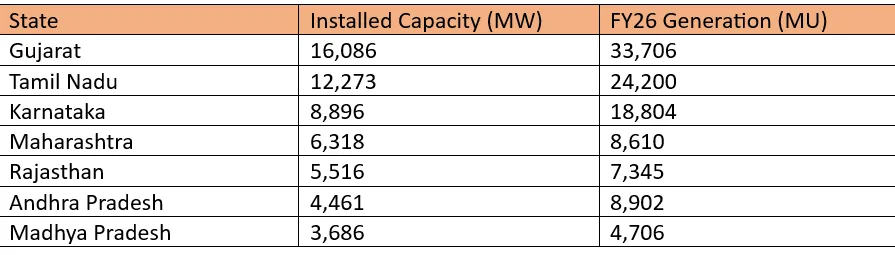
Eight states now host commercially significant wind capacity, led by Gujarat and Tamil Nadu, but with meaningful contributions from Karnataka, Maharashtra, Rajasthan, Andhra Pradesh and Madhya Pradesh. This is a geographically diversified base, not a single-state story vulnerable to local disruption a resilience factor that rarely features in the “sector in crisis” commentary.
Global Recognition, Not Just Domestic Claims
The government’s submission also notes that as per the GWEC (Global Wind Energy Council) Report 2026, India retained its 4th position globally in wind energy installation as of 31st December 2025, a ranking corroborated independently by industry trackers who confirm the country ranks fourth globally after China, the United States and Germany in wind capacity. This is not a self-congratulatory domestic claim, it is a position validated by the very international bodies that have, in other reports, also flagged the sector’s execution challenges. The credibility cuts both ways and on the capacity and generation numbers, the global assessment aligns with the government’s data, not with the “spiral” narrative.
Policy Groundwork Behind the Numbers
The acceleration in FY26 did not happen by accident. The Annexure to the Lok Sabha reply lists a dense sequence of enabling measures rolled out over the preceding years, 100 percent FDI under the automatic route for renewable energy, a Renewable Purchase Obligation moving to a Renewable Consumption Obligation trajectory notified till 2029-30 with statutory penalties for non-compliance, revised Standard Bidding Guidelines for competitive procurement, a Viability Gap Funding scheme specifically for Offshore Wind Energy Projects, the Offshore Wind Energy Lease Rules 2023, and a Green Term Ahead Market to facilitate exchange-based sale of renewable power.
None of this featured prominently in coverage that focused instead on missed interim milestones. Policy architecture takes years to translate into installed megawatts, the FY26 jump is the visible outcome of groundwork laid across several preceding budget cycles.
The criticism directed at India’s wind energy programme was never entirely baseless transmission bottlenecks, land acquisition friction and a steep distance still to travel toward the 140 GW decadal target are real. But the leap from “challenges exist” to “the sector is in decline” was always a stretch, and the Lok Sabha data now on record makes that stretch untenable. A record 6,057 MW added in a single year, generation up by nearly 28 percent, a broad-based multi-state capacity build-out, and an internationally verified 4th global rank together tell the story of a sector correcting course and accelerating not one collapsing under its own ambition.
The larger lesson for policy commentary is a familiar one, where distinguishing between genuine structural challenges that deserve scrutiny and manufactured narratives of failure that ignore the government’s own published, verifiable data. On wind energy, the numbers have now spoken and they do not support the doom narrative that dominated headlines for years.