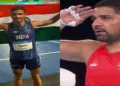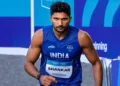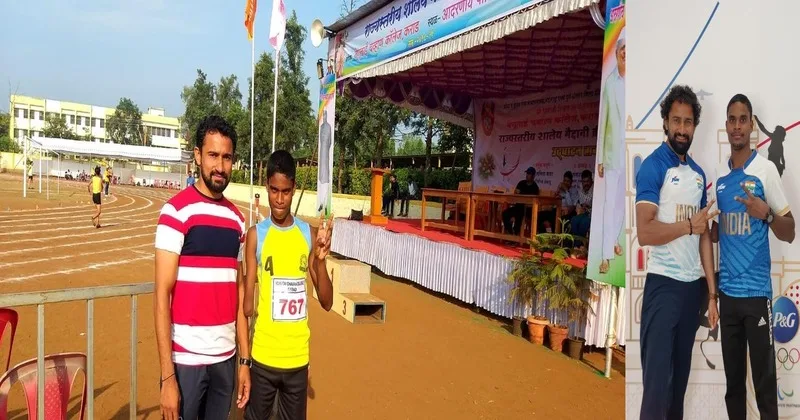
Glasgow (UK): Dilip Mahadu Gavit, a para-athlete from the Indian contingent at the Commonwealth Games 2026 at Glasgow blazed to a gold winning Games record clocking 10.71 s and India’s delight doubled with Mohammed Basil Morssinganakath clinching the silver in 10.83s. – making it a sensational 1-2 podium finish for the Men’s 100m Para T47 event in athletics.
When courage takes to the track, greatness follows.
Congratulations to Dilip Mahadu Gavit on winning Gold & Mohammed Basil Morssinganakath on winning Silver in the Men's 100m T47 Para Athletics event at #Glasgow2026.
A remarkable double podium for Bharat!#Cheer4Bharat… pic.twitter.com/7NKUvZhrrj
— Kiren Rijiju (@KirenRijiju) July 30, 2026
The 22-year-old gold winner Dilip Gavit has an absolutely riveting story to his march up to here and his coach Vaijnath Kale is the biggest part of it. Here’s all about Dilip’s transformation from a child with untapped potential into a world-class athlete.
Guru Saakshaat Parabrahma
On Wednesday July 29, after winning the race, Gavit did not run towards the photographers but straight into the fatherly arms of his coach Vaijnath Kale, to whom he provided me with everything from training to dedicated his Gold medal.
“Today is Guru Pournima (the Hindu festival to honour and acknowledge the teacher’s contribution to one’s making),” Gavit said, “And I dedicate my medal to my Guru Vaijnath Kale Sir who has been more of a father to me. He adopted me, food, shelter, and sporting gear – all in his house and trained me. This is my Guru Dakshina to him.”
“I dedicate this Gold to my coach on Guru Purnima. I lost part of my arm after falling from a tree as a child. My coach saw me running, spoke to my family, and took me under his wing.”
“I also thank PM Modi for supporting us.”
– Dilip Gavit wins Gold 🥇 pic.twitter.com/XnmRSuOvnl
— The Khel India (@TheKhelIndia) July 30, 2026
Coach Vaijnath Kale present at the venue at the end of the tracks at Glasgow watched with eyes full of happy tears and pride.
Speaking exclusively to The Organiser, the 40-year-old proud coach who gave Dilip Gavit a home and helped win a Commonwealth Games gold narrated he had ‘adopted’ an 11-year-old tribal child from Torandongri village of Surgana Taluka of Nashik, a village with barely a few 100 families and almost no civic amenities.
When Vaijnath Kale ‘adopted’ a disabled 11-year-old from an impoverished tribal family in Maharashtra, his only promise was to give him a better life. On Wednesday, that boy, Dilip Gavit, won gold at the Commonwealth Games.
“In 2015, I had gone to the village in the capacity of a Technical Officer for the Maharashtra Athletics Association and was interacting with the school children (his role being that of a school observer) and spotted this 11-year-old child with one arm amputation jostling and playing with the able-bodied youngsters as though he had no serious disability,” Kale said. That was in the premises of the Adivasi Vikas Ashram, a boarder facility school for the tribal children.
But this boy, Dilip Mahadu Gavit was not a student there. With one arm missing from the elbow, the family had no clue how he can study or do any fruitful or productive work. But he was full of energy and joie de vivre.
As a child, he had fallen from a tree and suffered grave injury to his arm. But lack of timely and appropriate treatment meant he had to undergo amputation of the gangrenous section of the forearm.
“He struck me as an extraordinary person, and my heart went out to him. Not with any specific training plan in mind, I purely wanted to give the child the environment and nurturing to grow like a normal child,” Kale told The Organiser.
He spoke to the village elders and took their help to broach the topic of ‘adopting’ the boy with his family. The parents were poor farm labourers and though they had a small stretch of land, it was barely cultivable. There are 5 other siblings elder to Dilip and the parents had been worried how the boy will fare when he will have to earn a livelihood.
But with all those challenges in life too, they were not eager to send the boy t the city with a man whose motives they were initially and understandably suspicious of, says Kale.
When he spoke to his own family too, they pointed out that he should rethink the proposal as he had only recently been married and how would he fulfil all these responsibilities when his own kids came along.
But he persevered and though he did not adopt Dilip on paper per se (as Kale did not want to see the boy miss out on the numerous rights and benefits as a tribal person – due to his listing as a tribal at birth on the national SC-ST Schedule), he could bring him into his family and start working on building his future.
Kale had worked as a Circle Officer in Anil Ambani’s Reliance group’s security wing, and he quit the handsomely paying secure corporate job to found his own business and to work on projects that he was passionate about through his foundation/NGO.
Several years ago, he had reluctantly tucked away his own dreams of success on the tracks despite being a national level athlete as he had to join the corporate sector to earn a livelihood. Now, after quitting the 9-5 circuit, he felt the urge to return to athletics and began working as a coach and technical official in Nashik. It was in that role, in the summer of 2014, that he found himself in Dilip’s village.
Today, Dilip is a graduate but that is the least of his achievements. After bringing him into his family fold, and after discovering that the boy loves to play sports, especially sprinting, Vaijnath started letting Dilip practise with the other young athletes that he was training at a local college ground.
I asked him how the boy balances his body while running as he has half an arm missing on one side. Vaijnath Kale admitted that the condition does leave the athlete with challenges regarding coordination and strength limitations compared to able-bodied athletes, but nevertheless, he encouraged him to compete against them. Vaijnath Kale then worked a lot on the science of how to help Dilip ergonomically overcome the balance and speed challenges that came along with the loss of the arm.
Vaijnath Kale says he did not allow an inferiority complex to seep into the boy’s psyche. “I had to get that fear out of Dilip’s mind. So for the first four or five years in which I trained him, I only made him compete with able bodied athletes. I didn’t want him to think he was a disabled runner,” he says.
His wife Jyoti Kale is a trained nutritionist and he admits that without her help, he could not have been able to do any of this.
“She draws up the food plan and the fitness-nutrition plan for all my other ‘adopted’ wards (there are 4 more, some of them physically challenged in sight, and a girl as well). She has given up her corporate job to focus on our own kids and these adopted children who are now as good as our own,” Kale says. He has rented an adjacent flat to house the three adult adopted boys, and the girl lives with his children inside their home.
Vaijnath now supports the academy and the athletes living with him through charity and a part-time property business.
Dilip soon began outpacing able-bodied runners, winning medals at the state and junior national levels in the 200m and 400m events.
Vaijnath, however, believed that Dilip’s true potential lay elsewhere. He encouraged Dilip to start competing in para athletics, a decision that paid immediate dividends when Dilip won the gold medal in the 400m at the 2023 Para Asian Games in Hangzhou.
Dilip’s core and pet event is the 400 metres race but last year, Vaijnath urged Dilip to make another bold transition.
As things may turn out, the 400m is not part of the disability category at the Commonwealth Games, Vaijnath Kale had to suggest Dilip to move to the 100m event.
Now, that was not Dilip’s regular event, but he did not hesitate before filling up for that category for the qualifying rounds. He says he knows his coach and guardian thinks things through before suggesting to him and is therefore always ready to quickly adopt whatever is told.
To his coach’s joy, Dilip found success after competing in the 100m at the World Para Athletics Grand Prix events in Dubai and India, winning bronze at the latter to secure qualification for the Commonwealth Games.
At Glasgow, his coach, watching from afar must have missed a beat or two as Dilip was not off the block quick enough and showed a sluggish start, but he made up for that initial setback in a blink and gathered pace brilliantly over the closing metres.
Watch | Vaijnath Kale, national coach of Dilip Gavit, says, "Dilip's gold is a milestone, as it is his first international medal and India's first-ever Commonwealth Games track and field gold. We were confident of a 1-2 finish. I urge the youth to never give up and choose winning… pic.twitter.com/AMsHDQFOJc
— United News of India (@uniindianews) July 30, 2026
Kale says that Dilip clocked a personal best of 10.71 seconds, setting a new Commonwealth Games record on his way to the gold medal and what makes him very proud is that the figure is impressive even by able-bodied men’s standards back home in the national records.
Accolades and congratulations flowed in from India and the world over. Prime Minister Narendra Modi, President Droupadi Murmu, Home Minister Amit Shah, and Sports Minister Dr Mansukh Mandaviya were amongst those who celebrated Dilip’s win.
Prime Minister Narendra Modi tweeted: “A phenomenal performance by Dilip Mahadu Gavit! Congratulations to him on winning the Gold Medal in the Men’s 100m T47 event with a remarkable timing, setting a new Games Record and achieving his Season Best. His speed, determination and dedication have made our nation proud. Best wishes for his future endeavours!”
India shines brighter with another glorious sporting achievement.
Congratulations to Dilip Mahadu Gavit on winning the Gold and Mohammed Basil Morssinganakath on securing the Silver in the Men's Para 100M T47 event at #CWG2026.
Your remarkable determination, resilience and… pic.twitter.com/CMw85jG7Fv
— Nitin Nabin (@NitinNabin) July 30, 2026
Next stop the Para Asian Games
“I will be competing in the 100m and 400m at the Para Asian Games this year and I want to win gold there also. Then at the Los Angeles Paralympics I want to win another gold medal. Coach and me have the dream that one day India’s anthem plays at the Paralympics,” he says.
Vaijnath Kale’s Academy – an Incubator of sporting talent
Coach Vaijnath Kale, founder of Nashik’s VDK Sports Foundation, has quietly built a reputation for spotting raw talent and developing athletes capable of competing on the international stage.
While para sprinter Dilip Mahadu Gavit has brought him widespread recognition, Nashik girl Shravani Sangale’s meteoric rise has further underlined his credentials as one of India’s (not just Maharashtra’s) most successful athletics coaches.
Shravani Sangale has been training under Kale for several years, focusing on the demanding 400m and 400m hurdles. His coaching philosophy emphasises endurance, speed endurance, race tactics and mental resilience, qualities that have become evident in her performances on the international circuit. Under his guidance, she has steadily progressed from the domestic athletics circuit to representing India at the continental level.
Shravani’s stunning run in 2026
Recently, Shravani announced herself as one of India’s brightest young quarter-milers at the inaugural Asian Under-23 Athletics Championships in Ordos, China, where she produced one of the finest performances by an Indian athlete at the meet.
Her achievements included:
- Gold medal in the Mixed 4x400m Relay, where she ran a sensational anchor leg to overtake the Chinese runner in the closing metres, helping India win in 3:18.64, just 0.10 seconds ahead of China.
- Gold medal in the Women’s 4x400m Relay, making a significant contribution to another Indian victory.
- Bronze medal in the 400m hurdles, clocking a lifetime best of 58.09 seconds.
With two gold medals and one bronze, Shravani completed a remarkable hat-trick of medals, becoming one of the standout performers of the championships and drawing praise from across Indian athletics.
Even before Ordos, she had shown immense promise, but her performances in China elevated her into the league of India’s most exciting young 400m runners. Her aggressive anchor leg in the mixed relay, where she reeled in China’s athlete in the final stretch under immense pressure, was widely hailed as the defining moment of the championship for the Indian contingent.
For Coach Vaijnath Kale, Shravani’s success is another validation of the athlete-development system he has built at VDK Sports Foundation.
Within a short span, he has mentored athletes who have won medals at the Asian Championships, Commonwealth Games and Para Asian Games, demonstrating his ability to nurture both able-bodied and para athletes to international success.
And Coach Vaijnath Kale is not done yet. He says watch out for some more pleasant surprises in the offing in the coming days when Indian athletes compete at the 20th Asian Games which are scheduled in Aichi-Nagoya, Japan, from September 19 to October 4, 2026. Watch out for Dilip and Anjana, Kale says.