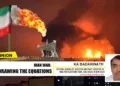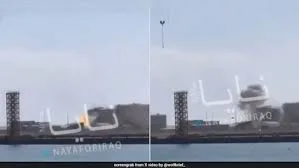
An Iranian drone targeted the Ras Al-Jaima port in Oman early Tuesday (March 3) morning, causing a loud explosion and sending black smoke billowing into the sky, according to videos circulating widely on social media.
Unverified footage shows what appears to be a drone descending toward an installation at the port before bursting into flames. Moments later, a thick column of smoke rises from the facility, which serves as one of Oman’s key maritime and logistics hubs.
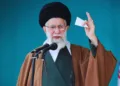
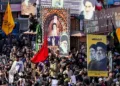
The strike comes amid heightened regional tensions after joint military operations by the United States and Israel reportedly led to the death of Iran’s Supreme Leader, Ayatollah Ali Khamenei, over the weekend. Tehran has since launched a wave of retaliatory attacks targeting infrastructure and assets across the Gulf.
Duqm port also targeted
In a separate development, Oman’s Port of Duqm was targeted “by a number of drones,” according to a security source cited by the Oman News Agency.
One fuel tank at Duqm was reportedly struck, though authorities said the resulting damage was contained and no casualties were recorded. However, Duqm had already faced an earlier drone strike on Sunday, which left one worker injured.
BREAKING: EXPLOSIONS AT THE PORT OF RAS AL JAIMA IN OMAN pic.twitter.com/QprSU2SXqj
— Sulaiman Ahmed (@ShaykhSulaiman) March 3, 2026
Ummah collapsed?
The unfolding crisis presents a striking paradox: many of the states reportedly targeted in Iran’s retaliatory strikes, including Oman, Qatar, Saudi Arabia, United Arab Emirates, Kuwait and Bahrain are themselves Muslim-majority nations. Yet they have found themselves in the crosshairs of Iran amid its confrontation with Israel and the United States. This raises an uncomfortable question often framed in ideological terms: if the concept of the Ummah represents transnational Muslim unity, why are Muslim states attacking one another?
The answer lies less in theology and more in geopolitics. Modern nation-states operate primarily on strategic interests, security calculations, and alliance structures not purely on religious identity. Gulf monarchies host US military bases, maintain security partnerships with Washington, and, in some cases, have normalized or quietly coordinated ties with Israel. From Tehran’s perspective, these alignments place those states within a hostile security architecture, regardless of shared religious identity.
The idea of the Ummah historically emphasises spiritual and civilizational unity among Muslims. However, contemporary international politics is shaped by sovereignty, national interests, sectarian divides, and regional rivalries. Iran’s strategic worldview is influenced not only by Islamic solidarity rhetoric but also by its rivalry with Sunni Arab monarchies, competition for regional leadership, and its doctrine of “forward defense.” In that framework, a Muslim-majority country aligned with Washington may be viewed as strategically adversarial.
Sectarian dynamics further complicate the narrative. Tensions between Shia-majority Iran and predominantly Sunni Gulf states have deep historical and political roots. These divides have played out in proxy conflicts across Iraq, Syria, Lebanon, and Yemen for years. Thus, what appears externally as “Muslim versus Muslim” conflict is, internally, a contest for regional power, ideological influence, and security dominance.
Oman’s case is particularly notable because it has traditionally acted as a mediator rather than a combatant. If even neutral or mediating Muslim states are struck, it shows how rapidly escalation can override diplomatic nuance.
Broader Gulf impact
The drone strike in Oman is part of a broader Iranian campaign against Gulf states perceived as closely aligned with Washington. Tehran has reportedly targeted critical infrastructure and US-linked assets across the region.
In the United Arab Emirates, a fire broke out at the Musaffah fuel tank terminal after it was allegedly targeted by a drone. The facility is operated by the state-owned oil giant Abu Dhabi National Oil Company (ADNOC). Officials stated that operations were not disrupted.
The rapidly expanding conflict has already disrupted energy production across the Gulf. Qatar temporarily halted liquefied natural gas output, Saudi Arabia suspended operations at its largest domestic refinery, and Israel reportedly took major offshore gas fields, including Leviathan gas field, offline as a precautionary measure.
Escalation after leadership strike
The ongoing crisis escalated sharply following coordinated US-Israeli strikes that killed Ayatollah Ali Khamenei and several senior Iranian military and political figures. The strikes marked an unprecedented escalation in the long-simmering confrontation between Iran and its regional adversaries.
In response, Iran launched multiple missile and drone barrages targeting Gulf countries that host US military bases, including Qatar, Kuwait, and Bahrain. Missiles were also reportedly fired toward the UAE, Saudi Arabia, and Oman.
According to preliminary estimates, the death toll in the rapidly unfolding conflict has crossed 500, including six confirmed American military personnel.
Mediation efforts collapse
Before the escalation, Oman had been playing a quiet but crucial mediating role in discussions between the US and Iran over Tehran’s nuclear programme. The latest attacks on Omani soil signal a potential breakdown of diplomatic channels and highlight the widening scope of the conflict.
As tensions spiral and regional infrastructure comes under repeated attack, fears are mounting of a broader Middle East war with severe geopolitical and economic consequences.