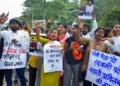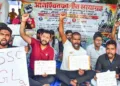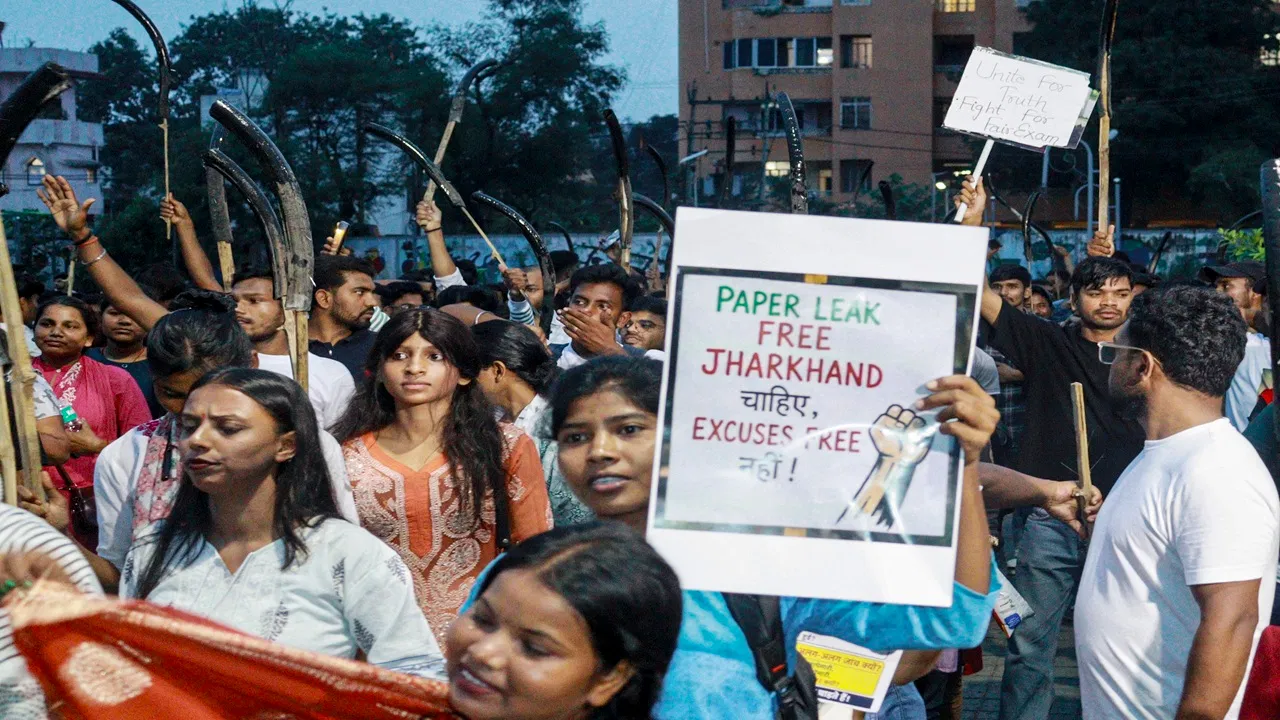
What began as a protest against irregularities in Jharkhand’s recruitment examinations has evolved into a larger movement demanding transparency, accountability and fairness in the state’s recruitment process.
Thousands of government job aspirants have been camping at Jaipal Singh Munda Stadium in Ranchi, where student leader Devendra Nath Mahato launched an indefinite hunger strike on August 2, escalating the agitation against the Jharkhand Public Service Commission (JPSC) and the Jharkhand Staff Selection Commission (JSSC).
The protesters are demanding the cancellation of the 14th JPSC Preliminary Examination, a Central Bureau of Investigation (CBI) and Enforcement Directorate (ED) probe into alleged paper leaks and examination irregularities, and structural reforms to restore public confidence in government recruitment.
The agitation gathered momentum after the declaration of the results of the 14th JPSC Preliminary Examination nearly a month ago. Aspirants alleged multiple irregularities, including paper leaks, OMR discrepancies and procedural lapses.
Since then, students have submitted memoranda to Governor Santosh Gangwar and Chief Minister Hemant Soren, organised marches and demonstrations, and presented documents that they claim pointed towards irregularities.
Addressing supporters at the protest site, Mahato said the response of the state government and the recruitment commission had disappointed thousands of aspirants.
“The current attitude of both the Jharkhand government and the Commission is demoralising students across the state,” he said.
Days Under Tarpaulins, Nights in the Rain
For the students gathered at Jaipal Singh Munda Stadium, the agitation has become more than a protest.
Many have spent years preparing for competitive examinations, sacrificing employment opportunities, financial stability and family time in pursuit of government jobs.
Now, instead of examination halls, they spend their days and nights beneath makeshift tarpaulin shelters.
Despite continuous monsoon showers, the protesters have remained at the site. Videos circulating on social media show students sharing plastic sheets to shield one another from rain, cleaning the protest area, arranging drinking water and helping fellow aspirants continue the sit-in.
Despite heavy rain and powerful winds, students in Ranchi remain on the streets, continuing their peaceful protest against the alleged paper leak while taking cover under plastic sheets and umbrellas.
These young people represent the determination of Jharkhand’s students.… https://t.co/PByl6pPEtK pic.twitter.com/wZVyqBKP8a
— Mukesh (@mksh_kgp) August 2, 2026
Unlike large political rallies supported by extensive organisational machinery, the Ranchi protest has largely depended on volunteers and students themselves.
Participants have organised food distribution, medical assistance and other essential arrangements collectively, saying the movement has survived because of shared commitment rather than institutional support.
Torchlight March Draws Thousands
The agitation intensified further on the evening of August 2, when thousands of aspirants participated in a torchlight procession from Jaipal Singh Munda Stadium to Albert Ekka Chowk.
Carrying placards demanding transparency and accountability in recruitment examinations, the students marched peacefully through Ranchi.
Videos from the march showed participants chanting “Vande Mataram” while appealing to fellow protesters not to raise unrelated political slogans.
“Vande Mataram” chants at the JPSC protests in Jharkhand
No violence. No vandalism. No abuses. Just students peacefully protesting against Jharkhand govt
Yet, don’t expect the usual outrage. The selective silence is because this is happening in a non-BJP-ruled state. pic.twitter.com/zqpKbcGV3q
— Naam Mein Kya Hai (@MithilaWaaaaala) August 3, 2026
In one widely shared video, a protester is heard saying: “This is not Jantar Mantar. There will be no Azadi slogans here and no political sloganeering. This is a students’ protest and nothing else.”
BREAKING: Student protesters clarify they will not chant “Azadi” slogans, emphasizing this movement is distinct from the Jantar Mantar protests. pic.twitter.com/8qCexY0fhQ
— GenZ media (@ApexAlertsHQ_01) August 3, 2026
Participants repeatedly urged fellow demonstrators to keep the movement focused solely on examination reforms and the concerns of government job aspirants.
Demand for Independent Probe
Throughout the agitation, protesters have maintained that their demands are limited to recruitment reforms.
Among their principal demands are:
Cancellation of the 14th JPSC Preliminary Examination.
A CBI and ED investigation into alleged irregularities in JPSC and JSSC-CGL examinations.
Investigation into allegations of paper leaks, leaked OMR sheets and procedural lapses.
Comprehensive reforms to improve transparency in future recruitment.
Although the Jharkhand government has ordered a CID investigation and arrests have been made in connection with certain allegations, many students argue that they lack confidence in a state-level inquiry and continue to seek an independent investigation.
Calls to Keep Protest Non-Political
One of the defining features of the Ranchi agitation has been its emphasis on discipline.
Students have repeatedly appealed to participants to avoid political messaging and ensure that the movement remains centred on recruitment examinations.
The protest site has echoed with patriotic slogans such as “Vande Mataram”, while organisers have discouraged abusive language, violence and vandalism.
Videos shared online show students reminding one another that the objective of the movement is to secure fair examinations rather than advance any political agenda.
Several social media users have also praised the aspirants for attempting to keep the protest focused on examination transparency rather than allowing it to become part of wider political debates.
Contrast With Delhi’s Jantar Mantar
The Ranchi agitation has inevitably drawn comparisons with recent protests held at Delhi’s Jantar Mantar over national examination issues.
Unlike the Delhi demonstrations, where multiple political parties and student organisations, including Left-affiliated groups such as AISA, SFI, AISF, DISHA, KYS, AIDSO, PDSU and Agragami Chhatra Naujawan Sabha, participated, the Ranchi protest has remained centred on alleged irregularities in Jharkhand’s recruitment examinations.
At Jaipal Singh Munda Stadium, students have continued their sit-in with basic facilities, relying largely on mutual support and volunteer arrangements while enduring heavy rainfall.
Participants insist their objective is not political confrontation but ensuring that deserving candidates are selected through a transparent and credible recruitment process.
Chief Minister Hemant Soren has assured that strict action will be taken against anyone found guilty of wrongdoing in the recruitment process.
Meanwhile, several opposition leaders have visited the protest site and expressed support for the aspirants’ demands.
However, students maintain that their struggle extends beyond politics.
For many of those sleeping under plastic sheets in Ranchi, the movement represents years of preparation, sacrifices made by their families and aspirations tied to securing government employment through merit.
They say they are not demanding special treatment but a recruitment system where examinations are conducted fairly, answer sheets remain secure and deserving candidates are not denied opportunities because of alleged malpractice.
Hunger Strike Enters Critical Phase
As Mahato’s indefinite hunger strike enters its next phase, uncertainty continues to surround the future of the agitation.
The protesters insist they will continue their peaceful movement until their demands receive a satisfactory response.
For the thousands assembled at Jaipal Singh Munda Stadium, the protest is no longer only about one examination.
They say it is about restoring trust in a recruitment system upon which the future of countless young people depends.