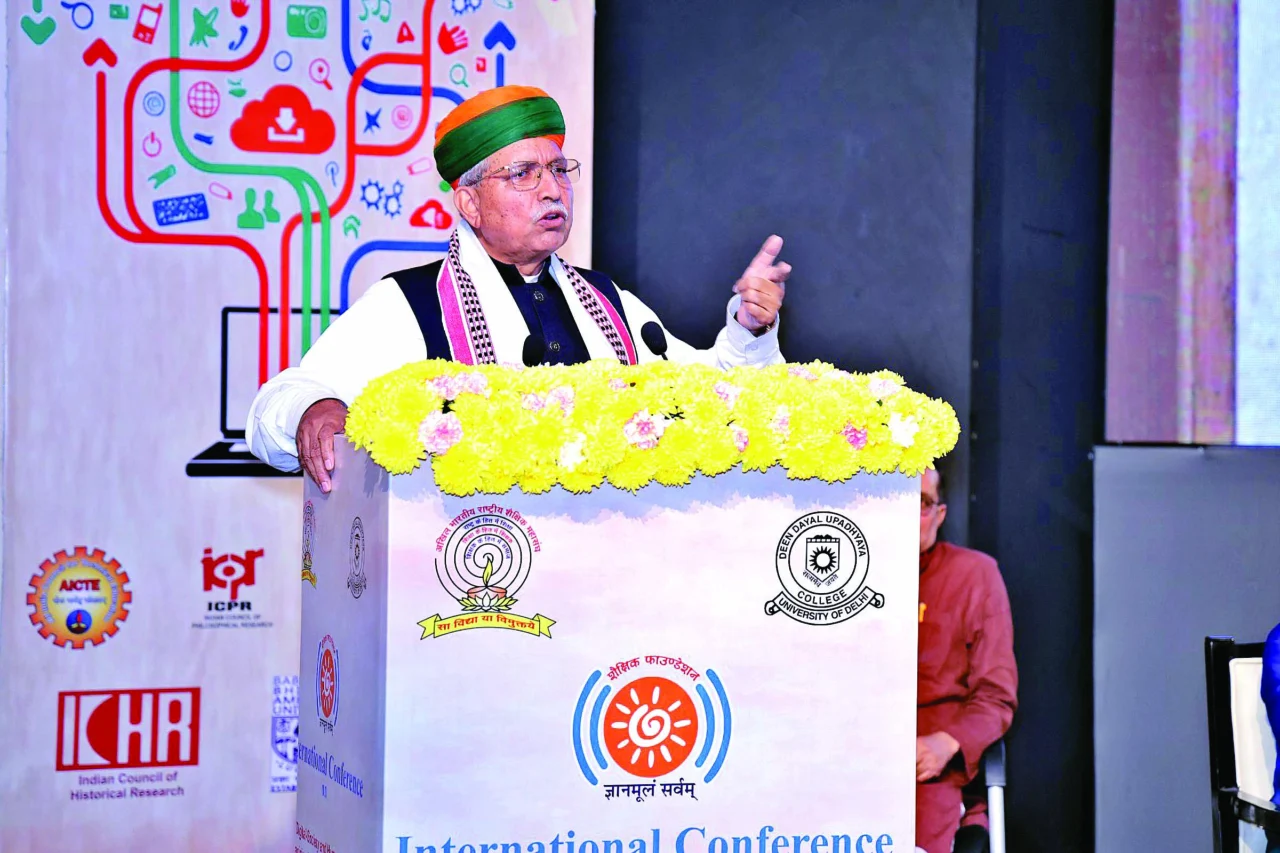
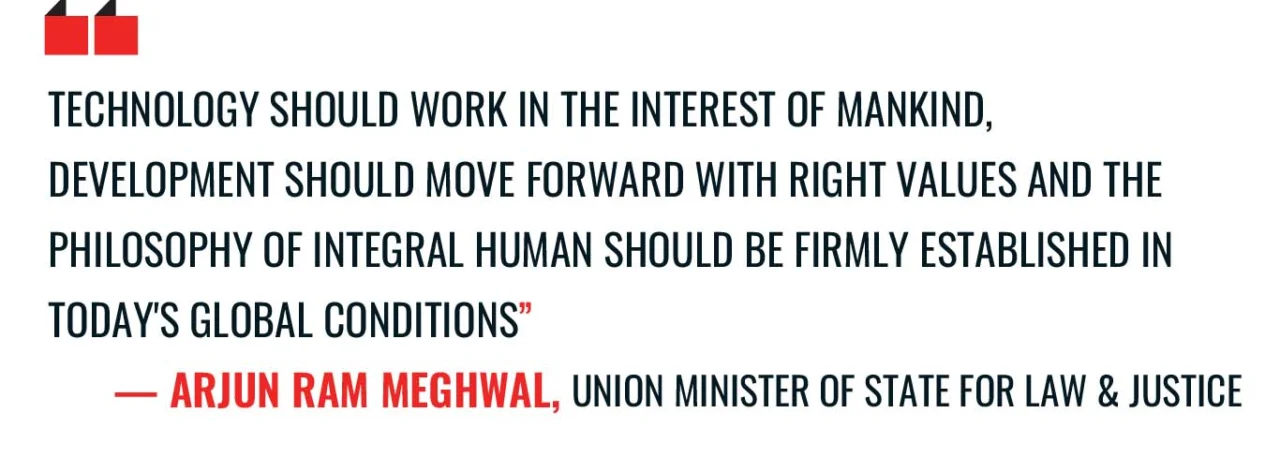
“This Sammelan has marked a transition from philosophical inquiry to pressing legislative and strategic considerations. There is a need to balance Virasat (heritage) with Vikas (development), for Bharat to realise its vision of becoming a Viksit Bharat by 2047, its legal and ethical frameworks must ensure that Artificial Intelligence remains a “servant to humanity” rather than its master,” stated Arjun Ram Meghwal, Union Minister for Law and Justice. He was speaking in the valedictory session of the two day Vaishvik Sammelan (International Conference) on ‘Digital Society and Human Values: Reimagining Integral Humanism in the AI Era’ at the Dr BR Ambedkar International Centre on February 23.
In a significant push to align Bharat’s technological trajectory with its civilisational ethos, the Sammelan was organised by the Akhil Bharatiya Rashtriya Shaikshik Mahasangh (ABRSM) in association with the Shaikshik Foundation and Delhi University’s Deen Dayal Upadhyaya College. The Sammelan emerged as a high-stakes deliberation on how Bharat can lead the global AI discourse without compromising its moral fabric.
The Sammelan, which drew over 800 scholars and policy thinkers from across the country, sought to revisit the philosophy of ‘Integral Humanism’ as a governance framework for the age of automation. Opening the deliberations, Jitin Prasada, Minister of State for Commerce & Industry and Electronics & IT, asserted that Bharat is no longer a mere consumer of global technology but a standard-setter for human-centric AI. Referencing a recent landmark global pact signed by 86 nations, the Minister emphasised that the “Mother of all AI Summits” had already signalled a shift towards inclusive technology, though he remained pointed in his warning against the “darker side” of innovation—specifically the proliferation of deepfakes and AI-driven misinformation.
In his presidential address, Prof Narayan Lal Gupta, President of ABRSM, outlined the core objectives of the Sammelan, stating that the ABRSM not only raises issues concerning the teaching fraternity but also plays a pivotal role in addressing significant contemporary challenges such as Artificial Intelligence and its societal implications. Meanwhile, Prof Geeta Bhatt, General Secretary of ABRSM, elaborated on the diverse academic and thematic sessions, highlighting how each segment was thoughtfully designed to foster meaningful dialogue on technology, ethics, and human values in the emerging AI-driven world.
Academic rigour underscored the event’s plenary sessions, where prominent authors and scientists—including Santishree Dhulipudi Pandit (Vice Chancellor, JNU), Prof Anand Ranganathan Professor at JNU, K G Suresh (VC, MCU), and Prof Jagadesh Kumar (Former Chairman, UGC), debated the erosion of social trust in the era of rapid automation. During these sessions, several distinguished speakers, including Prof Alok Kumar Chakrawal (VC, Guru Ghasidas University), Prof Alpana Kateja (VC, University of Rajasthan), Atul Jain (VC, Deendayal Research Institute), Prof RK Mittal (VC, Babasaheb Bhimrao Ambedkar University), Lt Gen Rakesh Kapoor (Retd), Maj Gen RPS Bhadauria (Retd), and Prof Ashok Kumar Nagawat (VC), remarked that while AI is a formidable tool, it cannot replicate the intellectual or moral excellence of a human “Guru.”
Mahendra Kapoor (Organising Secretary, ABRSM), G Laxman (Joint Organising Secretary, ABRSM), and Mahendra Kumar (Sr Vice President, ABRSM) were among the prominent personalities who graced
the occasion.