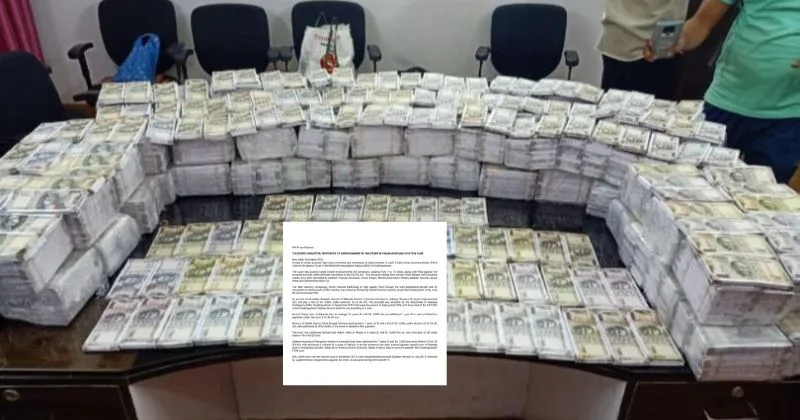
Guwahati: Three Islamists from Assam, amongst the seven convicted in the fake Indian currency smuggling from Bangladesh case by the NIA court. Assam resident Saddam Hossain, who was the prime conspirator of the FICN smuggling and distribution case, was in communication with the international racket based in Bangladesh. The racket’s motive was to undermine the country’s economy by circulating counterfeit currency in the market.
A Special Court of the National Investigation Agency (NIA) in Visakhapatnam has convicted seven individuals for their involvement in a 2015 Fake Indian Currency Notes (FICN) racket linked to cross‑border smuggling of high‑quality counterfeit notes. After 11 years of investigation and trial, the NIA court found 7 residents of Assam, West Bengal, and Karnataka guilty.
Saddam Hossain, Amirul Hoque, and Mohammed Akber Ali from Assam; Roustum and Mohammad Hakim Sheikh from West Bengal; and Karnataka‑based Saddam Hussein and Sayed Imran.
The sentences, pronounced on March 3, range from seven to ten years of simple imprisonment along with monetary penalties, under various sections of the Unlawful Activities (Prevention) Act (UAPA), 1967.
Saddam Hossain of Barpeta district in Assam received the highest sentence—10 years’ simple imprisonment and a fine of ₹5,000 under Section 16 of the UAPA. He was arrested in September 2015 at Visakhapatnam Railway Station after officials of the Directorate of Revenue Intelligence (DRI) seized counterfeit notes worth Rs 5,01,500 from him.
Another Barpeta resident, Amirul Hoque, was sentenced to 10 years and fined Rs 5,000 under Section 18 of the Act. In West Bengal, Malda’s Roustum was awarded seven years in prison and a Rs 2,000 fine under Section 20, while his district counterpart, Mohammad Hakim Sheikh, received an eight‑year sentence and a Rs 5,000 fine under Section 18.
From Karnataka, Saddam Hussein of Bengaluru and Sayed Imran of Mandya were each sentenced to seven years’ imprisonment and fined Rs 2,000 under Section 20. According to the NIA, Imran is also a convict in another FICN case probed in Visakhapatnam. A similar sentence was imposed on Assam’s Mohammed Akber Ali.
Conspiracy to destabilise economy
The NIA stated that the group was part of a wider network involved in smuggling counterfeit currency across the Indo‑Bangladesh border and pushing it into circulation across India. The agency found in its investigation that the operation was designed to undermine the country’s financial system.
The NIA assumed control of the investigation in December 2015. A chargesheet against Saddam Hossain was filed in July 2016, followed by supplementary chargesheets naming the remaining accused in 2018 and 2019.