
The mind and the intellect are not the key-power of our existence. For they can only trace out a round of half-truths and uncertainties and revolve in that unsatisfying circle. But concealed in the mind and life, in all the action of the intellectual, the aesthetic, the ethical, the dynamic and practical, the emotional, sensational, vital and physical being, there is a power that sees by identity and intuition and gives to all these things such truth and such certainty and stability as they are able to compass. Obscurely we are now beginning to see something of this behind all our science and philosophy and all our other activities – Sri Aurobindo, The Human Cycle, Complete Works of Sri Aurobindo, Vol 25, Sri Aurobindo Ashram Trust 1997, Puducherry, p. 244
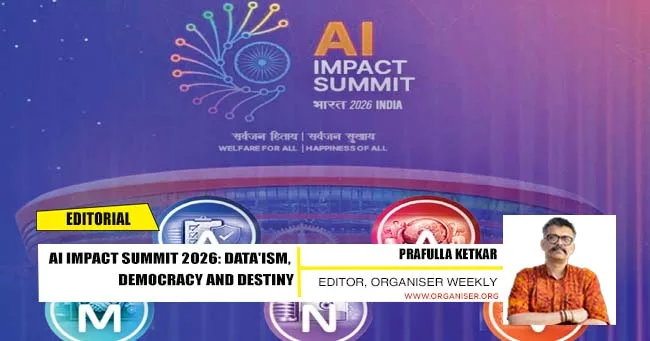
Bharat hosted the first-ever AI Impact Summit of the Global South at Bharat Mandapam in New Delhi from February 16 to 21, 2026. Not that it was the first summit revolving around Artificial Intelligence (AI) and its impact. Earlier, the United Kingdom, South Korea and France had organised theme-based summits ranging from safety to action. Yet, the impact summit organised by Bharat for all differed in many ways from earlier versions.
Earlier versions of AI summits revolved around safety measures, naturally with the defensive approach about the Data‘ism’ – the data-based human life taking the shape of a new religion or ideology in which information flow or data has the supreme value. Yuval Noah Harari, in his 2016 book Homo Deus: A Brief History of Tomorrow, argues that dataflow has the potential to influence the most critical decisions of human life, as religion once did. The response to institutionalised religio-centricism in Europe was Scientificism and the idea of intelligence based on rational decisions and cognitive abilities. Since then, intelligence, emotional intelligence, social intelligence and adversity intelligence evolved as new dimensions of human capabilities. All of them are essentially rooted in the anthropocentric, individualistic logic of intelligence. The current discussion on Artificial Intelligence is a counter to it, as it is driven by data and technology. Bharat offers a more holistic conception of intelligence, where spirituality grounded in evolutionary consciousness provides the foundation.
Contrary to the Western paradigm of data supremacy and monopoly, Bharat, as a leader in AI for the Global South, advances the themes of “AI for All” and the “Sarvajan Hitaya, Sarvajan Sukhaya” philosophy – welfare and happiness of all. The MANAV paradigm outlined by Prime Minister Modi in his inaugural address is an effort to provide a more humanistic, integrated, and inclusive framework for AI. The focus has shifted from safety-centric discussions to impact or development concerns. The principles of sovereignty, accessibility, democracy, inclusivity and governance make the discussion on AI more vibrant and all-inclusive. The female, youth innovation, grassroots applications and non-traditional AI development opened up new avenues. For the first time, agriculture, healthcare, and governance attained centre stage, taking AI beyond techno-centric deliberations.
The launch of several AI models and products developed in Bharat, and their demonstration at the summit, was another heartening feature. Sarvam AI launched a new generation of large language models perfectly addressing the needs of a multi-lingual country like Bharat. The Bombay IIT-based Param 2 model from BharatGen, which supports 22 Bharatiya languages and demonstrates multimodel capabilities, offers new hope for accommodating diversity.
The scale was unparalleled, with more than 35,000 registrations from 118 countries, including heads of Government, Ministers and officials, as well as global tech wizards such as Sam Altman and Sundar Pichai. The French President, acknowledging the UPI kind of innovation for grassroots governance, positioned Bharat as a bridge between the developed world and the Global South through this summit.
The endorsement of the New Delhi Declaration by 89 countries, calling for equitable and responsible AI development, was a landmark achievement. Common people in large numbers joined the celebrations in a Bharatiya style to experience and learn about the emerging technological world. Through the solidification of the three pillars – People, Planet, Progress – to bring in the ethical and sustainable AI deployment is the only way we can control our destiny. Bharat has a continuous and unbroken civilisational wisdom grounded in an integral idea of intelligence spanning material and spiritual dimensions. Hence, the success of India AI Impact Summit should be celebrated as the achievement that would refine data’ism’, based on democratic values to shape our destiny.