
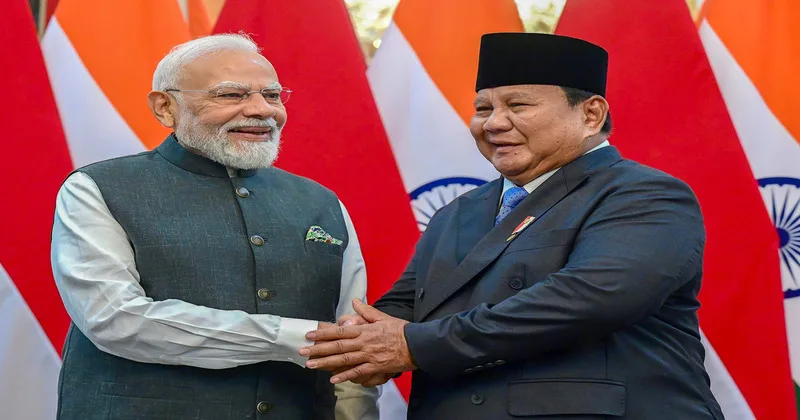
When Prime Minister Narendra Modi arrived in Jakarta to a fighter-jet escort and a personal airport reception by Indonesian President Prabowo Subianto, the symbolism was unmistakable. Defence cooperation dominated the headlines, with reports suggesting Indonesia is considering purchasing a second BrahMos supersonic cruise missile battery after signing its first deal earlier this year. Military hardware makes for compelling diplomacy: it projects power, reinforces strategic partnerships and offers the kind of visual spectacle that naturally commands attention.
Yet the true significance of Modi’s visit lies elsewhere. Beyond the photographs of missile systems and ceremonial welcomes, India and Indonesia are negotiating something potentially far more consequential: a long-term partnership centred on critical minerals, especially nickel. In an era where energy security is increasingly inseparable from national security, access to mineral supply chains may prove more valuable than arms exports.
India’s clean-energy transition rests on an uncomfortable reality. While the country has set ambitious goals to electrify transport and expand battery manufacturing, it lacks sufficient domestic reserves of several critical minerals required to achieve those ambitions. Nickel, a key ingredient in high-performance lithium-ion batteries and stainless steel production, represents one of the most glaring vulnerabilities.
India currently imports the overwhelming majority of the nickel it consumes. More than four-fifths of its ferronickel requirements already come from Indonesia, while battery-grade nickel is sourced almost entirely through imports. Domestic reserves are limited, making self-sufficiency an unrealistic prospect in the foreseeable future. This creates a structural dependency that could undermine India’s broader industrial strategy if left unaddressed.
The timing could hardly be more critical. The government has committed itself to accelerating electric vehicle adoption, with the EV30@30 initiative targeting electric vehicles accounting for 30 per cent of new vehicle sales by 2030. Simultaneously, India’s Production Linked Incentive (PLI) scheme is supporting the establishment of 50 GWh of advanced battery manufacturing capacity. These investments are designed to reduce dependence on imported battery cells, create domestic manufacturing jobs, and position India as a global manufacturing hub.
However, manufacturing battery cells domestically while importing nearly all the critical minerals that go into them merely relocates dependency rather than eliminating it. Battery production is only as resilient as the supply chain feeding it. Without secure access to nickel and other critical minerals, India’s manufacturing ambitions remain exposed to external disruptions, geopolitical competition, and commodity price volatility.
This is where Indonesia becomes indispensable.
Indonesia possesses the world’s largest nickel reserves and accounts for more than half of global nickel production. Over the past several years, Jakarta has pursued an aggressive industrial strategy by banning exports of raw nickel ore and requiring domestic processing before export. The policy aimed to capture greater value within Indonesia by encouraging investment in refining and downstream manufacturing rather than simply exporting raw materials.
By many measures, the strategy succeeded. Indonesia rapidly emerged as the world’s dominant processor of nickel, attracting billions of dollars in investment and establishing itself as a cornerstone of global battery supply chains. Yet success has brought new challenges. A surge in processed nickel production has contributed to falling global prices, squeezing refinery margins. At the same time, the growing popularity of lithium-iron-phosphate (LFP) battery chemistries, which require little or no nickel, has softened demand growth.
For Indonesia, the challenge is no longer building refining capacity but ensuring that capacity remains commercially viable through diversified investment and stable long-term buyers.
The larger complication is China’s overwhelming presence in Indonesia’s nickel sector. Chinese companies financed much of the country’s refining infrastructure and today reportedly control roughly three-quarters of Indonesia’s nickel processing capacity. While this investment transformed Indonesia into a global refining powerhouse, it also created an imbalance. Jakarta increasingly recognises the risks of excessive dependence on a single foreign investor that exercises considerable influence over pricing, technology, and downstream value creation.
India sees the same problem from the opposite direction. As geopolitical competition increasingly centres on supply chains rather than finished goods, New Delhi is seeking to reduce its exposure to Chinese-controlled processing networks. The International Energy Agency projects that Indonesia could account for nearly half of global refined nickel production by 2040. If much of that refining remains dominated by Chinese firms, India’s clean-energy transition would remain indirectly dependent on Beijing, even if raw materials originate elsewhere.
The agreements under discussion during Modi’s visit therefore represent a shift in India’s strategic thinking. Rather than simply importing processed nickel, India is seeking joint ventures that would allow Indian companies to participate directly in refining and processing operations within Indonesia. Such investments would give Indian firms equity stakes in the midstream supply chain, secure long-term offtake agreements, and reduce vulnerability to supply disruptions.
Institutions such as Khanij Bidesh India Limited are expected to play an important role in facilitating overseas investments, while Indian battery manufacturers could underpin commercial viability through long-term purchase commitments. For Indonesia, attracting Indian participation broadens its investor base and strengthens its bargaining position by reducing overreliance on Chinese capital.
Importantly, the emerging partnership extends well beyond nickel alone. Discussions between the two governments increasingly encompass downstream metals, semiconductors, advanced manufacturing, and technology transfer. There have even been proposals to develop integrated supply chains linking Indonesian silica processing with Indian electronics manufacturing capabilities. Companies such as Tata Electronics have featured prominently in conversations about future industrial cooperation.
Connectivity also forms part of the strategic vision. Plans to improve maritime links between India’s Andaman and Nicobar Islands and Indonesia’s Aceh province, including the development of Sabang Port, could significantly reduce shipping times for critical minerals and manufactured goods. At the same time, both countries are exploring cooperation on environmental, social and governance (ESG) standards, including the possibility of establishing recognised certification for “green nickel” that would appeal to increasingly sustainability-conscious global markets.
Taken together, these initiatives point towards a broader Indo-Pacific industrial architecture. Indonesia contributes nickel, Australia provides lithium and rare earths, and India develops large-scale battery manufacturing capacity. Rather than viewing these relationships as isolated bilateral agreements, New Delhi appears to be constructing an integrated regional supply chain capable of supporting both economic growth and strategic autonomy.
Of course, significant obstacles remain. India’s record on implementing overseas resource partnerships has often fallen short of ambitious announcements. Financing, regulatory approvals, commercial negotiations, and infrastructure development all require sustained political commitment over many years. Moreover, today’s oversupplied nickel market may not remain favourable indefinitely. As prices recover, Indonesia’s negotiating leverage will likely increase.
Nevertheless, the direction of travel is unmistakable. Defence cooperation will remain an important pillar of India-Indonesia relations, and BrahMos exports reinforce India’s emergence as a credible defence manufacturer. But missiles are ultimately transactional. Critical mineral partnerships create long-term interdependence through shared infrastructure, industrial investment, technology collaboration, and integrated supply chains.
That is why Modi’s Jakarta visit deserves to be understood as something more than another defence-focused diplomatic engagement. It marks India’s recognition that the defining strategic competition of the coming decades will not simply revolve around military capability but around who controls the materials that power the industries of the future.
The fighter-jet escort may have captured the headlines. The nickel agreements, if successfully implemented, could shape India’s economic and strategic resilience for decades to come.