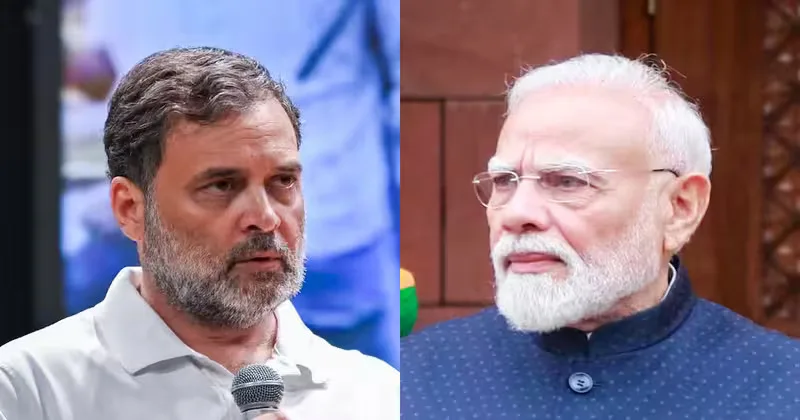
Congress leader Rahul Gandhi’s allegations on government, regarding NEET examination paper leak, employment opportunities and educational reforms is presented with “distorted facts”. This article, counters five major fake allegations made by Rahul Gandhi by producing adequate data & facts.
Over the past deacade, there has been significant legal, technological and institutional reforms, to strengthen examination integrity, expand opportunities for young Indians and modernise the education ecosystem. Thus, political rhetoric cannot overshadow measurable policy outcomes and structural reforms.
Argument 1: The statement given by Rahul Gandhi was, 52 paper leaks had taken place in the last decade, about one paper leak every month.
Reality
- Paper leaks are a serious problem that the government has treated with the utmost seriousness. But the Leader of the Opposition’s figures are a misinterpretation of facts. Bulk of the exams that he is referring to are state-conducted recruitment examinations, many in states his party and its allies have governed. Rolling them into a single charge against the Union Education Minister is politics, not accuracy.
- It is the PM Modi government that established the National Testing Agency in 2017, which became operational from 2019 and now conducts the country’s principal entrance examinations to a common, scientific standard.
- It is the PM Modi government that enacted the Public Examinations (Prevention of Unfair Means) Act, India’s first dedicated national law against paper leaks and organised cheating, prescribing stringent imprisonment and fines up to ₹1 crore for those who would trade in students’ futures.
- When concerns arose around the 2024 medical entrance, the PM Modi government constituted a high-level committee under Dr K. Radhakrishnan recommended deeper reforms and acted on them. To further prevent such ill practices, from January 2026, facial biometric authentication and live photography were rolled out across entrance examinations. JEE Main 2026 used Aadhaar-based biometric checks at centres.
- Considering the history of lies of Rahul Gandhi, one needs to fact check if he has mistaken the paper leaks that occurred under Congress governments for the NDA governments.
The High-Level Committee chaired by Dr K. Radhakrishnan introduced a series of institutional reforms, including
- Enhanced Standard Operating Procedures for the secure transportation and custody of question papers
- Stricter accountability mechanisms for examination functionaries,
- Improved grading and monitoring of examination centres
- Stronger district-level coordination among administrative agencies
- Multiple layers of verification throughout the examination process
- These reforms complemented technological interventions such as biometric authentication, AI-enabled surveillance and live monitoring, creating a significantly more resilient examination architecture designed to protect the integrity of merit.
- In fact, even this year’s medical re-examination was conducted under an unprecedented security architecture. The NTA deployed 1,38,560 CCTV cameras with live feeds monitored at national, state and ministry levels, 38,795 frisking personnel and 48,448 biometric-verification staff supported by face-authentication technology, with two invigilators in each of over 95,000 rooms. It also deployed roughly 51,000 jammers, AI tools analysing live footage, and thousands of ground and virtual observers.
- The work is not finished, and no system that serves 20 million aspirants a year will ever be free of challenge. But the direction of the past decade is unmistakable – a stronger legal and technological shield around the examination hall, and a demonstrated willingness to act in the student’s interest.
- When the 2026 exam got compromised, the government did not let a tainted result stand. It cancelled the exam, held a secure re-examination for over 20 lakh candidates under the heaviest security ever deployed, and declared results on schedule, with over 11 lakh students qualifying on merit, so no honest aspirant paid for the wrongdoing of a few.
- The government shares the anguish of every student and family affected, including the families who suffered the most grievous losses. Their concern is precisely why a re-examination was held.
- As a matter of fact, one should not forget the scams in MCI during the UPA rule under the leadership of Ketan Desai, It was the Modi government which abolished the MCI and established the National Medical Commission and subsequently NEET exam was implemented. For the first time after independence, India had a national examination for medical seats. This is historic in its own right.
Argument 2: Another statement given by Rahul Gandhi is, there have been zero convictions in the last 10 years
Reality
- Accountability is not measured in slogans and theatrics. In NEET 2024 the CBI registered six FIRs, filed three chargesheets and arrested around 49 people, including the masterminds and the officials who enabled the theft. In the 2026 NEET case, 13 accused are currently in custody1. Further arrests followed across six states, and the matter is under the Supreme Court’s own supervision. Convictions follow due judicial process, which takes time, but to say nothing was done ignores the arrests, the chargesheets and the courts.
- If Rahul Gandhi and Congress are sincere, let it explain why it never enacted a law against paper leaks, the bill it introduced was never passed. It was this government that enacted India’s first national anti-paper-leak law, the Public Examinations (Prevention of Unfair Means) Act, 2024, with jail terms and fines up to ₹1 crore.
- The Prime Minister of India has vowed to ensure “stringent punishment” for those involved in the NEET paper leak and stated that “security and the future of youth” is the government’s priority.
Argument 3: The education system was not only rigged but also unaffordable. He claimed the education budget was ₹1.4 lakh crore, while families spend about ₹1.32 lakh crore every year on one exam
Reality
- Education received its highest-ever allocation this year, ₹1.39 lakh crore. Not just allocation, radical reforms, directly attacking the ‘Gulami ki Manasikta’. This is the real concern of Rahul Gandhi, not on reforming the education.
Added chapters on the Emergency (1975–77).
- Reduced the excessive focus on Mughal history
- Included India’s own civilizational and cultural history
- Added the stories and valor of Indian heroes
- Included modern military operations, such as the Surgical Strikes, in the curriculum
- Gave greater importance to regional dynasties like the Marathas, Cholas, and Mauryas
- Promoted education in mother tongues and regional languages, critical thinking, skill based learning, innovation through the NEP 2020
- On the wider issue about coaching costs and opportunity, those concerns are taken seriously by the government and a committee has been constituted on coaching dependency and exam pressure, and they are matters for debate, not grounds to declare the system beyond repair
- The Centre is weighing the possibility of both, a national law to regulate the coaching sector and redesigning entrance exams to make private coaching less decisive in JEE, NEET-UG and CUET-UG.
- First Rahul Gandhi should debate in the Parliament instead of doing media stunts, if he is serious on education
Argument 4: Young people have no opportunities in India. Manufacturing, entrepreneurship, corporate, public sector, do not have opportunities
Reality
- The UPA government created only 2.9 crore jobs in 10 years. The Modi government created 17.19 crore jobs in the same time span. Manufacturing jobs grew just 6 percent under UPA. They grew 15 percent under the NDA. PLFS 2025 data shows educated unemployment fell to 6.5 percent from 7.0 percent. Youth made up 61 percent of new EPFO subscribers in July 2025 alone.
- India had 452 recognized startups in 2013. India has 1.59 lakh startups today. These startups created 17.2 lakh jobs. India now has 132 unicorns. India ranks third in the world for unicorn creation. Indian unicorns raised nearly 20 billion dollars through IPOs in 2025 alone. Founders like Kaivalya Vohra and Aadit Palicha built Zepto into a billion dollar company before turning 23.
- Skyroot Aerospace shows what young Indians achieve when given the chance, something Rahul Gandhi’s own startup never did. Two former ISRO engineers started Skyroot in 2018 with a team of ten people. The team’s average age is 20 to 25. Skyroot became India’s first private space unicorn. Skyroot became the first Indian private company to place payloads into orbit, on 18 July 2026.
- Rahul Gandhi’s own startup shut down years ago. Despite raising capital from anti-national agencies, he failed to understand the real power of the youth of the country. Instead of insulting the youth, students, soldiers, and constitutional bodies, he should learn the success formula from the nationalistic youth of the country.
Argument 5: Congress fully supported the students’ demands and every student protesting on the streets
Reality
- If Congress fully supported the demands of the youth, first it should take responsibility for the paper leaks in Kerala and in Punjab, where its fair weather friend AAP is ruling
- If it fully supports, then it should debate on education reforms in the parliament, instead of joining hands with the anarchists and anti-national elements
The government’s response to NEET paper leak, thus seeks to frame institutional reforms. While, challenges remain, the past decade has also witnessed strong legal, technological and administrative measures to safeguard public examinations and expand opportunities for India’s youth. The government has also urged the opposition to engage in substantive parliamentary debate on education reforms rather than indulging in disruptive politics. Ultimately, students’ welfare remain central to government’s approach.