We all know that the Congress was established by a senior British officer A.O.Hume in 1885. It is important to know about the background and purpose of such an action by an officer of the British Raj in India before venturing into the history of the oldest political party of India. Congress evolved itself as a ‘party of petitioners’ before the then government of India which had its complete control in the hands of the Imperial British government in London. They had by then converted the huge Indian nation into a full-fledged colony of the British empire about which it was said that ‘the sun never sets in the British empire’.
In 1857, Indians of all hues contributed to the First War of Indian Independence against the East India Company which had tacit understanding with the British government and had also full support of its official wings and the army. The way the Indian revolutionaries of 1857 participated in the war against the Britishers was shocking for the British government. However, it took all measures to defeat the revolution and called it the ‘Indian mutiny of 1857’.
After the decisive battle, the British government took some important decisions to continue their empire in India. The first thing they did was to restore the so-called law and order situation in the country to their taste, take direct control of the government in India, unleash a process of punitive actions against the people participating in the independence war and also those attached with the war directly or indirectly. They started appointing ‘conniving’ Indians in different areas of governance and importantly the Indian army. It also ended the direct role of the East India company in the governance structure of India.
By the year 1858, the whole of India barring a few territories was under the British government directly including the Princely ruled states of India. In order to check any resurgence of similar nature, the British government in India kept a close vigil on the activities of the general masses throughout India. One and a half decade after the revolution of 1857, Bankim Chandra Chattopadhya wrote his famous poem ‘Vande-Mataram’ in Bangla language in 1875. It created a great impact on the minds of the activists and intellectuals in Indian society about the concept of freedom.
When Bankim Babu wrote the Bangla novel “Anand-Math” in 1882, he incorporated the song ‘Vande-Mataram’ in it. The novel and the song caught the imagination of the people and the urge for freedom resurfaced at an intellectual and social activism level. Keeping in view the resurgence of the sentiment of independence in Indian society, the British government evolved the idea of creating a sponsored valve for the Indian mind to give vent to their feelings. It created a non-political platform through the British officer under the banner of Congress(INC).
It provided an opportunity to the thinking minds in India to explore the possibility of raising their voice about the grievances against the government and finding solutions at the governmental level. Thus Congress became a soft-spoken ‘party of petitioners’ as conceived by the Britishers. People of higher intellectual girth particularly attached with legal, medical and teaching faculties, serious social activists and the general youth started coming closer to the new platform and give it a strength to operate as a people’s voice recognised by the then government and administration.
The first President of Congress was W.C Bannerji, an Indian by birth. He was followed by a number of Presidents who were Britishers by their birth. They were: George Yule (1888, Allahabad): He was the first British president of the Indian National Congress, Sir William Wedderburn (1889, Bombay & 1910, Allahabad): A former civil servant and a close associate of A.O. Hume, he served twice and was a staunch supporter of Indian self-governance, Alfred Webb (1894, Madras): An Irish Member of Parliament and supporter of the Indian nationalist cause, Sir Henry Cotton (1904, Bombay): A former Chief Commissioner of Assam who was critical of British policies, including the partition of Bengal. Annie Besant was also elected the President of Congress in 1917 in an altogether different socio-political scenario. By then the Congress had become a people’s movement for independence in India. Annie Besant was also the international president of the Theosophical Society.
People of repute in the society came closer to Congress and included men and women like Dadabhai Naroji, Ferozeshah Mehta, Gopal Krishen Gokhle, Surendra Nath Banerjee, Motilal Nehru and Dinshaw Wacha. In its session in Kolkata in 1896, Rabindra Nath Tagore, the compiler of ‘Jana-Gana-Mana’ -our national anthem, sang Vande-Mataram from the dias of the All India session of the INC. This marked the first such public performance of the song that achieved public applause, admiration and support. The moderate face of INC started changing slowly and steadily after that and elements in the society which had revolutionary views also came closer to Congress. It was in 1905, consequent upon the partition of Bengal, that the Congress started moving like a political party and opposed such partition on communal lines vehemently.
With this also came up a non-moderate face within the Congress led by Lala Lajpat Rai, Bal Gangadhar Tilak and Bipin Chandra Pal commonly known as ‘Lal-Bal-Pal’ by the people at large. The Britishers and their cohorts called them ‘extremists’ and the rest of the Congress as ‘moderates’. From 1905 to 1920, both the ‘extremists’ and the ‘moderates’ took the Congress to new heights and the Congress became a truly people’s movement for all practical purposes. During the period from 1915 to 1920, the leadership of the Congress went into the hands of Mahatma Gandhi and Jawaharlal Nehru and the leadership by and large stayed with them up to the division/freedom of India in 1947. The Congress that opposed the Bengal partition in 1905, became a party to the division of India on communal basis as per the demand of Muslim League and the wishes of the British government.
The Congress in 1920, with its session at Nagpur and afterwards, fell a victim to Muslim appeasement with its support to the Khilafat movement unleashed by the communal forces in the country. This appeasement never ended and became a part and parcel of the Congress ideology and practice on the ground. The leadership of the Congress assumed the leadership of the nation once the unfortunate division of the country happened in 1947 with the active role of Muslim League and the British government and the tacit understanding of the Congress. Freedom from Britishers and the division of the country coupled with the massacre and displacement of lakhs and crores of people respectively are the two sides of the same coin.
Congress didn’t learn lessons of history and continued with its policy of appeasement from 1947 onwards and thus derailed the nationalistic outlook of governance in practice. Instead of evolving an egalitarian society with equal rights for all inspired by our age-old civilization and culture, the Congress went into a different mode inspired by the foreign rulers and colonizers of India and continued with the same policy for the rest of the history till date. There are glaring examples to show how the leadership of Congress and the government led by the rotten ideology of Congress damaged the civilizational ethos and the governance model of an independent India that was supposed to evolve itself as a vibrant, aspirational, powerful, self-sufficient, backed by its civilizational goals and the historical achievements. Congress and its governments committed huge mistakes particularly after 1947 in context of its appeasement politics and some of these blunders are enumerated here point-wise.
The government of India headed by Nehru declared a unilateral ceasefire in 1948-49 against Pakistan in Jammu and Kashmir without retrieving the occupied parts of the state and took the matter of J&K to the UN without any approval of the Union Cabinet. The Constituent Assembly of India was ‘compelled’ to incorporate Article 370(formerly 306A) in the constitution at the behest of Nehru only to appease Sheikh Abdullah and his politics in regard to the accession of the state to the Indian Union.
The Congress government in 1949 refused to be a party to the reconstruction and rejuvenation of the depleted Somnath Mandir in Gujarat which was ruthlessly destroyed by Mohd. Ghazni, the invader-looter from Ghazni. Two important treaties were signed with Pakistan by India, one in 1950 in regard to the ‘protection of minorities in India and Pakistan’ and the other in 1960 called ‘Indus Water Treaty’, both to the extreme detriment of the Indian interests far and beyond.
The government of India headed by Indira Gandhi, in October 1966, despite her promise, didn’t take any steps for enacting law to stop cow-slaughter in the country and instead ordered firing on the protesting Hindu saints outside the Parliament. Hundreds of sadhus and protesting men and women were killed on the spot. The Congress government under Rajiv Gandhi reversed the Supreme Court judgement in regard to the Muslim Personal Law in the Shah Bano case in 1986 through a law in the parliament. This gave a big fillip to the communal politics in the entire body politic of the nation.
The Congress government created all sorts of hurdles in the solution of the Ramjanambhumi-Babri disputed site in Ayodhya which convinced the majority community about the intent of the Congress. The enactment of the Places of Worship Act 1991 by the Congress Government was another attempt to debar the majority community to approach courts about the status of their places of worship. The attempt of the Manmohan Government to introduce the Communal Violence Bill was the worst attempt to blame the majority community for all riots in the country.
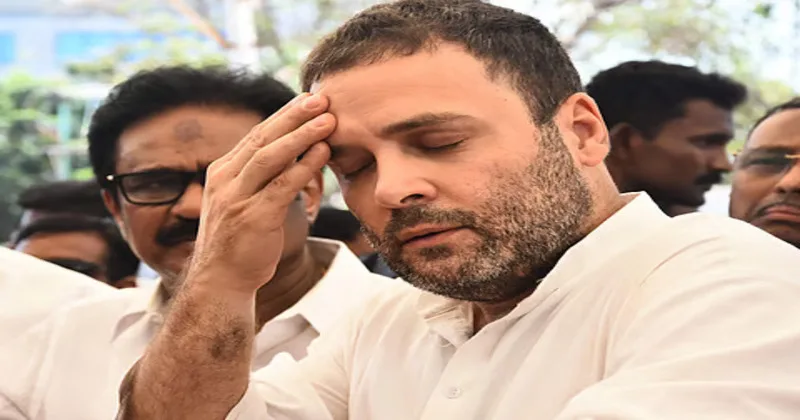
What was left undone by the Congress in line with its policy has been done by the Congress under the leadership of Rahul Gandhi over the last twelve years. With the passage of time, a general perception has evolved about Congress that it has become a national liability. Its actions inside and outside the Parliament, within and outside the country particularly by its leaders like Rahul Gandhi, Mallika Arjun Kharge and others have converted the oldest political party into a functional ‘national curse’. There is hardly any hope left in the current circumstances to reverse the existing trend in this context. Time alone will decide which way Congress leads itself in future…!