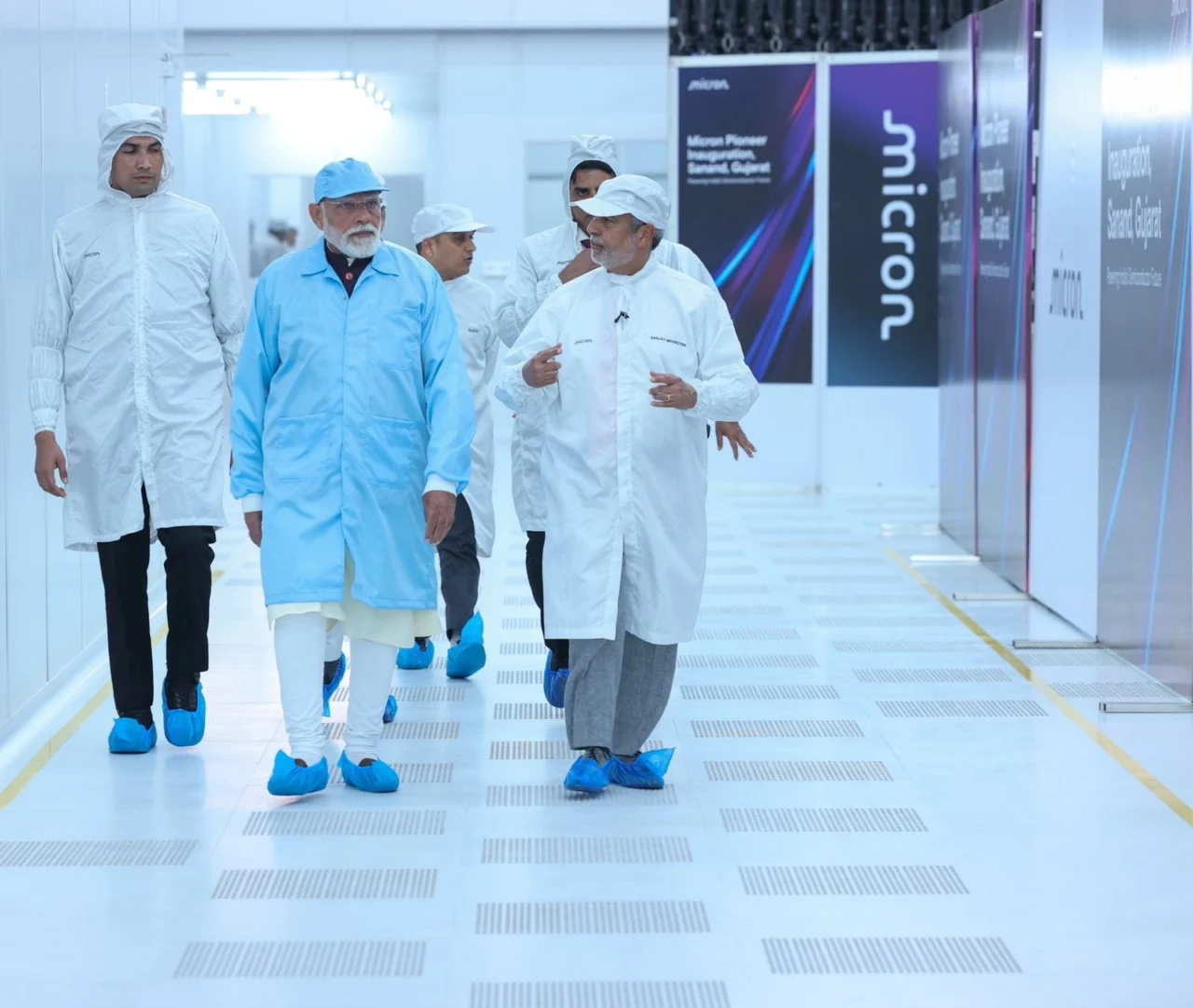
The Prime Minister inaugurated Micron’s state-of-the-art ATMP facility in Sanand, Gujarat, India’s first operational semiconductor assembly and packaging plant producing chips within the country. The facility will assemble and package semiconductor chips used in SSDs and RAM modules, directly linking India to the global electronics supply chain.
The project positions Gujarat as an emerging centre in the international semiconductor ecosystem and signals India’s transition from a software-driven technology economy to a hardware manufacturing powerhouse.
Where is the facility located?
The semiconductor unit has been set up in Sanand, located in Gujarat, a region that has already emerged as a prominent automobile manufacturing hub over the past decade. Once known primarily for a single automobile plant, Sanand today hosts multiple global manufacturing units. The addition of a semiconductor facility marks a major diversification of the region’s industrial base.
What are the job prospects?
The Micron ATMP plant has been built with an investment of approximately Rs 22,516 crore.
Key highlights include:
1. Expected creation of around 5,000 direct and indirect jobs
2. Integration into global electronics manufacturing supply chains
3. Boost to India’s semiconductor self-reliance mission
4. Potential attraction of ancillary suppliers and technology partners
The project is expected to catalyse the development of a broader semiconductor ecosystem in and around Gujarat.
What did PM Modi say at the event?
Addressing the gathering, Prime Minister Narendra Modi described the inauguration as more than just an industrial project. He said the facility sends a powerful message to the world about India’s technological capabilities.
He remarked that the project demonstrates that “India is capable, India is competitive, India is committed,” underlining India’s growing role in advanced manufacturing.
A proud day for India!
Micron Technology’s Semiconductor ATMP facility was inaugurated in Sanand earlier today.
Here are some glimpses from the occasion…@MicronTech @MicronCEO pic.twitter.com/y4vrYEMhdy
— Narendra Modi (@narendramodi) February 28, 2026
Drawing a historical comparison, the Prime Minister said that just as machines defined the Industrial Revolution, semiconductors will define the modern century. He stated that if oil was the regulator of the last century, the microchip will regulate the current one, highlighting the strategic importance of semiconductor production in geopolitics and economic development.
Why is this significant for India?
A decade ago, discussions around technology in India were largely focused on IT services and software exports. According to PM Modi, India is now successfully making its mark in hardware manufacturing as well.
The inauguration represents:
1. A shift from services-led growth to manufacturing-driven technological expansion
2. Strengthening of India’s technological sovereignty
3. Reduced dependence on imported semiconductor components
4. Enhanced global credibility in critical technology sectors
The semiconductor sector is widely regarded as foundational to industries such as artificial intelligence, defence electronics, telecommunications, automotive manufacturing, and consumer electronics.
What is the role of India–US collaboration?
The event was also significant for India–United States technological cooperation. PM Modi emphasised that the program reflects strong collaboration between the two countries in advanced technologies such as artificial intelligence and semiconductor manufacturing.
The presence of the US Ambassador, Sergio Gore, at the inauguration, his first visit to Gujarat after assuming office underlined growing bilateral ties in critical and emerging technologies.
This cooperation is expected to influence the global technology order, particularly amid shifting supply chains and geopolitical realignments in semiconductor production.
How does this fit into Gujarat’s industrial journey?
PM Modi reflected on Sanand’s transformation over the years, recalling how the region evolved from hosting a single automobile plant to becoming one of India’s major automotive manufacturing hubs.
He also mentioned late industrialist Ratan Tata while discussing Gujarat’s entrepreneurial spirit. The Prime Minister suggested that just as the automobile sector reshaped Sanand’s economy, Micron’s investment could similarly anchor a thriving semiconductor cluster in the region.
With this plant in place the suppliers, design firms, packaging specialists, and component manufacturers could follow, creating a multiplier effect across the state’s industrial ecosystem.
What does this mean for India’s youth?
The Prime Minister highlighted that the semiconductor sector will generate new opportunities for young professionals in electronics, design, chip testing, and advanced manufacturing.
He noted that as more semiconductor projects begin production across India, their broader economic and employment impact will become visible.
The launch is expected to encourage skill development in semiconductor design and manufacturing, opening new gates for India’s youth in high-technology domains.
With global semiconductor supply chains undergoing restructuring, India’s entry into chip assembly and packaging is seen as a strategic step. The Sanand facility is expected to serve as a foundation for future semiconductor fabrication and advanced chip manufacturing units in the country.
By integrating policy support, global investment, and domestic manufacturing readiness, the project marks a defining moment in India’s semiconductor mission.