Rahul Gandhi has now taken his fight with the Election Commission to a point where the argument is no longer confined to electoral rolls, Special Intensive Revision or alleged irregularities in particular constituencies. On September 24, he described Chief Election Commissioner Gyanesh Kumar, along with Prime Minister Narendra Modi and Home Minister Amit Shah, as “deshdrohis” and said that what had happened to the vote amounted to an act against the country. He again demanded Kumar’s resignation and suggested that the CEC should “turn approver”.
That is a serious escalation.
Political parties are entitled, indeed expected, to question the constitutional bodies like Election Commission. Governments can also be accused of using institutions improperly, provided there is evidence for the accusation. But calling the head of the constitutional body responsible for conducting elections a traitor is serious. It moves the argument from an institutional dispute into an attack on the personal legitimacy of the constitutional officeholder.
The question that Mr Rahul Gandhi and the Congress party needs to reflect on is, what standard is it applying to the Election Commission today, and what standard did it apply when it was in power? This reflection matters because the history of Indian elections is not a story in which Congress has always stood outside the system, defending institutions against political interference. The record is considerably to the contrary.
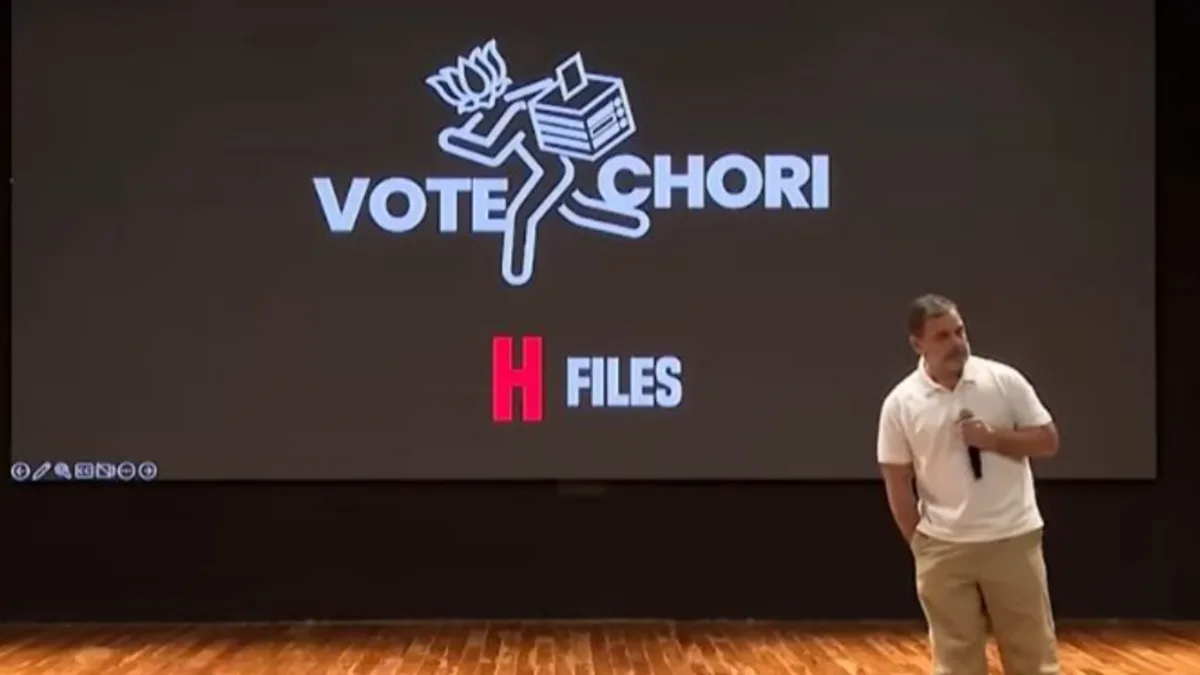
The Congress argument today is that the Election Commission has compromised the electoral process. Rahul Gandhi has repeatedly alleged “vote chori”. In August 2025, the Election Commission responded by asking him to substantiate the allegation through a sworn affidavit or withdraw it. The CEC said allegations of vote theft would otherwise be treated as baseless. Gandhi scion did not accept that demand and the political confrontation continued. In 2026, the argument has moved further. Gandhi has linked alleged “vote chori” to “kanoon chori” and “sanstha chori”, arguing that if the electoral mandate itself is illegitimate, then laws made by Parliament on the basis of that mandate are also illegitimate.
That has much larger repercussions than alleging an irregularity in an electoral roll. It effectively prods the citizens to question the legitimacy of the elected Parliament itself. That is why the language used by Mr Gandhi needs examination.
There is nothing wrong with asking whether the Election Commission has made an error, or demanding electoral transparency. There is nothing wrong with asking why a particular name was deleted or added to a voter list. Those are legitimate democratic questions. But there is a considerable difference between saying that a process needs scrutiny and declaring that the person heading the institution administering that process is a traitor.
The distinction becomes even more important when one looks at Congress’s own history and this history goes to period much before emergency. The first general election of 1951–52 itself raises uncomfortable questions about Congress’s own electoral record. In Rampur, Congress candidate Maulana Abul Kalam Azad was reportedly facing defeat when Nehru is said to have warned UP Chief Minister Govind Ballabh Pant, “If Maulana loses, you lose your chair.” The account by former UP Information Director Shambhunath Tandon alleges that administrative pressure followed, including the tampering of ballot boxes to turn the result in Azad’s favour.
There is another part of the early Congress record that is beyond dispute as a matter of political history: the 1946 Congress leadership contest. The Pradesh Congress Committees overwhelmingly nominated Vallabhbhai Patel. Nehru did not receive those nominations. Yet Nehru became Congress president and subsequently the first Prime Minister after independence following Mahatma Gandhi’s intervention. That episode is relevant because it illustrates something that has remained characteristic of Congress party, that often claims to have internal procedures, but in the party, political power has never been determined by procedure alone. Congress cannot therefore present its own institutional history as one uninterrupted story of procedural purity.
Even Dr. B.R. Ambedkar, fell victim to the Congress’s electoral machinations. After losing the Bombay North constituency in 1952, Dr. Ambedkar openly questioned the integrity of the results, noting that an astonishing 74,333 ballot papers had been suspiciously rejected. Jointly with Ashok Mehta, Ambedkar filed a petition before the Election Commissioner to set aside the result, bitterly noting that the Congress had degenerated into a platform devoid of principles. When Ambedkar contested the 1954 bypoll in Bhandara, he was defeated again amid a relentless campaign of character assassination led by Nehru.
The Emergency makes the point far more starkly. In 1975, the Allahabad High Court found Indira Gandhi guilty of electoral malpractice in the case arising from her 1971 election. The political response culminated in the declaration of the Emergency. Fundamental rights were curtailed, opposition leaders were imprisoned and constitutional changes were made to protect the Prime Minister’s election from judicial challenge.
The Shah Commission subsequently investigated abuses committed during the Emergency. The Government of India’s own account of the Commission records that it examined misuse of governmental power, preventive detention, press censorship and other Emergency excesses. The Emergency remains one of the most important episodes in the history of Indian constitutional democracy.
The 1987 Jammu and Kashmir Assembly election is an even darker chapter in Congress’s electoral record. The Congress-National Conference alliance was accused of rigging the election, with MUF candidates allegedly denied victories and polling agents arrested. The consequences were severe. Among those who turned to militancy were MUF candidate Muhammad Yusuf Shah, who became Syed Salahuddin, and his election manager Yasin Malik, who later headed the JKLF. The episode is widely cited as one of the factors that helped fuel the subsequent insurgency in Kashmir.
The pattern repeated in Amethi during the 1980s. In 1984, Maneka Gandhi was subjected to severe intimidation, assault, and violence by Congress workers while contesting against Rajiv Gandhi. In the 1989 Amethi Lok Sabha poll, widespread ballot-stuffing and booth capturing by Congress cadre reached such alarming proportions that the Election Commission was forced to order an investigation after opposition leader Sanjay Singh was shot and critically wounded during polling violence.
When Rahul Gandhi points fingers at Chief Election Commissioner Gyanesh Kumar, accusing him of bias, he conveniently expects the country to forget the dark era of UPA governance when the Election Commission was actively converted into an extension of 10 Janpath.
Chawla served in the Delhi administration during the Emergency and later became an Election Commissioner and then Chief Election Commissioner. The Shah Commission criticised the manner in which Chawla and other officials exercised power during the Emergency. The Commission found that they had exercised enormous power because of their access to the Prime Minister’s house and described their approach as authoritarian and callous. The Commission’s conclusions regarding Chawla remain part of the historical record, even though aspects of the Commission’s findings were subsequently contested in legal and political debate.
The issue became politically explosive when Chawla was appointed Election Commissioner in 2005 under the UPA government. In January 2009, Chief Election Commissioner N. Gopalaswami recommended Chawla’s removal to the President, alleging partisan conduct. The controversy was particularly serious because Gopalaswami himself was the head of the institution. The recommendation was rejected. Chawla subsequently became Chief Election Commissioner in April 2009 and conducted the 2009 general election. The official history of the Election Commission records Chawla’s tenure as CEC beginning on April 21, 2009.
If the argument today is that the appointment of a CEC must be free from any possibility of executive influence, that principle should be applied consistently across governments.
For decades, the appointment of the CEC was the sole prerogative of the Prime Minister’s office. Sukumar Sen, S.P. Sen Verma, T. Swaminathan, S.L. Shakdhar, every single one was handpicked without any panel or opposition consultation. When Senior BJP leader L.K. Advani wrote to PM Manmohan Singh suggesting a bipartisan selection committee including the Leader of Opposition and the CJI, the Congress government arrogantly dismissed the proposal and appointed V.S. Sampath unilaterally.
For Rahul Gandhi—whose party turned the Election Commission into a post-retirement placement agency for family loyalists, to claim moral high ground today is the absolute pinnacle of political hypocrisy.
Contrast the Congress party’s murky history with the appointment of Mr. Gyanesh Kumar and the present electoral mechanism. Rahul Gandhi claims that the process of selecting the CEC is compromised and “illegal”. Once again, he misleads the public. The current selection process is governed by the Chief Election Commissioner and Other Election Commissioners Act, 2023, enacted by Parliament. This Act was brought in following the Supreme Court’s March 2023 ruling, which explicitly noted that its interim arrangement (including the CJI) would only apply “until Parliament enacted a law” pursuant to Article 324(2). Today, for the first time in Indian history, the selection is codified by statute
Rahul Gandhi participated in that Selection Committee and recorded his dissent. His disagreement with the composition of the committee is legitimate political argument. He can argue that the Chief Justice of India should have a role. He can argue that the government has too much influence. He can seek amendment of the law. But there is a difference between saying that the law should be changed and saying that the officer appointed under that law is therefore illegal.
That distinction has been blurred in the current political campaign.
There is another point worth remembering. Internal disagreement within a constitutional body is not itself proof of institutional capture. The recent controversy arose after reports that Election Commissioners Sukhbir Singh Sandhu and Vivek Joshi had raised objections over aspects of the Election Commission’s handling of electoral-roll revision. Rahul Gandhi seized upon those reports as evidence of something much larger.
But dissent inside an institution requires examination of the underlying documents. It does not automatically establish that the institution has been captured. If Election Commissioners disagree, the proper democratic response is to ask what they disagreed about, what decision was ultimately taken, what evidence supports each side and whether the final decision complied with the law. That is a much stronger method of accountability than simply declaring the CEC a traitor.
There is also a problem with the argument that repeated electoral victories by one political party are themselves evidence that elections must have been manipulated. Anti-incumbency is not a constitutional rule, but a political tendency.
Congress itself won five consecutive Lok Sabha elections from 1951–52 through 1971. Congress governments remained in office for decades. In later years, regional parties have also won repeated mandates. The Left Front governed West Bengal for 34 years. Naveen Patnaik served five consecutive terms in Odisha. Pawan Kumar Chamling governed Sikkim for 25 years. There is no democratic principle saying that a government must lose simply because it has been in office for a certain period.
The BJP has also lost elections since 2014. It lost Rajasthan, Chhattisgarh, Karnataka, Himachal Pradesh and Jharkhand at the state level. Those results are important because they complicate any simple theory that the Election Commission mechanically delivers victories to the ruling party.
The only restates that the Indian voter is sovereign.
In a constitutional democracy, power will alternate. But when a major political leader tells the youth of the nation that the vote has no meaning, that laws are illegal, that constitutional bodies are meaningless, and that the Chief Election Commissioner is a “traitor,” he is actively undermining the republic and is dangerous as well as risky.
When challenged by the Supreme Court and the Election Commission to provide concrete evidence and sign a legal affidavit backing his claims of vote theft, Rahul Gandhi routinely refuses. He prefers press conferences over court affidavits because a press conference carries no perjury penalty. He can fling wild allegations of “400-plus conspiracies” and “stolen rolls” without presenting a single shred of admissible evidence.
India’s electorate is too vast, too politically conscious, and too proud of its democratic tradition to allow a entitlement-driven narrative to tear down its institutions.
Chief Election Commissioner Gyanesh Kumar and the Election Commission of India do not need to bow to wild ultimatums, nor should they be intimidated by threats of post-power investigations. The Congress party, with its grim history of Shah Commission condemnations, Navin Chawla’s partisan misconduct, the 1987 Kashmir rigging, and systematic post-retirement bribes for CECs, has zero moral authority to lecture anyone on institutional integrity. It is time for Rahul Gandhi to stop hiding behind conspiracy theories, step away from the slideshows of doom, and learn the hardest lesson in a democracy: respect the wisdom of the Indian voter, or prepare to be repeatedly rejected by them.