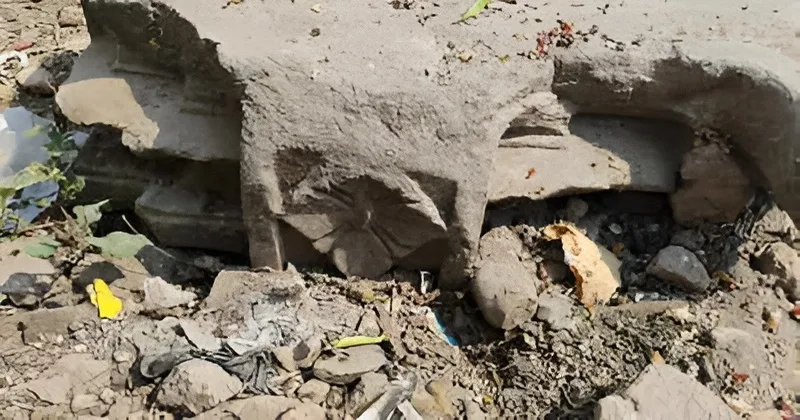
Researchers have claimed the discovery of remains of a 12th-century Mandir-style stone pillar from the Seuna (Yadava) dynasty near the banks of the Vena River in Hinganghat town of Maharashtra’s Wardha district, around 70 km from Nagpur. The finding is being seen as fresh evidence of Hinganghat’s historical importance.
The fragments were spotted by idol researcher Panchsheel Thul while he was studying ancient Mandir sites along the riverbank. What initially appeared to be ordinary stones caught his attention due to intricate carvings. Upon closer examination, Thul identified architectural features typical of Yadava-era Mandirs. After a joint inspection with researcher Pravin Kadu, the team concluded that the remains likely date back to the 12th century.
According to the researchers, the fragments are carved from locally available black basalt. A finely sculpted lotus motif stands out on one piece, reflecting the high level of craftsmanship, especially given the hardness of basalt. They believe the pillar may have formed part of a Mandir’s sabhamandap (assembly hall) or stood in front of the garbhagriha (sanctum). Another fragment appears to belong to the base or pedestal of a main pillar.
The carvings are characteristic of the Hemadpanti architectural style associated with Yadava rule in the 12th and 13th centuries. This style is known for its interlocking stone construction without the use of lime mortar.
Historians note that several parts of Vidarbha flourished culturally, religiously and commercially under Yadava rule, with references to ancient settlements and temples along the Vena river found in historical accounts.
Thul and Kadu have informed the local municipal council and submitted a memorandum to CEO Prashant Urkude, urging protection of the fragments, which are currently lying exposed to weather and possible human interference. Officials have advised them to approach the Archaeological Survey of India for further action.
The researchers believe more neglected historical remains may be scattered across the Hinganghat region and have called for a detailed archaeological survey. Citizens have also demanded the establishment of a small museum for scientific preservation and academic study. Experts say proper excavation and scientific examination could shed more light on Hinganghat’s antiquity and potentially boost heritage tourism in the area.