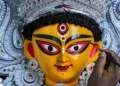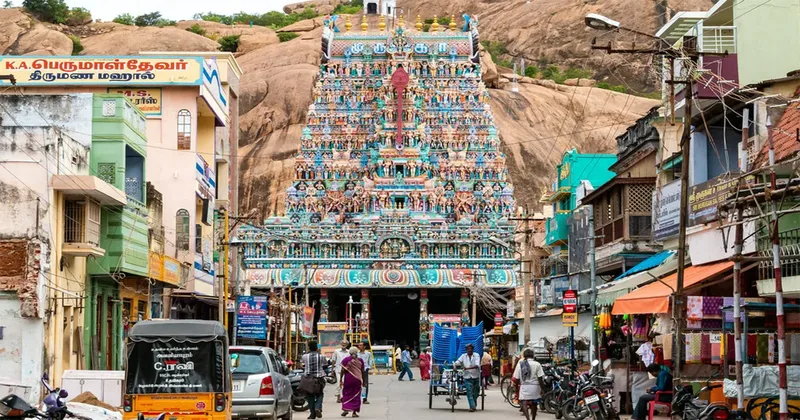
Chennai: The hill shrine of Thirupparankundram Murugan Mandir is not merely a sacred destination in Tamil Nadu; it is a civilisational symbol layered with memory, devotion, literature, and politics. As the first of the six sacred abodes, known as the Arupadai Veedu, of Bhagwan Murugan, Thirupparankundram occupies a deeply emotional and spiritual space in the Tamil consciousness.
In the ancient Sangam poetry, Murugan is described as Seyyon, the radiant Bhagwan of the hills, intimately connected to the kurinji landscape and indigenous Tamil spirituality long before later theological syntheses connected him with Skanda or Kartikeya in the broader traditions of Bharat. Over the course of many centuries, this fusion created a deity who is simultaneously Tamil in origin and pan-national in recognition. This dual identity makes Murugan uniquely positioned to function as a cultural bridge between South and North Bharat, particularly at a time when debates over Dravidian identity and national integration continue to shape the political discourse of the state.
The First Abode: Thirupparankundram’s Spiritual and Civilisational Legacy
Thirupparankundram’s legacy transcends modern constructs, marking where Bhagwan Murugan wed Deivayanai. This union symbolises the synthesis of indigenous Tamil traditions with Bharat’s broader Vedic frameworks. The rock-cut Mandir, a Pandya and Nayaka architectural marvel, features a sanctum carved directly into the granite hill. For millennia, this site has inspired poets like Nakkeerar. Beyond architecture, the hill is worshipped as a living divine entity. This profound connection between land and divinity is a cornerstone of Bharat’s identity, reflecting an ecological spirituality that reveres nature. Such enduring sentiments define a civilisational identity rooted in an ancient, continuous culture.
Prime Minister Narendra Modi’s Visit: A Symbolic Convergence
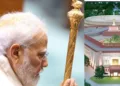
In the current political landscape of 2026, the arrival of Prime Minister Narendra Modi is far more than a routine spiritual gesture; it is a profound symbolic statement that resonates with the Prime Minister’s vision of Vikas aur Virasat development, coupled with heritage. Prime Minister Modi’s leadership has consistently employed civilisational imagery to frame the identity of Bharat not as a modern construct born in 1947, but as an eternal continuum stretching back thousands of years. His previous installation of the Sengol in the new Parliament building in New Delhi serves as a perfect precursor to this visit. The Sengol, associated with the Chola-era tradition of ethical and righteous rule, was presented as a Tamil civilisational artefact restored to the very heart of the democracy of Bharat. By placing a symbol of Tamil history at the centre of national authority, the Prime Minister signalled that Tamil antiquity is not peripheral but foundational to the national ethos. A visit to Thirupparankundram operates within the same symbolic vocabulary, communicating that Murugan is an integral figure in a broader narrative that unites the diverse regions of Bharat.
Murugan as the Bridge to Bharat
The theological identity of Murugan provides a fertile ground for national integration that respects regional distinctiveness while celebrating a common heritage. In the northern regions of Bharat, Kartikeya or Skanda is recognised as the valiant son of Shiva and Parvati and the supreme commander of the celestial armies. While he may not occupy the same daily devotional centre in the North as he does in the South, his presence in the Puranas and the Mahabharata establishes a shared scriptural foundation for all of Bharat. In Tamil Nadu, however, Murugan is the “Tamil Kadavul,” the very heartbeat of the land. This asymmetry creates an interesting and productive dynamic where Murugan acts as a symbolic connector, reducing the perception of a civilisational gap between different parts of the country.
Unlike historical narratives that focused on a perceived fake “Sanskritic dominance” over the South, a Murugan-centred narrative highlights how Tamil spiritual traditions have actively contributed to and enriched the broader fold of Bharat. If framed with the respect and inclusivity that the Prime Minister often emphasises, Murugan’s devotion has the potential to soften the ideological binaries that have characterised local political rhetoric for decades. Traditional Dravidian ideology often emphasised linguistic pride in a way that sometimes positioned it in opposition to a perceived northern cultural imposition. However, by presenting Murugan as both distinctly Tamil and authentically a deity of Bharat, the narrative shifts from one of resistance to one of contribution. This reframing allows Tamil identity to be seen as one of the most luminous and ancient strands of the tapestry that is Bharat, rather than a separate entity standing outside of it.
Deconstructing the Aryan Migration Theory and Modern Synthesis
The early ideological construction of the Dravidian movement was heavily reliant on the “Aryan migration theory,” a colonial-era model that suggested a violent invasion or a major migration of “Aryans” into the subcontinent, who then supposedly suppressed the indigenous Dravidian peoples. Within this framework, Tamil identity was often cast in a narrative of historical oppression, making resistance to “Brahminical” or northern influence a political imperative. However, as Bharat enters a new era of self-understanding in 2026, modern scholarship is moving toward a much more nuanced and unified picture. Archaeological and linguistic evidence no longer supports the idea of a violent conquest. Instead, researchers now speak of complex interactions, gradual migrations, and, most importantly, a deep-seated genetic and cultural synthesis that occurred over millennia.
Genetic research over the last decade has fundamentally altered how we understand the people of Bharat. Studies show that all populations within the country are the product of multiple layers of admixture. There is no such thing as a “pure” Aryan or a “pure” Dravidian in a biological sense. Modern Indians, whether in the North or the South, share a common genetic foundation that includes Ancestral South Indian and Ancestral North Indian components in varying proportions. Furthermore, on a broader evolutionary scale, all non-African populations, including everyone in Bharat, carry roughly 1 per cent to 2 per cent Neanderthal DNA, a fact that highlights our shared prehistoric journey as a species. This scientific reality makes the old political use of racial theories increasingly obsolete. Human history in Bharat is characterised by movement, synthesis, and shared ancestry, making the narrative of “us versus them” scientifically untenable. Recognising this complexity allows for a political discourse that focuses on shared destiny rather than ancient divisions.
The 2026 Tamil Nadu Assembly Election: A Historic Shift
The Prime Minister’s visit to Thirupparankundram occurs as the 2026 Tamil Nadu Assembly elections approach, marking a significant moment for the state’s political future. A key feature of this landscape is the strengthened synergy between the AIADMK and the BJP, as both parties work in harmony to provide a stable, development-oriented alternative. The AIADMK, with its deep grassroots legacy and commitment to social welfare, complements the BJP’s national vision, creating a formidable alliance rooted in mutual respect for Tamil traditions.
Under Prime Minister Modi’s leadership, this partnership is strategically merging Tamil spiritual pride with Bharat’s broader nationalism. By championing the rights of Murugan devotees and honouring sacred sites, the alliance seeks to reconnect with millions of voters who cherish the land’s spiritual roots. With over 5.67 crore voters, this election has become a pivotal opportunity to integrate Tamil Nadu’s unique cultural identity with the collective progress of Bharat, ensuring a future that honours both heritage and growth. The 2026 election is not just about governance; it is a battle for the very soul of Tamil politics and its relationship with the rest of Bharat.
The “Karthigai Deepam” Dispute: Faith, Politics, and Governance
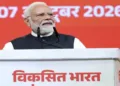
The “Karthigai Deepam” dispute over lighting the sacred lamp at Thirupparankundram’s “Deepathoon” pillar became a significant flashpoint for religious freedom in Bharat. Administrative hurdles led to a landmark legal battle, where the Madras High Court and Supreme Court ultimately upheld the devotees’ rights. Prime Minister Modi’s visit on March 1, 2026, serves as a powerful validation of these spiritual sentiments, signalling solidarity with the heritage of Bharat. This intersection of faith and governance has elevated local traditions to national importance, likely influencing the electoral landscape in southern Tamil Nadu, where devotion to Murugan remains a profound force.
Infrastructure as the “Modi Guarantee” in the South
Parallel to cultural gestures, the Prime Minister’s “Modi Guarantee” focuses on tangible progress. During his March 1, 2026, visit to Madurai, he will launch infrastructure projects exceeding Rs 4,400 crore, including the four-laning of NH-87 to enhance connectivity to Rameswaram. This dual strategy of honouring the ancient while building the modern presents a vision of Bharat where world-class highways coexist with vibrant temples.
By framing these projects as a national effort to uplift all of Bharat, the Prime Minister invites Tamil Nadu to lead in a story of growth. The message is clear: the development of Tamil Nadu is essential for the prosperity of Bharat, and the South’s cultural heritage is a national pride. This approach aims to bridge regional barriers through shared goals of prosperity and strength.
The Emerging Political Synthesis
The confluence of spiritual symbolism and developmental focus is creating a new kind of political synthesis in the region. For years, the Dravidian model was built on a foundation of social justice and regional autonomy. While these elements remain vital, there is an increasing demand for a narrative that also includes cultural rootedness and national integration. The Prime Minister’s visit to Thirupparankundram is a key moment in the articulation of this new narrative. It suggests that one can be a staunch defender of the Tamil language and culture while also being a committed citizen of Bharat.
This synthesis is also being reflected in the changing language of the opposition. Even parties like the TVK are now using terms that emphasise “purity” and “traditional values,” showing that the ground is shifting away from the purely secularist and rationalist rhetoric of the past. As we move closer to the election dates, the competition for the cultural and spiritual heart of Tamil Nadu will only intensify. The 2026 election will likely be remembered as the moment when the state’s political identity was fundamentally reframed, moving toward a model that is more integrated with the civilizational ethos of Bharat.
A Unified Vision for Bharat
The hill of Thirupparankundram and the deity who resides there, Lord Murugan, serve as profound symbols of the enduring and unifying spirit of Bharat. The Prime Minister’s visit on March 1, 2026, is a landmark event that brings together history, faith, science, and the future of politics. By engaging with the “Tamil Kadavul” at this historic site, the Prime Minister is performing an act of civilizational bridging that seeks to heal old divisions and build a unified national identity. The transition from the old Aryan-Dravidian binary to a modern scientific understanding of shared ancestry reflects a nation that is growing more confident in its own story.
As Tamil Nadu prepares for the historic 2026 elections, the symbols of the Sengol and the Arupadai Veedu will continue to play a central role in the public imagination. They represent a vision where regional pride and national unity are two sides of the same coin. Whether through the massive infrastructure projects that improve the lives of millions or the symbolic poojas that touch the hearts of the faithful, the current path of Bharat is one of synthesis and strength. Thirupparankundram, with its ancient rocks and eternal devotion, stands as a silent witness to this unfolding chapter in the history of a great nation, reminding everyone that while the political seasons may change, the soul of the land remains constant and divine