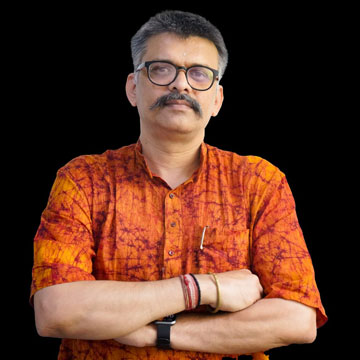

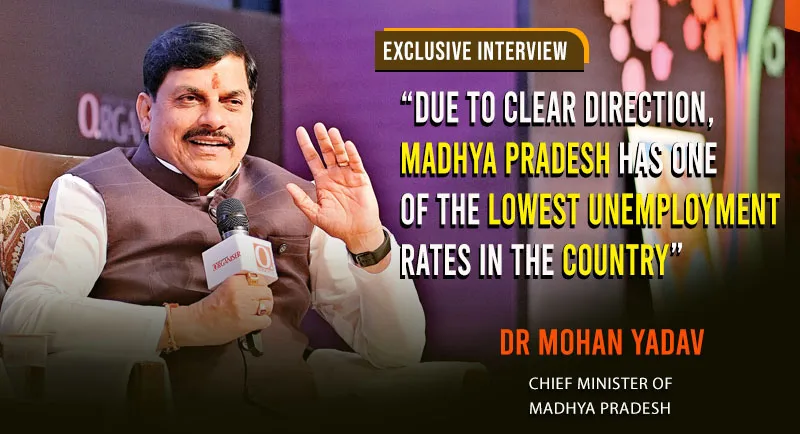
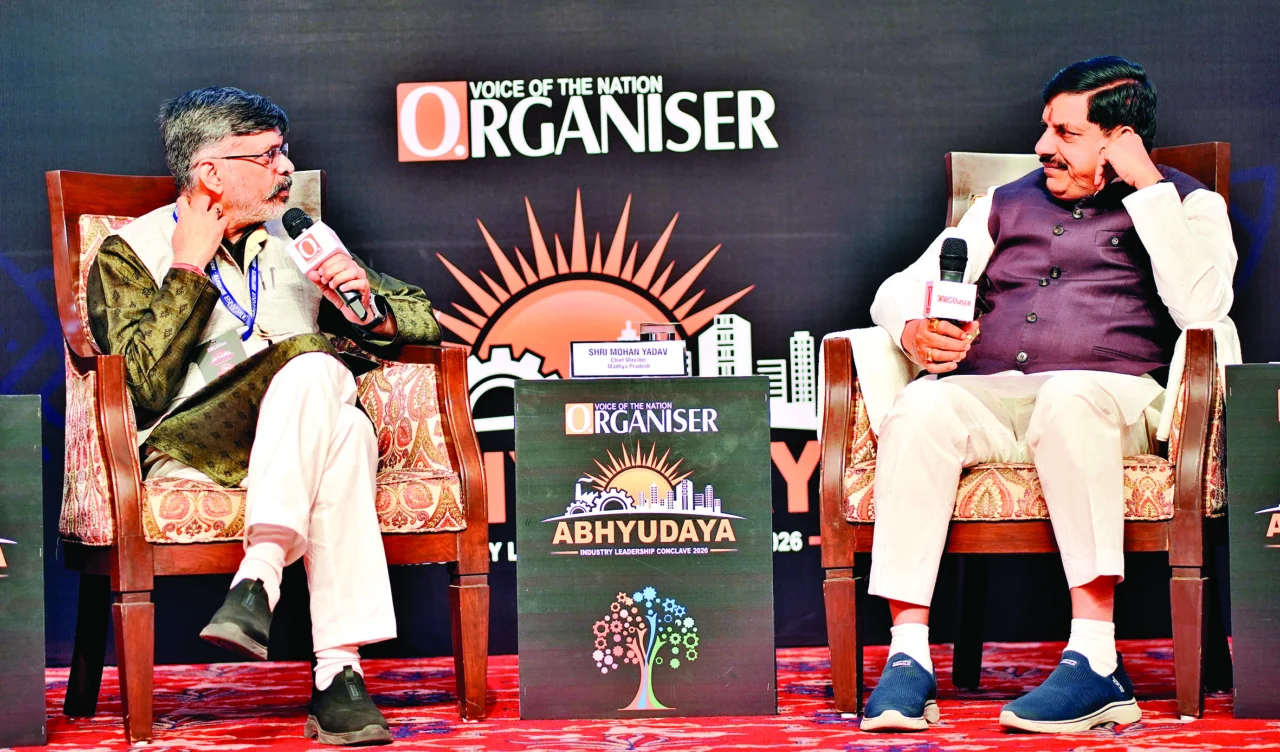
In this wide-ranging conversation with Organiser Editor Prafulla Ketkar, Chief Minister of Madhya Pradesh Dr Mohan Yadav, outlines how policy reforms, infrastructure expansion, irrigation projects, employment-driven incentives, industrial promotion strategies, and a strong Centre–State partnership have reshaped the State’s trajectory. Excerpts:
Madhya Pradesh was long seen as a “BIMARU” and agriculture-dominant state, contributing over 12 per cent to the agricultural sector. What enabled such a rapid shift in perception towards industry, including AI, pharma, manufacturing, and defence? What is unique about your industrial policy that made this transformation possible?
Due to Congress’s misgovernance and poor policies, the State was held back for years. In the last 10–11 years under Prime Minister Modi’s leadership, progress has been visible across every sector. We realised that with our natural resources and skills, what we needed was the right vision, infrastructure, and markets. Projects like bringing Narmada water to Malwa and Indore, once declared “impossible,” changed the region’s future, boosting agriculture, irrigation, and industry. Earlier governments lacked the will to modernise industries, update technology, protect workers, or build trust. After forming Government, we focused on reforming policies, building investor confidence, and promoting industrialisation. We reached out nationally and internationally, inviting industries to partner with us, creating opportunities for growth, jobs, and a stronger State economy.
Ujjain is emerging both as a spiritual tourism hub and a centre for pharma and medical equipment industries. MSME leaders have appreciated the 87 per cent subsidy policy and the timely clearance of backlogs in Madhya Pradesh. However, the supply chain remains a concern. Like Andhra Pradesh, which guarantees minimum Government purchases for new industries, is your Government also considering a similar assured procurement policy, especially to help sectors like pharma and medical equipment to compete with China?
We are thinking beyond just guaranteed purchases. Our focus is on employment-driven industrialisation. For industries that generate jobs, we provide Rs 5,000 per labourer as support. We have clearly distinguished between labour-intensive and highly automated, machine-based industries. While all industries receive policy support, employment-generating units get additional incentives because job creation is our priority.
The results are visible today. Madhya Pradesh is now counted among the states with the lowest unemployment rates in the country, at around 1–1.5 per cent.
With the launch of the Madhya Pradesh Industrial Promotion Policy 2025 and last year’s major Industrial Investment Summit, what key achievements have emerged?
We worked on two fronts. First, we want our youth to become job creators, not job seekers. So we are building a system where they can set up their own industries and generate employment. Second, we adopted a region-specific approach. Madhya Pradesh, being geographically large and diverse, has different strengths – mining, tourism, agriculture, religious tourism, and more. We introduced around 24 new sectoral policies and organised industry conclaves to highlight each region’s potential. For example, in Narmadapuram, abundant water from the Tawa and Narmada rivers, good transport links, and available wasteland made it ideal for solar and battery projects. A 200-acre solar park quickly expanded to 800 acres, and now a new 1,000-acre park is being planned due to strong demand. Similarly, in Shahdol and Singrauli, where raw materials like iron ore were earlier sent outside the State, we encouraged local value addition. As a result, major investments like a Rs 3,000 crore project in Shahdol have materialised. The focus is clear: use local resources, build local industries, and create employment in MP.
In the context of NEP 2020 and the growing focus on R&D and innovation, how do you plan to strengthen the education–industry interface? Will policy input and consultancy be driven mainly by external firms like the Big Four, or will academic institutions also play a direct role in policymaking and industry collaboration?
Absolutely. Our thinking is aligned with this vision. If industries are coming to Madhya Pradesh, the State’s skilled workforce should also be developed. That is why strengthening the education–industry link is a priority. When NEP 2020 was introduced under Prime Minister Modi’s leadership, I was serving as Education Minister. I am proud that Madhya Pradesh was among the first States to implement NEP, and we have introduced several innovations since then. For example, in medical education, we created a unique model: the State provides 25 acres of land for Rs 1 and even offers an existing hospital to run for 10 years. This enables private players to establish medical colleges with minimal initial burden. After 10 years, they return to the hospital and develop their own. Under this model, multiple new medical colleges have been established. We also merged the Health and Medical Education departments to ensure better coordination. On the governance side, we are focusing on increasing income and GDP, not just running schemes. We have planned to double the State Budget within five years. At the same time, we are digitising systems; through our cyber mission, registrations, loans, and property documentation can now be completed from home.
Industry and agriculture should develop but the vision should be ‘Ekatma’. How will we keep a balance between environmental protection, and industrial and agricultural development? How will we implement this Ekatma vision into policies?
Our approach is simple: we prioritise employment-oriented industries. Our goal is not just profit or running the Government, but generating jobs. That is why we provide special support to labour-intensive sectors. Earlier, cotton grown in our fields would go to places like Coimbatore, where yarn and cloth were made, while our own cotton mills, like Vinod Mill and Bimla Mill, shutdown due to a lack of long-term vision. We realised that ignoring local resources and focusing only on profit-driven industries is not sustainable. That is why we are promoting value addition within the State.
We are also encouraging agriculture-based industries – food parks, poultry, milk processing, so that farmers get better prices. For example, while irrigation increased to only 7.5 lakh hectares over 55 years after 1956, our Government expanded irrigation by the same amount in just about one and a half years. This has directly boosted employment and farm output. In dairy, procurement has risen from around 7 lakh litres to over 12 lakh litres, benefiting nearly 50 lakh people.
We have increased Rs 5 per litre for farmers and aim to raise Madhya Pradesh’s share in national milk production from about 9 per cent to 20 per cent. Through river-linking projects such as the Ken–Betwa and Parvati–Kalisindh–Chambal, irrigation is expanding further. The vision is integrated development, linking irrigation, agriculture, processing, industry, and tourism, so that every sector supports the other and State resources are fully utilised for broad-based prosperity.
Maoism had become a major concern, especially in the MMC belt – Maharashtra, Madhya Pradesh, and Chhattisgarh. Recently, the Union Home Minister said we are moving towards a decisive victory. As normalcy returns, what is Madhya Pradesh’s vision for janajati areas?
Madhya Pradesh became the first State in the country to completely eliminate Naxalism. In that sense, the final salaam to “Lal Salaam” happened in our State. We consider this a matter of pride. Under the leadership of Prime Minister and the guidance of Union Home Minister, the Centre and State worked together. Many officers initially said it was “impossible” – given the dense forest belts of Kanha, Balaghat, Mandla, and Dindori, with difficult terrain and vast areas. Some even argued that since there had been no major incidents for 10 years, we should not “disturb” the situation.
But we said this mindset was dangerous. Just because there is no visible incident does not mean that the threat has gone. The menace had to be ended permanently. Within two years, we achieved decisive results. Our security forces carried out courageous operations, eliminating top Naxal leaders and dismantling networks. Madhya Pradesh is now fully free of Naxal influence.
At the same time, we focused on preventing its return. We implemented rehabilitation measures, supported affected families, and created around 850 local police posts to ensure lasting stability. Alongside security, we prioritised roads, electricity, agriculture, employment, and integrated development in tribal regions, so that extremism never finds ground again.
How is Madhya Pradesh planning to ensure affordable access to modern technology and AI tools so that MSMEs remain competitive and future-ready?
Technology always brings both challenges and opportunities. When computers, digital systems, or 3D technologies arrived, similar concerns were raised. Today, with AI and cyber systems, risks exist, but so do major opportunities. We see this phase as an opportunity, while taking necessary precautions.
Compared to some Southern States, Madhya Pradesh is still in a tier-two stage in this sector, which actually gives us room to grow strategically. We are expanding IT infrastructure beyond Indore, new IT parks are coming up in places like Rewa and Ujjain, and within Engineering College campuses, so that students can study and work in the same ecosystem. Our focus is on skill development and nurturing talent. Ultimately, AI is guided by human capability. If we strengthen our human capital, MSMEs and youth will be able to adopt and benefit from emerging technologies effectively.