“Every civilisation has to do its own learning and in its own way. The knowledge of what others did can only serve as one pointer amongst many. Similar understanding can be initiated in many other long neglected technologies and industries. It should not be surprising if at least some of them (with minor modifications here and there) prove to be as productive and cost-efficient as the new technologies which we have borrowed from modern world industry”
–Dharamapal, Essays on Tradition, Recovery and Freedom, Dharampal Collected Writings, Vol-V, Other India Press, Mapusa (Goa), 2000, pg. 66
The AI Impact Summit, the largest ever and the first ever in the Global South, created a buzz. Naturally, there are concerns about the future of traditional manufacturing. The Covid-19 pandemic and multiple shocks throughout the globalisation and liberalisation period have necessitated policymakers to rethink the development model. The AI revolution has just multiplied the apprehensions. Amidst this extreme enthusiasm and excess worries about the future of technology, what would be the trajectory for the national aspiration for Aatmanirbhar and Viksit Bharat? Organiser brought together policymakers, experts, innovators, industrialists, and activists on a single platform to discuss the future of one of the most important sectors , the Micro, Small and Medium Enterprises (MSMEs), sector and its role in the economy, the challenges they face, and the opportunities they can seize in the changing global landscape.
Since time immemorial, Bharat has thrived on economic clusters and small-scale enterprises. Not that we did not know how to scale up, but it was our civilisational value to keep things small, rooted, sustainable and employable. Contrary to popular perception, as Dharampal ji has demonstrated in his seminal works based on British archives, villages in Bharat were not just agriculture-driven but also well supported by industrial skills and output, ranging from garments to metallurgy. On the basis of industrial society, we could consistently maintain a share of more than twenty-five per cent in the global economy. The skills of the communities, the resources of the terrain, and the scaling of production through family-owned units were the three features that distinguished Bharatiya clusters of prosperity from the Western paradigm.. The British policies systematically destroyed many of them, yet some still thrive.
From colonialism, to socialism, to globalisation, these family-driven, community-based industrial clusters, now called MSMEs, form the backbone of Bharat’s economy. They contribute substantially to employment generation, exports, innovation, and decentralised industrial growth. Their operations in a cluster system make them viable and community-centric. When Bharat aspires to be an Aatmanirbhar Bharat and Viksit by 2047, we need to revisit our traditional growth engines and create new ones. Overlapping of Union and state laws, multiple compliances, credit crunch, and technological limitations are among the common challenges MSMEs face. The changing image of Bharat and a series of free-trade agreements have created a path of new opportunities for young entrepreneurs. The colonially infused mindset of employability means government jobs have been the main hurdle in this process of streghtening the MSME clusters.
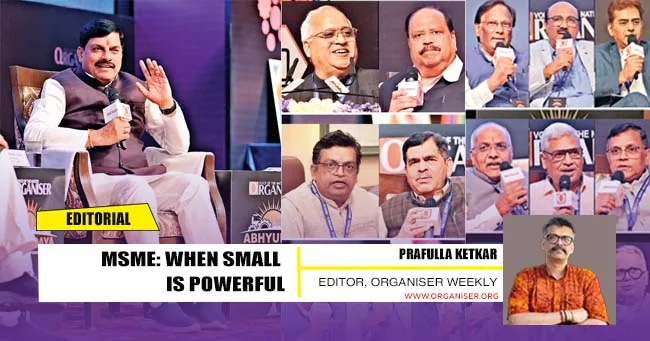
Abhyudaya: Industry Leadership Conclave 2026, an initiative of Organiser Weekly, sought to foster dialogue, collaboration, and strategic thinking among all possible players of this sector. Dr Mohan Yadav, the Chief Minister of Madhya Pradesh, articulated his vision for the state with the ambitious target of 22 Lacs per capita income by 2047. His Cabinet colleague, Chetanya Kashyap explained the industry policy of the State and opportunities it provides for the focus sectors. Swadeshi activist Shri Satish Kumar ji presented an eight-point programme for a prosperous and great Bharat. Economic experts discussed the intellectual issues while academic representatives explored the possibilities for industry-education linkages. Industry leaders shared their personal experiences and offered tips to aspiring entrepreneurs. Besides the public event, a roundtable discussion among the industry representatives was meant to catalyse meaningful partnerships and encourage innovation-led growth.
The consensus among the participants that unless small is made powerful while retaining its inherent beauty, we cannot achieve the goals of Aatmanirbhara, underscores the need for revitalising the MSME clusters. The government, society, and industry associations all need to work together in this process to mitigate challenges and leverage new opportunities, giving a renewed push to small industries with powerful social and economic impact.