
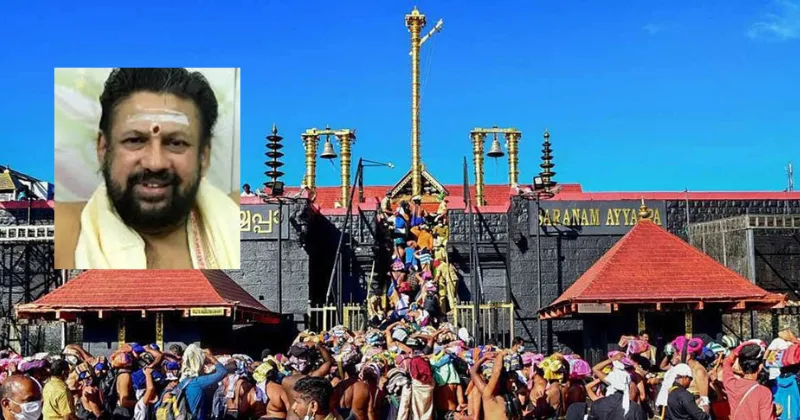
Sabarimala Tanthri Kantararu Rajeevaru was granted bail by the Kollam Vigilance Court on February 18, with the court observing that there was “not even an iota of evidence” to establish his involvement in the alleged gold irregularities at the shrine, after he spent 41 days in custody following his arrest on January 9, 2026.
In his plea, Rajeevaru described the arrest as a revengeful step linked to his stand against the controversial young women’s temple entry in October 2018 and alleged that police actions were aimed at pleasing the ruling political leadership, which he said he had firmly opposed.
He was obviously referring to the police efforts to bring two ‘undesirable’ women named Rahana Fatima and Kavita Jakkal to the temple. And it was shameful that the police provided police uniforms to those two women. Apparently, their attempts turned futile as the devotees stopped them from entering the shrine.
Tanthri, in his plea, stated that he had made it clear that he did not permit political interference in the temple. He also warned that he would stop the pooja and step out of the temple if the young women entered the temple. He stated that the CPM government had considered opening the temple every day instead of only during the monthly, Mandal and Makar Jyoti seasons. But he would not agree to that. He stated that these actions from his end led to the revenge.
Tantri alleged that the Special Investigation Team (SIT) hid several facts to establish that the first accused, Unniskrishna Potti, was brought to Sabarimala by him (Tanthri). In fact, Potti’s relatives had been working at Sabarimala for a long time. But this was hidden with the sole idea of strengthening the conspiracy to trap him (Tanthri).
Tantri insisted that his duties were confined to conducting the rituals, ceremonies and poojas; he had no legal authority over the temple administration or the security of valuable items.
One who observes and studies the Sabarimala rituals and practices will definitely endorse Tanthri’s arguments.
The Court has questioned the charges of conspiracy as there was no evidence to substantiate them. Rajeevaru is the 16th accused in the case concerning the alleged loss of gold from Dwarapalaka plates and the 13th accused in the loss of gold from the sanctum doorframes. Significantly, the Court observed that there is nothing on record not even an iota of evidence from the SIT to establish his involvement in the alleged irregularities.
The Court observed that the conspiracy case failed because he had not signed the crucial mahazars dated May 18, 2019, and July 20, 2019. The Court said that if he were part of any conspiracy, he would have signed them.
Another observation of the Court was about the position of the artefacts. They were outside the sanctum sanctorum and did not have any direct link to the rituals. The Devaswom manual says that the Tanthri shall give an opinion only when it is sought by the Devaswom Board.
The Court granted bail on medical grounds and in view of his limited role in the irregularities. He was directed to execute a bail bond with two solvent sureties of Rs 2 lakhs each in both cases. He was also directed to surrender his passport, not to leave the state nor enter Pathanamthitta, his home district, and to appear before the investigating officer on Tuesdays and Saturdays between 10am and 1pm.
Now it is clear that Tanthri’s case was a revengeful act of CM Pinarayi Vijayan’s government for his strong stand against the young women’s temple entry and the conspiracy to convert the Sabari temple into a mere tourist spot. He had warned the government that he would close the temple and leave Sabarimala if such conspiracies were executed. In those days, some CPM ministers and leaders had challenged him to hand over the temple keys to the Devaswom Board and go. This challenge itself showed the sinister design of the Communists’ anti-Hindu leadership to desecrate the sacred temple.