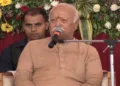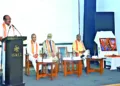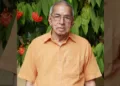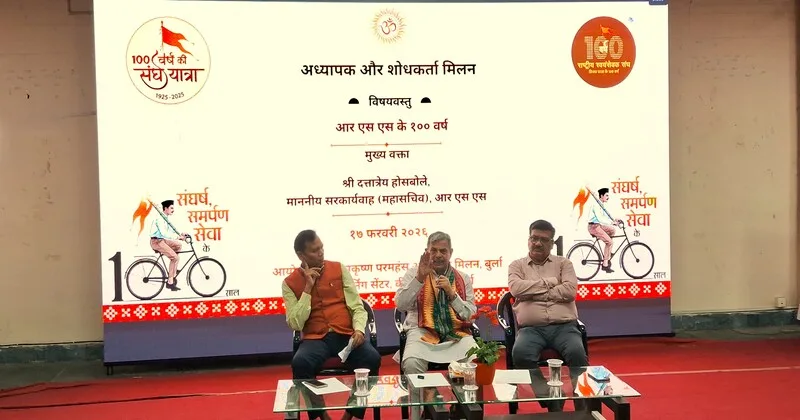
BHUBANESHWAR: Emphasising that Bharat’s long-term progress depends on the strength of its villages, RSS Sarkaryavah Dattatreya Hosabale urged scholars and researchers to align their academic work with rural development rooted in Indian knowledge systems during a conference held at Veer Surendra Sai University of Technology (VSSUT) in Burla, Sambalpur, on 17th February.
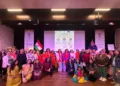
The conference, organised at the university’s e-Learning Centre under the aegis of the Shri Ramakrishna Paramahamsa Professors’ Forum, was part of the centenary year celebrations of the Rashtriya Swayamsevak Sangh (RSS). Faculty members, research scholars, and students from several higher educational institutions attended the event.
In his address, he presented a brief overview of the Sangh’s hundred-year journey, highlighting the milestones and challenges it has encountered since its inception.
He stated that the RSS views Hindutva from a nationalist perspective. Every individual devoted to serving the nation enhances the country’s dignity through their own work. The Rashtriya Swayamsevak Sangh inspires people toward character building, individual development, family strengthening, and the construction of society and the nation. It needs no proof that in times of various emergencies, the Sangh has selflessly stood by society.
He noted that the organisation has consistently stood beside society during times of crisis and continues to promote social responsibility and collective action. Referring to India’s post-independence development trajectory, he highlighted significant progress in sectors such as food technology, education, sports, and defence, adding that India has attained self-sufficiency in food production.
Highlighting national unity, he observed that while differences of opinion exist in a diverse society, citizens unite around national pride. When an athlete wins an Olympic medal or an individual earns global recognition, people celebrate collective achievement without considering background or identity. He described this unity as a defining strength of India’s civilizational ethos and asserted that unity and integrity remain the nation’s greatest assets.
Speaking about self-reliance, Hosabale cited India’s role during the COVID-19 pandemic, noting that the country extended medical assistance and humanitarian support to many nations. He connected this to the cultural principle of Vasudhaiva Kutumbakam, the world as one family, which he said continues to guide the RSS in its social outlook. He added that preserving unity is a shared responsibility of all citizens.
He also referenced colonial-era narratives that portrayed Indians as weak or less capable, remarking that the British made us believe we were less educated and weak, a notion we accepted too easily. This belief became our weakness, allowing them to rule over us for many years. For the past hundred years, the RSS has been working to awaken that forgotten self-awareness among the Indian people, enabling them to recognise both their strengths and shortcomings. Throughout this century-long journey, the RSS has faced many obstacles and disruptions; yet, it has never deviated from its goal or path.
During an interactive question-and-answer session, teachers and researchers raised queries on social change and development priorities. In response, Hosabale stressed that India’s development is closely tied to rural transformation. He asserted that prosperous, secure, and self-sustaining villages will strengthen both culture and economy.
He appealed to researchers to study village ecosystems, preserve local traditions, and develop practical solutions to rural challenges. He further encouraged scholars to incorporate Indian knowledge systems into their research and contribute to strengthening infrastructure, livelihoods, and social resilience in rural areas. Discussions also included ways to protect villages facing decline due to migration and rapid modernisation.
The program was conducted by Dr Yashbinder Beerdy, Associate Professor at Veer Surendra Sai University of Technology. The vote of thanks was delivered by Dr Satyanarayan Behera, Associate Professor and gynaecology specialist at Veer Surendra Sai Institute of Medical Science and Research. On this occasion, Vice-Chancellor Professor Devdutt Mishra, faculty members and PhD scholars from Sambalpur University, Gangadhar Meher University, Odisha Open University, IIM Sambalpur, VIMSAR, VSSUT, and other nearby universities of Sambalpur were present.