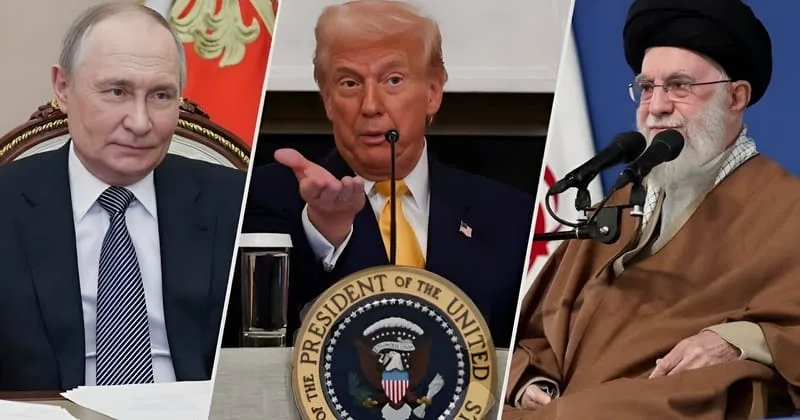
Washington, DC/Moscow/Tehran: US President Donald Trump has warned of strong military action against Iran if ongoing nuclear negotiations fail, issuing what amounted to an ultimatum during the first “Board of Peace” meeting held in Washington on Thursday. Speaking about the heavy costs of war, Trump said that decisive clarity would emerge within the next 10 days, stressing that serious consequences would follow if Tehran failed to reach a meaningful agreement. His remarks came amid stalled nuclear talks, raising fresh concerns over a potential military escalation.
Following the breakdown in negotiations, the United States has significantly increased its military presence in West Asia, deploying aircraft carriers, fighter jets, and submarines. Defence sources indicated that potential targets could include Iran’s nuclear facilities, ballistic missile installations, and key military bases. Trump emphasised that war costs far more than peace, noting that his administration was seeking reconciliation rather than conflict. He also suggested that despite deep divisions, efforts were underway to restore dialogue and stability on the global stage.
The US president made clear that his priority was saving lives rather than seeking international accolades. He stated that he was unconcerned about the Nobel Prize, adding that preventing bloodshed remained his primary objective. This year’s Nobel Peace Prize was awarded to Venezuelan opposition leader Maria Corina Machado.
The inaugural “Board of Peace” meeting reportedly involved around 50 world leaders, either directly or indirectly. Trump was joined by Vice President J.D. Vance, Secretary of State Marco Rubio, Chief of Staff Susie Wiles, son-in-law Jared Kushner, and Middle East special envoy Steve Witkoff. Kushner serves as the US special envoy to the board.
Trump adopted a tougher stance after Iran requested additional time during nuclear talks in Geneva, which reportedly made little progress. While the US president maintained that his administration was pursuing peace, multiple reports suggested that military action could occur as early as this week if negotiations fail to produce an agreement.
Iran and Russia step up Naval coordination amid Trump’s threat
Meanwhile, Iran and Russia are set to hold joint naval drills this week, according to the Russian Defence Ministry and Iranian state media, even as US and Iranian officials meet in Geneva for renewed discussions on Tehran’s nuclear programme. Russia’s military released footage showing its warship, the corvette Stoiky, arriving at the Iranian port city of Bandar Abbas, home to Iran’s naval headquarters. In a statement, Moscow said Russian and Iranian sailors were operating together to ensure the safety of civilian navigation.
Iranian media, citing a navy spokesperson, reported that the joint exercises would begin on Thursday and take place across the Gulf of Oman and the Indian Ocean. The drills, Tehran said, are aimed at strengthening maritime security and deepening cooperation between the two navies, though no end date was announced. Iran also confirmed that it would partially close the Strait of Hormuz for several hours during its own security exercises. The narrow waterway is a vital corridor for global oil and liquefied natural gas shipments, making any disruption a matter of international concern.
Russian presidential aide Nikolai Patrushev said this week that Russian, Iranian and Chinese warships had been deployed to the Strait of Hormuz as part of joint manoeuvres known as Marine Security Belt 2026.
The naval activity comes as Iranian and American officials reported progress in nuclear talks being mediated by Oman. However, tensions remain high. US President Donald Trump has sharply escalated rhetoric against Iran over its nuclear programme and a deadly crackdown on anti-government protests earlier this year. Washington and its European allies continue to accuse Tehran of pursuing nuclear weapons, claims Iranian leaders deny. At the same time, the US military has carried out a major buildup of air and naval forces across the Middle East as part of Trump’s pressure campaign.
Earlier this week, the ideological arm of Iran’s armed forces launched exercises in the Strait of Hormuz, widely seen as a direct signal to American forces operating in the region, underscoring the fragile security environment surrounding the stalled negotiations.